Eighty-eight official regions
Constellations began as patterns of stars linked to myths, seasons and navigation, and different cultures drew them differently. To bring order to astronomy, the International Astronomical Union adopted a list of 88 constellations in 1922. The Belgian astronomer Eugène Delporte then drew precise boundaries, published in 1930, following lines of celestial longitude and latitude. Since then, a constellation has been an area of sky rather than just a stick figure. Every star, galaxy and comet lies in exactly one constellation, which makes it easy to say where an object is. Because the boundaries are fixed, their areas, measured in square degrees, are among the most stable figures in astronomy.
Hydra, the water snake
Hydra is the largest constellation, stretching more than 100 degrees across the sky, longer than the distance from horizon to overhead. Despite its size, it is faint. Its brightest star, Alphard, takes its name from an Arabic word meaning the solitary one, because it shines alone in a dim part of the sky. Hydra lies along the celestial equator and is visible from almost everywhere on Earth, best in the evening sky in the first half of the year. Its size is a reminder that the largest constellations are not necessarily the most striking; many cover broad expanses of sky with only a few moderately bright stars.
Virgo and Ursa Major
Virgo, second, is the largest constellation of the zodiac, the band of sky through which the Sun, Moon and planets appear to move. Its brightest star, Spica, is a hot blue-white star, and the constellation contains the Virgo Cluster, a group of more than 1,000 galaxies about 50 million light-years away. Ursa Major, the great bear, is third. Its seven brightest stars form the Plough, or Big Dipper, one of the most recognisable patterns in the northern sky. That pattern is an asterism, not a constellation in its own right, and two of its stars point towards Polaris, the North Star, which has long helped travellers find north.
Whales, heroes and rivers
Cetus, the sea monster or whale, contains Mira, a famous variable star that brightens and fades over about 11 months. Hercules holds one of the finest globular star clusters visible from the northern hemisphere, a dense ball of hundreds of thousands of ancient stars. Eridanus, the river, winds a long way southwards and ends at Achernar, whose Arabic-derived name means the end of the river. Pegasus, the winged horse, is recognised by its Great Square of four stars, one of which is formally part of the neighbouring constellation Andromeda. Each of these constellations covers more than 1,100 square degrees, a sizeable fraction of the sky.
Dragons, centaurs and water
Draco, the dragon, coils around the north celestial pole. One of its stars, Thuban, was the pole star around 2,700 BCE, in the era when Egypt’s great pyramids were built; the slow wobble of Earth’s axis has since shifted the pole towards Polaris. Centaurus, ninth, is a rich southern constellation containing Alpha Centauri, the nearest star system to the Sun, and Omega Centauri, the largest globular cluster in our galaxy. Aquarius, the water bearer, completes the list. At the other extreme, Crux, the Southern Cross, is the smallest constellation, covering only about 68 square degrees, roughly one-nineteenth of the area of Hydra.
A sky shaped by Arab astronomy
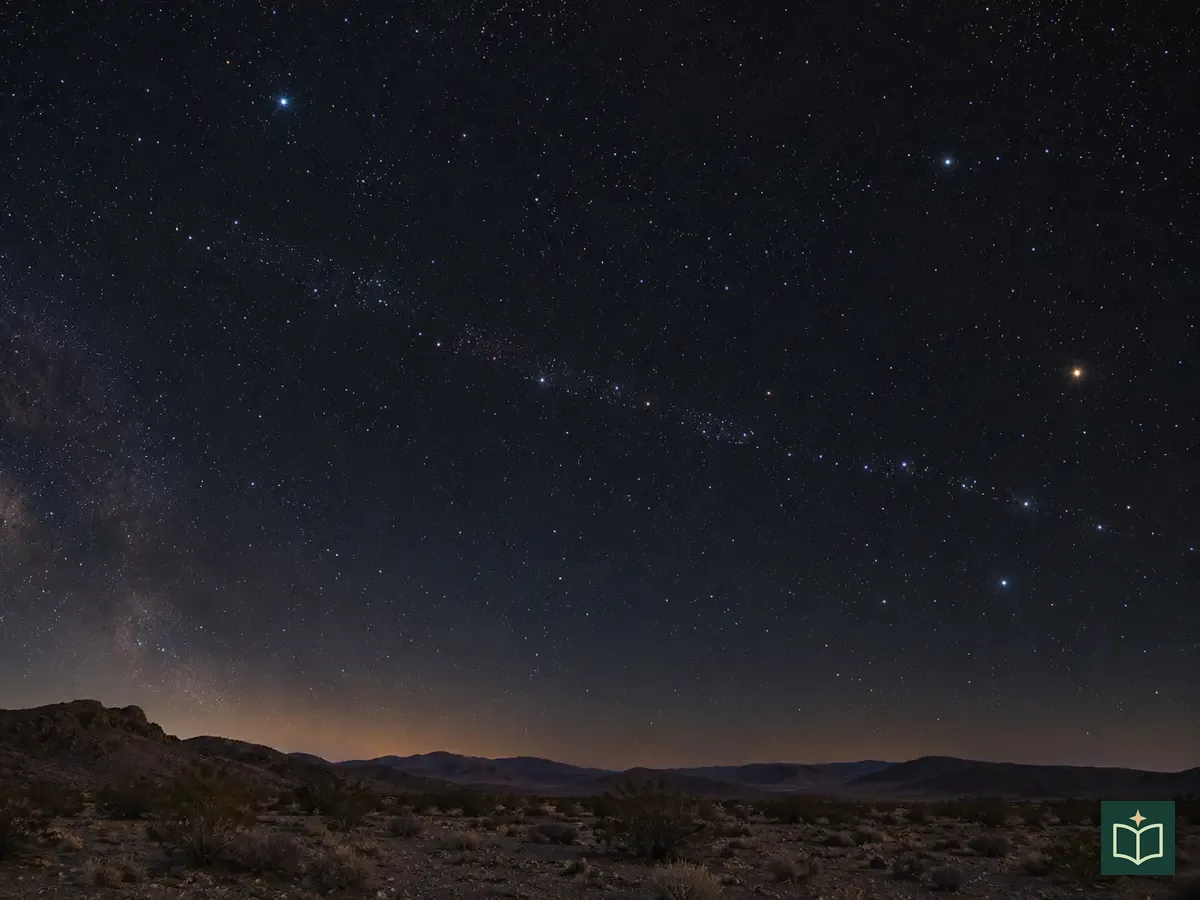
Many of the stars within these constellations carry names derived from Arabic. Ptolemy’s great catalogue of the second century was translated into Arabic and became known as the Almagest, and in the 10th century the Persian astronomer Abd al-Rahman al-Sufi produced the Book of Fixed Stars, which refined star positions and brightnesses. His work also contains the earliest known record of the Andromeda galaxy. From the Gulf’s latitude, observers can see most of the sky over the course of a year, including all ten of these constellations at least partly. Clear, dark desert nights make the region well suited to learning the constellations without a telescope.
Sources & further reading
Figures are rounded and widely published; check the linked organisations for the latest editions. These organisations do not endorse this website.