A lopsided family
Saturn has hundreds of known moons, and astronomers keep finding more, most of them only a few kilometres across. The overall count therefore changes, but the ranking of the largest moons does not. Titan stands far above the rest: it is more than three times wider than Rhea, the second largest, and holds about 96% of all the mass orbiting the planet. Seven moons, from Titan down to Mimas, are large enough for their gravity to have pulled them into round shapes. Below them, the moons are irregular lumps. Diameters in this table are mean values derived mainly from images taken by the Cassini spacecraft and are rounded.
Titan
Titan, about 5,150 kilometres across, is larger than the planet Mercury and is the second-largest moon in the solar system after Jupiter’s Ganymede. It is the only moon with a thick atmosphere, made mostly of nitrogen, and its surface pressure is about one and a half times that on Earth. Beneath its orange haze lie dunes, rivers and lakes of liquid methane and ethane, discovered by Cassini and the European Huygens probe, which landed on Titan in 2005. Scientists also believe that a deep ocean of liquid water lies beneath its icy crust. NASA’s Dragonfly rotorcraft is due to explore Titan’s surface in the 2030s.
The icy middle tier
Rhea, Iapetus, Dione and Tethys are each roughly 1,000 to 1,500 kilometres across and made largely of water ice with some rock. All four were discovered in the 17th century by the Italian-French astronomer Giovanni Domenico Cassini, after whom the later spacecraft was named. Iapetus is the strangest: one hemisphere is as dark as coal and the other as bright as snow, and a mountainous ridge runs along much of its equator. Tethys carries a huge crater, Odysseus, and a canyon system, Ithaca Chasma, that stretches across much of its surface. Dione shows bright ice cliffs, evidence of past geological activity.
Enceladus, the active moon
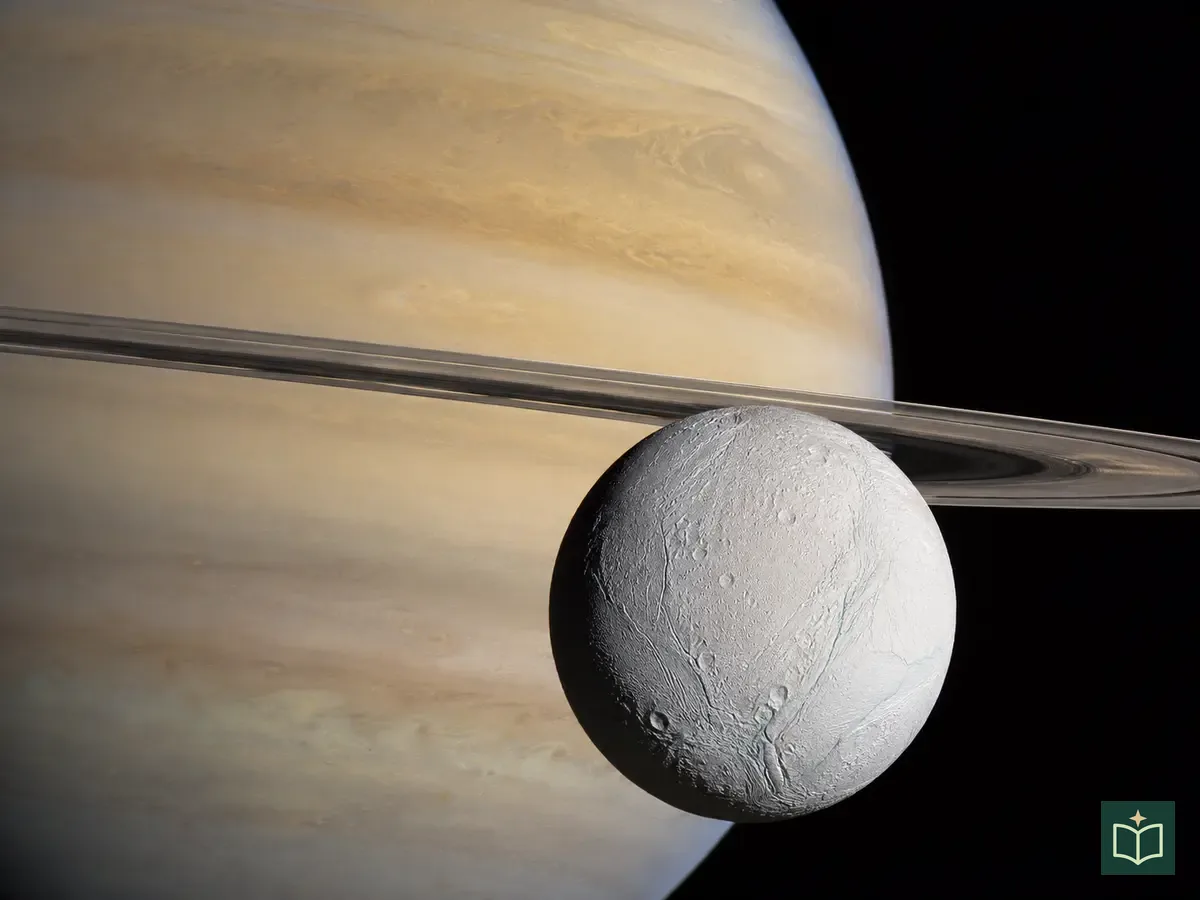
Enceladus, sixth, is only about 500 kilometres across, less than a sixth of the width of our own Moon, yet it is one of the most scientifically important places in the solar system. Cassini discovered jets of water vapour and ice grains erupting from long cracks near its south pole, nicknamed tiger stripes. Flying through these plumes, the spacecraft detected salts, silica, organic molecules and hydrogen, evidence of a global salty ocean beneath the ice and possibly of hydrothermal activity on its sea floor. The plumes also supply material to Saturn’s faint E ring. Enceladus reflects almost all the sunlight that hits it, making it one of the brightest objects in the solar system.
Mimas and the small moons
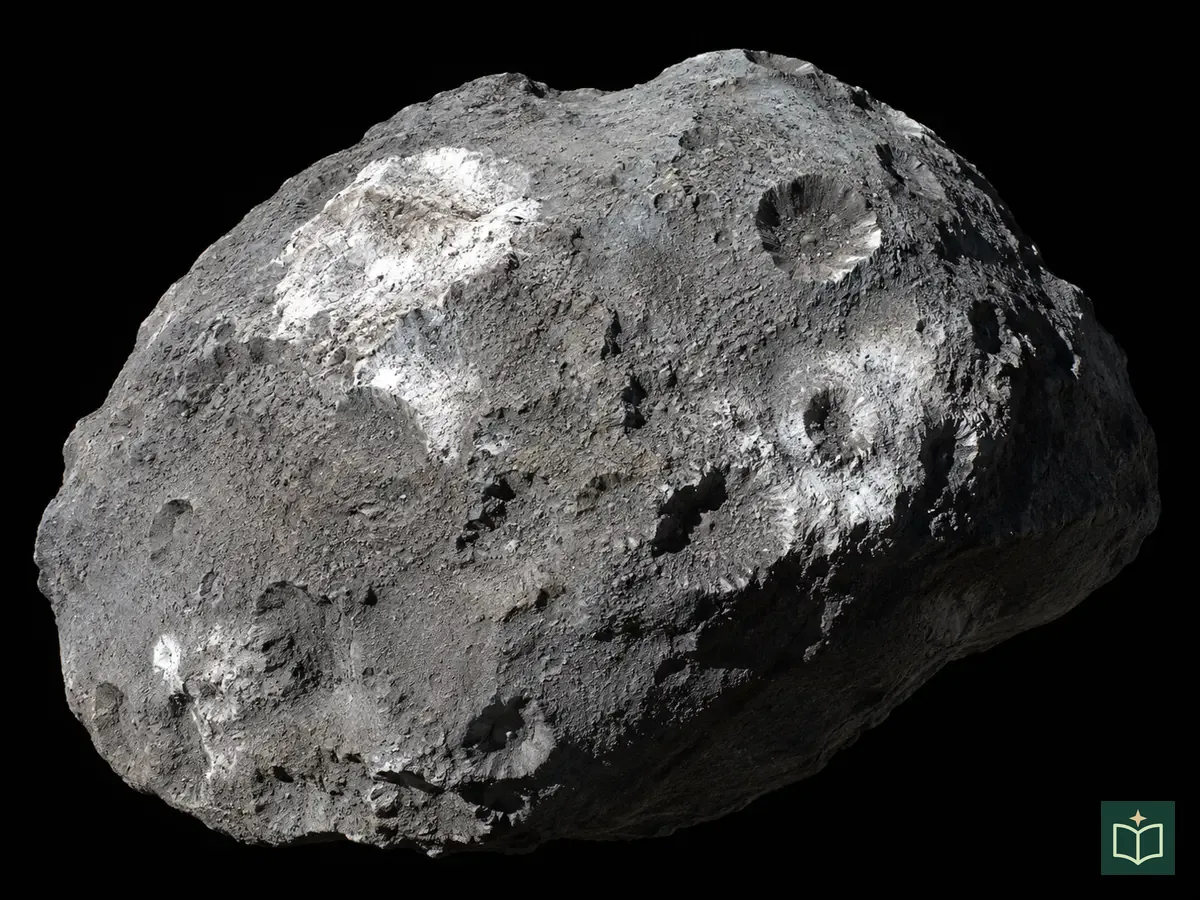
Mimas, seventh, is dominated by Herschel crater, about 130 kilometres wide, roughly a third of the moon’s diameter, which gives it a resemblance to a well-known science-fiction space station. A 2024 study suggested that Mimas may hide a young ocean beneath its battered surface. Below Mimas the moons are irregular. Hyperion looks like a sponge, with deep, sharp-edged craters, and tumbles chaotically rather than spinning steadily. Phoebe orbits far from Saturn in the opposite direction to most moons, suggesting it was captured, and dust from it feeds a vast, faint ring. Janus shares almost the same orbit as a smaller moon, Epimetheus, and the two swap places every four years.
Exploring Saturn’s moons
Most of what is known about these moons comes from the Cassini–Huygens mission, a collaboration between NASA, the European Space Agency and the Italian Space Agency. Launched in 1997, Cassini reached Saturn in 2004 and spent 13 years studying the planet, its rings and its moons. In 2017 it was deliberately steered into Saturn’s atmosphere so that it could not crash into Titan or Enceladus and contaminate them with microbes from Earth. Saturn itself is easy to see from the Gulf with the naked eye when it is well placed in the night sky, and even a small telescope shows its rings and Titan, a bright point beside it.
Sources & further reading
Figures are rounded and widely published; check the linked organisations for the latest editions. These organisations do not endorse this website.