The asteroid belt
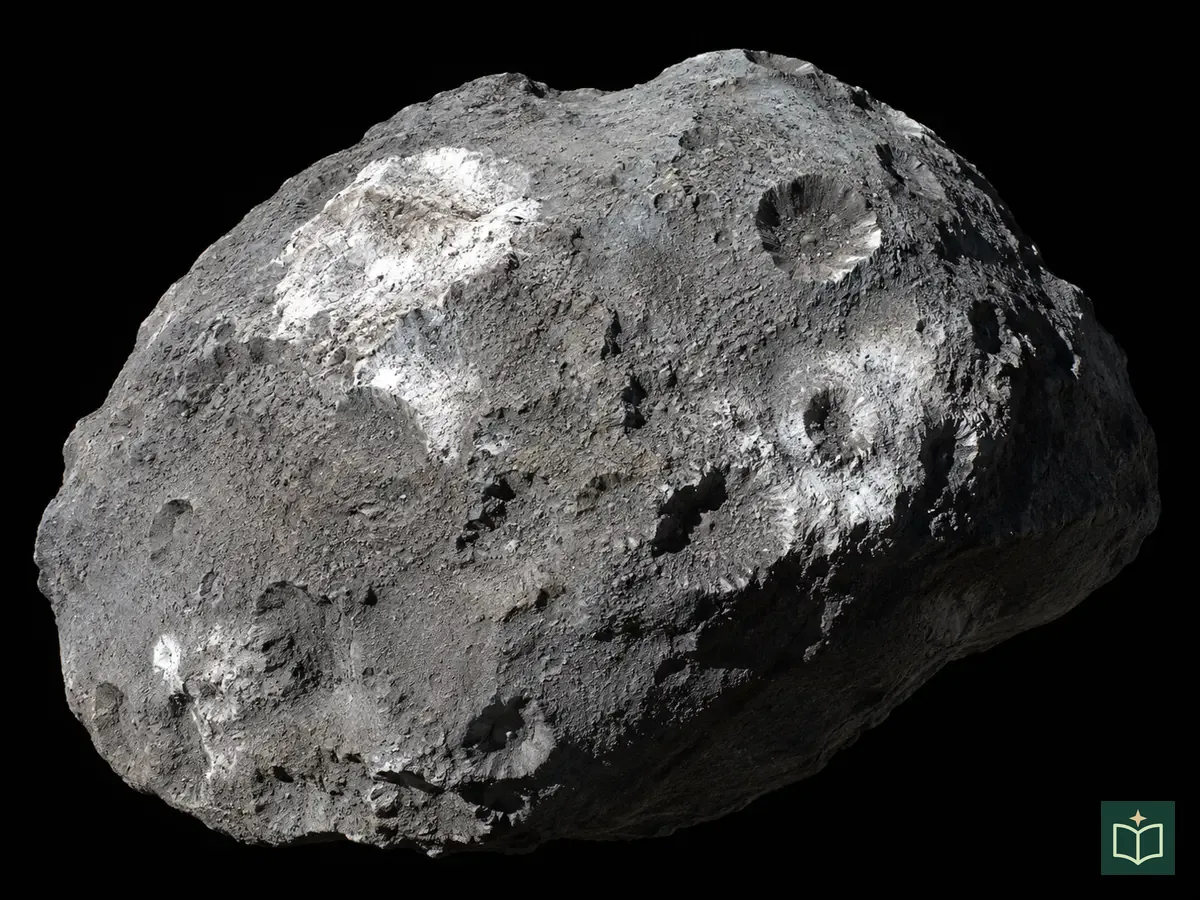
Most asteroids orbit the Sun in the main belt between Mars and Jupiter. They are leftovers from the formation of the planets about 4.6 billion years ago; Jupiter’s strong gravity stirred up their orbits and prevented them from gathering into a single planet. Science fiction often shows the belt as a crowded field of tumbling rocks, but in reality asteroids are typically separated by hundreds of thousands of kilometres, and spacecraft pass through without difficulty. Although there are millions of asteroids, their combined mass is only a few per cent of the Moon’s. Ceres alone accounts for roughly a third of it, and the four largest together account for more than half.
Ceres
Ceres was the first asteroid discovered, spotted by the Italian astronomer Giuseppe Piazzi on 1 January 1801. For a time it was considered a planet. In 2006 the International Astronomical Union classified it as a dwarf planet, the only one in the inner solar system. NASA’s Dawn spacecraft orbited Ceres from 2015 to 2018 and found bright patches of salts inside Occator crater, evidence that briny water from below has reached the surface relatively recently. Scientists think Ceres may still have pockets of salty liquid beneath its crust, making it an intriguing target for studying how water and the ingredients of life are distributed in the solar system.
Vesta and Pallas
Vesta, second by size, is the brightest asteroid and can occasionally be seen with the naked eye under dark skies. Dawn orbited it in 2011 and 2012 before moving on to Ceres. Vesta’s southern hemisphere is dominated by a huge impact basin, Rheasilvia, whose central peak rises about 20 kilometres, among the tallest mountains in the solar system. Fragments blasted out by such impacts have reached Earth as a well-known family of meteorites. Pallas, third, is almost as wide as Vesta but less massive. Its orbit is steeply tilted relative to the plane of the planets, which makes it difficult and costly for spacecraft to reach.
The next tier
Hygiea, fourth, is nearly spherical according to telescope observations published in 2019, prompting debate about whether it too should be considered a dwarf planet. Below Hygiea, the asteroids become irregular in shape and their sizes harder to measure. Interamnia, Europa, Davida, Sylvia, Eunomia and Euphrosyne are each a few hundred kilometres across. Sylvia is notable for having two small moons of its own, named Romulus and Remus. Many large asteroids are dark, carbon-rich bodies that preserve material from the early solar system, while others, such as Eunomia, are brighter and stonier, suggesting they formed in different places or have been altered by heating.
Why sizes are uncertain
Unlike Ceres and Vesta, most large asteroids have never been visited by spacecraft. Their sizes are estimated from how much sunlight they reflect, how much heat they give off and, most precisely, from stellar occultations, when an asteroid passes in front of a star and observers at different locations time the star’s disappearance. Results can differ by tens of kilometres. Positions seven to ten in this table are separated by only a few per cent and may change order between sources. NASA’s Psyche spacecraft, launched in 2023, is due to reach the metal-rich asteroid Psyche, about 220 kilometres across, in 2029, adding another directly measured body.
The UAE’s asteroid mission
The UAE is planning its own mission to the asteroid belt. The Emirates Mission to the Asteroid Belt, led by the Mohammed bin Rashid Space Centre, aims to launch a spacecraft in 2028 that would fly past several asteroids before landing on one, Justitia, in the following decade. It builds on the experience of the Hope probe, which has orbited Mars since 2021. Missions like these help scientists understand how the planets formed and what resources asteroids might contain. They also support planetary defence, although none of the large asteroids in this table poses any known threat to Earth; their orbits are well charted and stable.
Sources & further reading
Figures are rounded and widely published; check the linked organisations for the latest editions. These organisations do not endorse this website.