Our galactic neighbourhood
The Milky Way is a large spiral galaxy about 100,000 light years across, and it is surrounded by a swarm of smaller dwarf galaxies. They orbit it under the pull of its gravity, much as moons orbit a planet. Dozens of these satellites are known, and many more are probably too faint to have been found yet. The distances in this table are measured from the Sun, which lies about 26,000 light years from the centre of the Milky Way. A light year is the distance light travels in a year, about 9.5 trillion kilometres. Even the nearest neighbour lies far beyond the stars visible to the naked eye.
Closest of all, perhaps
The Canis Major dwarf galaxy was announced in 2003 by astronomers studying an infrared survey of the sky. It appeared as an overdensity of old red stars about 25,000 light years from the Sun, closer to us than the centre of our own galaxy. If it is a galaxy, it is the nearest known, and it is being torn apart by the Milky Way’s gravity, leaving a ring of stars around the galactic disc. But some astronomers argue that the stars are instead part of a warp or flare in the outer Milky Way itself. The question is still debated, which is why many lists give the title to Sagittarius instead.
A galaxy being swallowed
The Sagittarius dwarf spheroidal galaxy, discovered in 1994, lies about 70,000 light years from the Sun on the far side of the galactic centre. It is being stretched into long streams of stars that wrap around the Milky Way as it passes through our galaxy’s disc on repeated orbits. Data from the European Space Agency’s Gaia mission suggest these passages may even have triggered bursts of star formation in the Milky Way. Over the next few billion years, Sagittarius will probably be absorbed completely. The process is how large galaxies grow: by gradually merging with and swallowing their smaller neighbours over billions of years.
The Magellanic Clouds
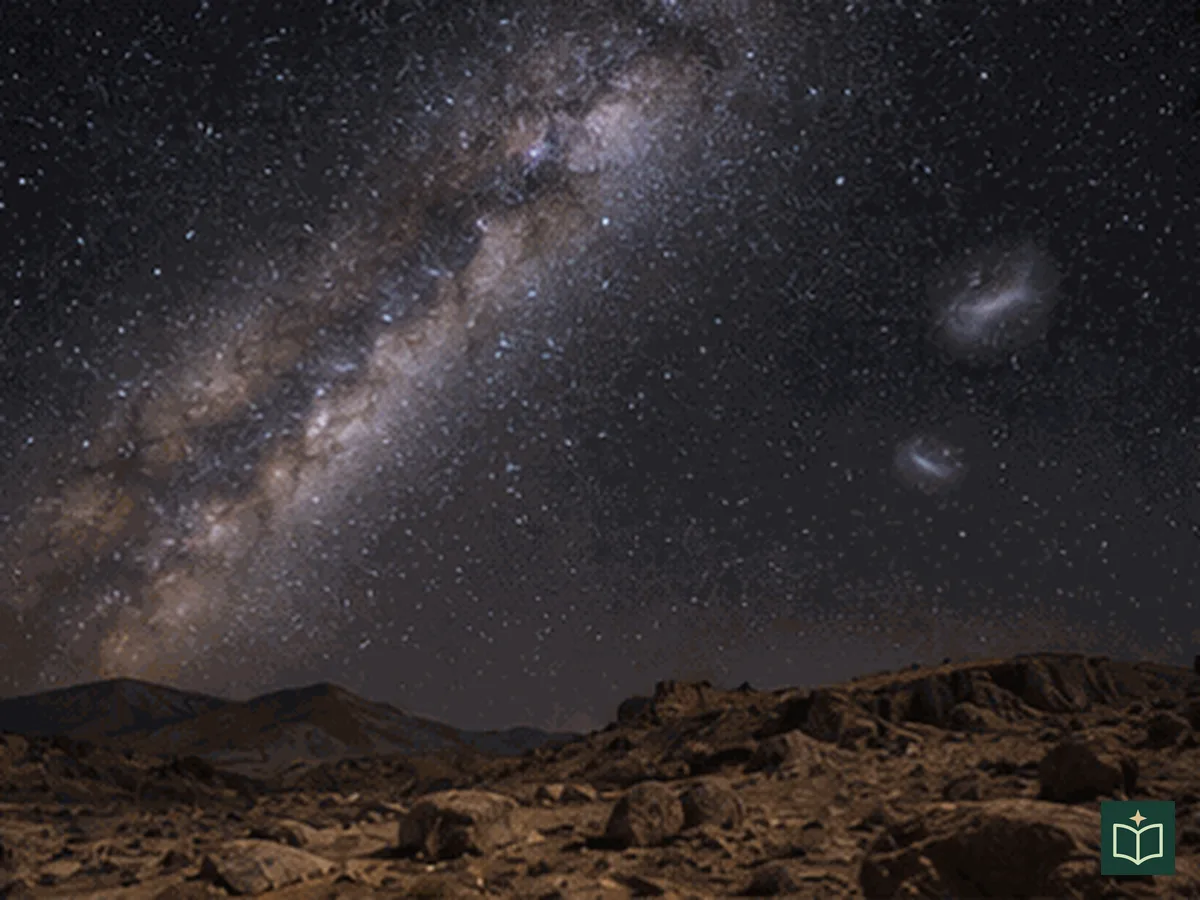
The Large and Small Magellanic Clouds are the brightest of the Milky Way’s companions, visible to the naked eye as two hazy patches in the southern sky. They lie about 160,000 and 200,000 light years away and are rich in gas and young stars. They are named after Ferdinand Magellan, whose crew described them during the first voyage around the world, although they were known long before that to peoples of the southern hemisphere. The Clouds lie so far south in the sky that they never rise above the horizon from the Gulf. Seeing them requires travelling south of about 20 degrees north latitude.
The faint dwarfs
The remaining galaxies in the table are faint dwarf spheroidal galaxies, small collections of old stars with almost no gas. Ursa Minor, Draco, Sculptor, Sextans, Carina and Fornax were found mostly during the twentieth century on photographic plates. They contain far more dark matter than their visible stars would suggest, which makes them important for testing theories of how dark matter behaves. Since 2005, large digital sky surveys have found dozens of even fainter dwarf galaxies, some closer than Ursa Minor. They are left out of this table because their distances and in some cases their status as galaxies are still being refined.
Andromeda and beyond
Beyond the dwarfs lies the Andromeda galaxy, about 2.5 million light years away. It is the nearest large spiral galaxy and slightly larger than the Milky Way. On a dark, moonless night it can be seen with the naked eye as a faint smudge, including from desert sites in the UAE and Oman away from city lights. Andromeda is approaching the Milky Way, and astronomers expect the two galaxies to interact and possibly merge in several billion years. Together with the Triangulum galaxy and dozens of dwarfs, they form a group of galaxies known as the Local Group, our small corner of the universe.
Sources & further reading
Figures are rounded and widely published; check the linked organisations for the latest editions. These organisations do not endorse this website.