Two ways to be biggest
Aircraft can be compared by wingspan, length, height or weight, and the leaders differ. This table uses wingspan, the distance from one wingtip to the other. On that measure the record belongs to Stratolaunch, also called Roc, with wings of about 117 metres, longer than a football pitch. By weight, however, the record belongs to the Antonov An-225 Mriya, which could take off at about 640 tonnes, more than any other aircraft. Size matters because lift grows with wing area. A heavier aircraft needs more wing to fly at speeds that runways and engines can manage, so the heaviest aircraft tend to have the widest wings.
A launch pad in the sky
Stratolaunch was conceived by Microsoft co-founder Paul Allen as a flying launch platform. It has two fuselages joined by a single central wing and is powered by six engines taken from Boeing 747 airliners. The idea was to carry rockets up to high altitude and release them, avoiding some of the limits of ground launches. It first flew in 2019, the year after Allen’s death. Its role has since shifted to carrying and releasing hypersonic test vehicles for research. Each of its two fuselages has a cockpit, but only the right-hand one is used by the crew; the left-hand cockpit is unpressurised.
The flying boat that flew once
The Hughes H-4 Hercules, nicknamed the Spruce Goose, was built during the Second World War as a giant flying boat to carry troops and equipment across the Atlantic without risk from submarines. Because aluminium was in short supply, it was built mostly of laminated birch wood. The war ended before it was finished. On 2 November 1947, with the businessman Howard Hughes at the controls, it lifted off the water near Long Beach, California, flew about 1.6 kilometres at a height of about 20 metres, and landed. It never flew again. Its wingspan of about 97.5 metres was the largest of any aircraft until 2019.
The An-225 Mriya
The Soviet Union built the Antonov An-225 in the 1980s to carry the Buran space shuttle on its back. Only one was completed. It first flew in 1988, and after the Soviet Union’s collapse it was operated by Ukraine’s Antonov company as a heavy cargo aircraft, carrying generators, turbines and other oversized loads around the world. It had six engines and 32 wheels. In February 2022 it was destroyed at Hostomel airfield near Kyiv during the Russian invasion of Ukraine. Its smaller sibling, the An-124, with a wingspan of about 73 metres, remains in use and still carries outsize cargo for commercial and government customers.
Airliners among giants
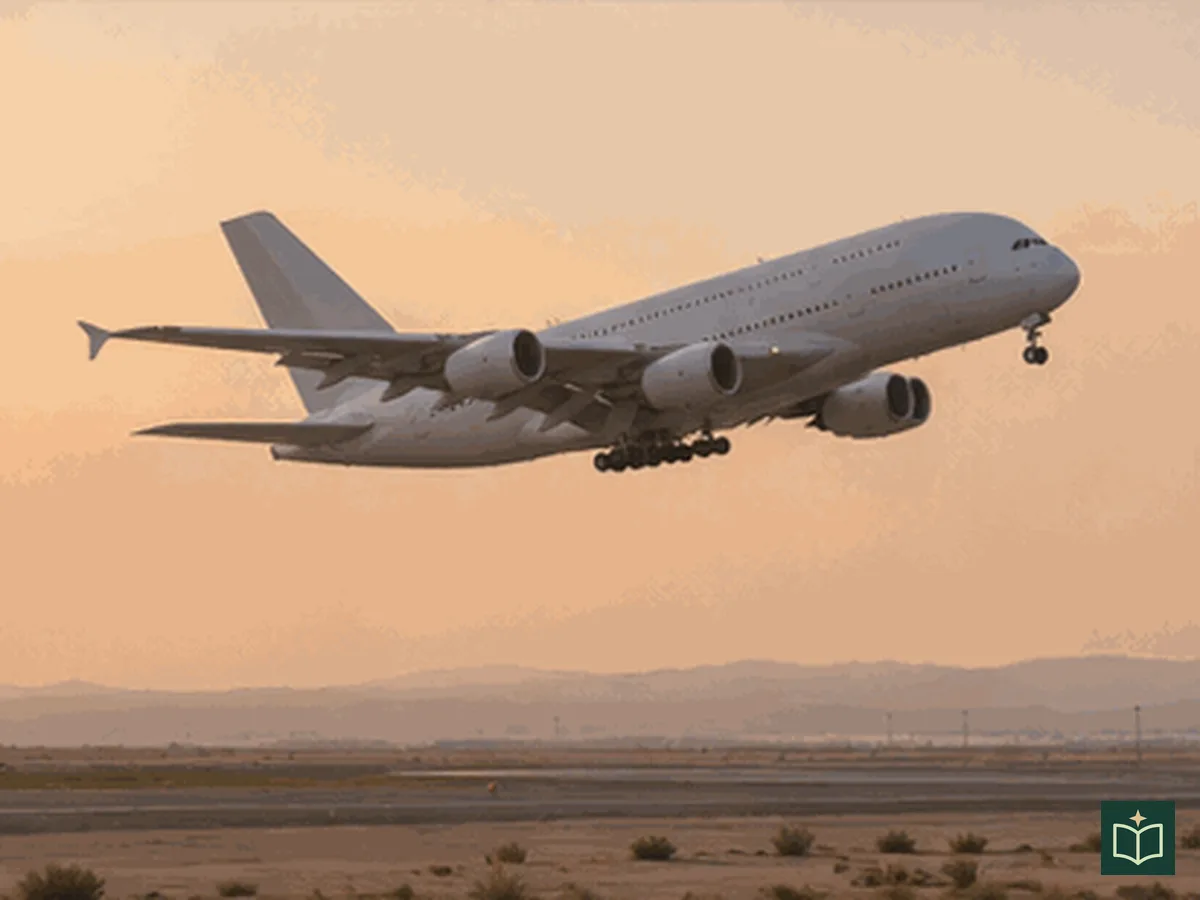
The Airbus A380, with a wingspan of about 80 metres, is the largest passenger airliner ever built. It entered service in 2007, and Dubai’s Emirates became by far its largest operator, flying it from Dubai to cities on every inhabited continent. Production ended in 2021, as airlines shifted to more efficient twin-engine aircraft. One of those is the Boeing 777-9, whose wingtips fold upwards on the ground so that it can fit the same airport gates as earlier 777s. The Boeing 747-8, the longest version of the jumbo jet, was the last 747 model, with the final aircraft delivered in 2023.
Military heavy lifters
Several entries are military aircraft built to carry heavy loads or long-range bombs. The Convair B-36, a bomber of the late 1940s and 1950s, had six piston engines driving propellers and four jet engines, earning the nickname six turning, four burning. The Lockheed C-5 Galaxy, an American military transport, can carry tanks and helicopters. The Soviet An-22, first flown in 1965, was the largest turboprop aircraft of its time. None of these aircraft is likely to be overtaken soon. Very large aircraft are expensive to develop and need special runways and hangars, so modern designers focus on efficiency rather than ever greater size.
Sources & further reading
Figures are rounded and widely published; check the linked organisations for the latest editions. These organisations do not endorse this website.