A continent dominated by Brazil
Brazil covers about 8.5 million square kilometres, close to half of South America and the fifth-largest country in the world. It borders every South American country except Chile and Ecuador. Most of its territory lies in the tropics, including the larger part of the Amazon rainforest, and it shares the continent’s greatest river basins. Argentina, in second place at about 2.8 million square kilometres, is roughly a third of Brazil’s size. Even so, Argentina is the eighth-largest country in the world and larger than Saudi Arabia, the largest country in the Gulf, which covers about 2.15 million square kilometres of mostly desert land.
Lines drawn by empires
The shape of the continent’s countries reflects a dispute between two European powers. In 1494 the Treaty of Tordesillas divided newly encountered lands between Spain and Portugal along a line running north to south. Portuguese settlers and explorers later pushed far west of that line into the Amazon, and later treaties recognised their gains. Spanish America, by contrast, broke up after independence in the early nineteenth century into several republics, roughly following the old administrative divisions of the Spanish empire. That is why one large Portuguese-speaking country sits beside nine Spanish-speaking ones, plus English-speaking Guyana and Dutch-speaking Suriname on the northern coast.
The Andean countries
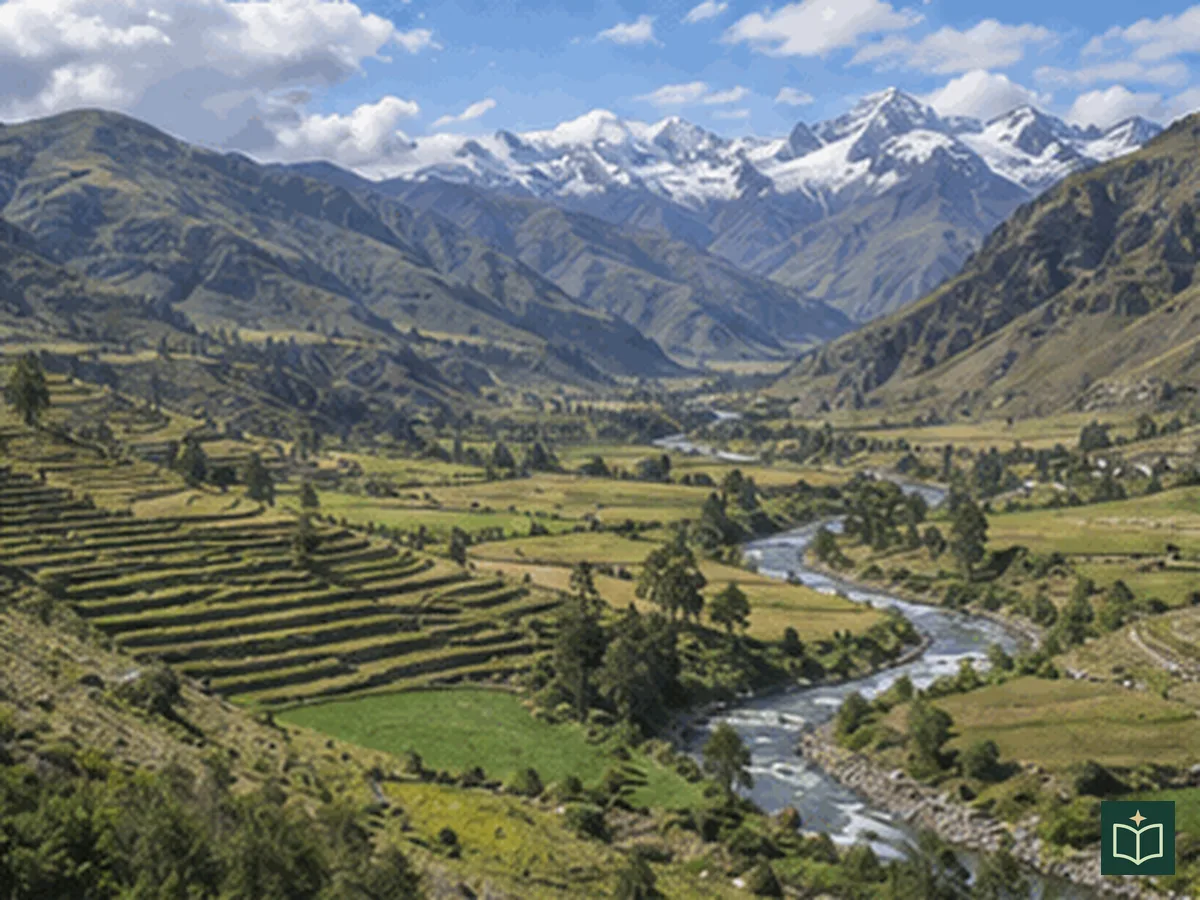
Peru, Colombia, Bolivia, Ecuador and Chile all stretch across the Andes, the world’s longest continental mountain chain. Their territories run from high mountains down to tropical lowlands, deserts or the Pacific coast, giving each a striking variety of climates within its borders. Peru, the third-largest country, includes coastal desert, the high Andes and a large section of the Amazon. Chile is about 4,300 kilometres long but averages less than 200 kilometres wide, one of the most unusual shapes of any country. Bolivia lost its Pacific coastline to Chile in a war in the late nineteenth century and is now one of two landlocked countries in South America.
Venezuela, Paraguay and Guyana
Venezuela, on the Caribbean coast, includes part of the Andes, the vast plains of the Orinoco basin and the tabletop mountains of the Guiana Highlands, where Angel Falls, the world’s highest waterfall, plunges from a cliff. Paraguay is the continent’s other landlocked country, lying between Argentina, Brazil and Bolivia; its rivers connect it to the Atlantic. Guyana is the smallest country in the table, at about 215,000 square kilometres. Venezuela has long claimed the Essequibo region, which forms about two-thirds of Guyana’s territory, and the dispute is before the International Court of Justice. This table uses the boundaries as they are administered.
Area versus population
The ranking by area differs from the ranking by population. Brazil leads on both counts, but Colombia has a larger population than Argentina despite being less than half its size, and Peru and Venezuela also have large populations. Much of South America’s interior is thinly settled: the Amazon basin, the Patagonian plains of southern Argentina and the high Andean plateaus hold relatively few people. Most of the continent’s inhabitants live within a few hundred kilometres of the coast, in large cities such as São Paulo, Buenos Aires, Lima and Bogotá, which grew as ports or as capitals in fertile valleys.
What is left out
The table counts only sovereign states. French Guiana, between Suriname and Brazil, covers about 84,000 square kilometres but is an overseas region of France and part of the European Union. The Falkland Islands, administered by the United Kingdom and claimed by Argentina, are also excluded. Chile and Argentina both claim slices of Antarctica, which would vastly increase their areas if counted, but such claims are suspended under the Antarctic Treaty. Areas also vary slightly between sources depending on how inland water and coastal islands are counted. The figures here are rounded from widely used official statistics, and the order is not in doubt.
Sources & further reading
- CIA World Factbook · Country profiles ↗
- UN Statistics Division · Demographic Yearbook ↗
- Britannica · South America ↗
Figures are rounded and widely published; check the linked organisations for the latest editions. These organisations do not endorse this website.