No official line
Most people assume there must be a fixed height at which a hill becomes a mountain. There is not. Neither the International Geographical Union nor any global body sets one, and dictionaries define a mountain only loosely, as a natural elevation that is larger and steeper than a hill. The United States Board on Geographic Names once used a 1,000-foot threshold but abandoned it decades ago. In Britain the same figure, about 305 metres, was long quoted as a rule of thumb, inspiring the comic film The Englishman Who Went Up a Hill But Came Down a Mountain. In practice, geographers judge several properties together rather than relying on one number.
Why sea level misleads
Height above sea level is the obvious measure, but it can deceive. Large parts of the Tibetan Plateau lie above 4,500 metres, yet many rises there look like gentle hills because they stand only a few hundred metres above the surrounding high ground. Meanwhile, Ben Nevis in Scotland reaches only 1,345 metres, but it rises steeply almost from sea level and is unquestionably a mountain, with harsh weather to match. What the eye registers is not absolute elevation but local relief: the difference between a summit and the land around it. A peak that stands well above its surroundings with steep flanks reads as a mountain, wherever it starts.
Measures that geographers use
Specialists use a few combined tests. One widely cited scheme, developed for global mapping of mountain environments by the UN Environment Programme's World Conservation Monitoring Centre, treats any land above 2,500 metres as mountainous, and lower land as mountainous only if it combines height with steep slopes or a large local range of elevation, down to areas of around 300 metres. Prominence is another tool. It measures how far a summit rises above the lowest point connecting it to any higher peak, so it captures independence rather than raw height. Hikers' lists, such as Scotland's Munros, set their own thresholds, showing that the definition often depends on purpose.
The view from the UAE
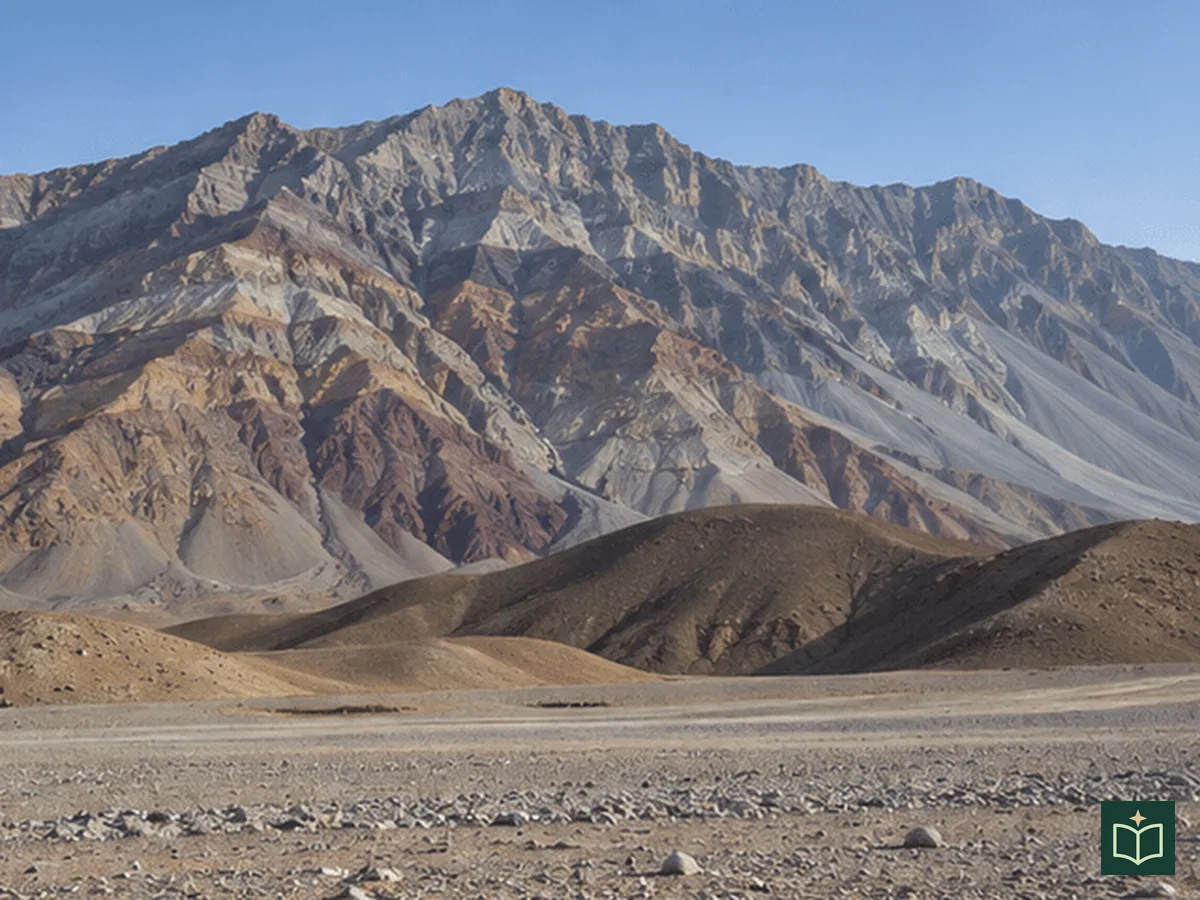
The Hajar Mountains, running along the UAE's eastern edge and into Oman, illustrate the point well. Their summits in the UAE reach close to 1,900 metres around Jebel Jais, modest by Himalayan standards, yet their steep, bare limestone and ophiolite slopes rise abruptly from the gravel plains and the coast, creating real mountain weather, including occasional winter frost at the top. By contrast, the red dunes of the interior can stand well over 100 metres high in places, but nobody calls them hills, let alone mountains, because they are shifting sand rather than rock. Local Arabic usage often applies jebel to both large hills and mountains, a reminder that language rarely follows strict thresholds.
How each one forms
Formation offers another clue, though it is not decisive. Most great mountain ranges are raised by tectonic forces: plates colliding, as in the Himalaya and Alps, or volcanic activity, as in the Andes. Their slopes are steep because the uplift is young in geological terms and erosion has not yet worn it down. Many hills are older uplands that have been eroded for hundreds of millions of years, or are piles of debris left by glaciers, or are carved by rivers into a plateau's edge. Yet old, eroded ranges such as the Appalachians are still called mountains by long habit, and some young, steep summits are called hills.
Names that ignore the rules
Place names are where the distinction breaks down most often. Many famous summits named as hills are steep and high, while some mountains are modest. Settlers, surveyors and local communities chose names centuries before modern definitions, and once fixed on maps those names rarely change. In some regions a whole range of summits is called hills, as with the Black Hills of South Dakota, which rise above 2,000 metres. Campaigns to reclassify a summit occasionally appear when a re-survey shows it is slightly higher or lower than thought, mostly for the prestige of hikers' lists. The practical answer is that context, not a magic number, decides which word fits.
Sources & further reading
Figures are rounded and widely published; check the linked organisations for the latest editions. These organisations do not endorse this website.