Two answers to the same need
Horns and antlers both grow from the skull, and both are used for fighting rivals, display and sometimes defence. But they are built differently and grown on different timetables. Antlers are made entirely of bone, usually branched, and are shed and regrown every year. They belong only to the deer family. Horns have a core of living bone that grows from the skull, covered with a sheath of keratin, the same protein found in fingernails and hair. They are normally unbranched, are never shed, and keep growing throughout the animal's life. Horns are found on cattle, sheep, goats, antelope and their relatives, a group known as bovids.
The yearly antler cycle
A deer's antlers grow from permanent bony bases on the skull, called pedicles. In spring, new antlers begin to sprout, covered in a soft, hairy skin known as velvet that carries blood vessels and nerves. Growth is astonishingly fast: in large species such as elk and moose, antlers can lengthen by up to about two centimetres a day, making them one of the fastest-growing tissues known in mammals. In late summer, rising testosterone stops growth, the bone hardens and the velvet dies and is rubbed off against trees. Males then use the bare antlers during the autumn breeding season, or rut. In late winter, the bond with the pedicle weakens and the antlers fall off.
How horns grow
Horns grow very differently. The bony core is an outgrowth of the skull, and the keratin sheath is added from the base, so the oldest material is at the tip. Because growth continues for life, horns are a record of an animal's history. In wild sheep and goats, growth slows in winter, leaving visible rings that can be counted to estimate age. Both males and females carry horns in many species, although males' are usually larger. A broken horn does not regrow its lost section, unlike antlers, which are rebuilt in full every year. If the keratin sheath is removed, the bony core underneath is exposed, which is why horns must not be cut carelessly.
The oryx and the gazelle
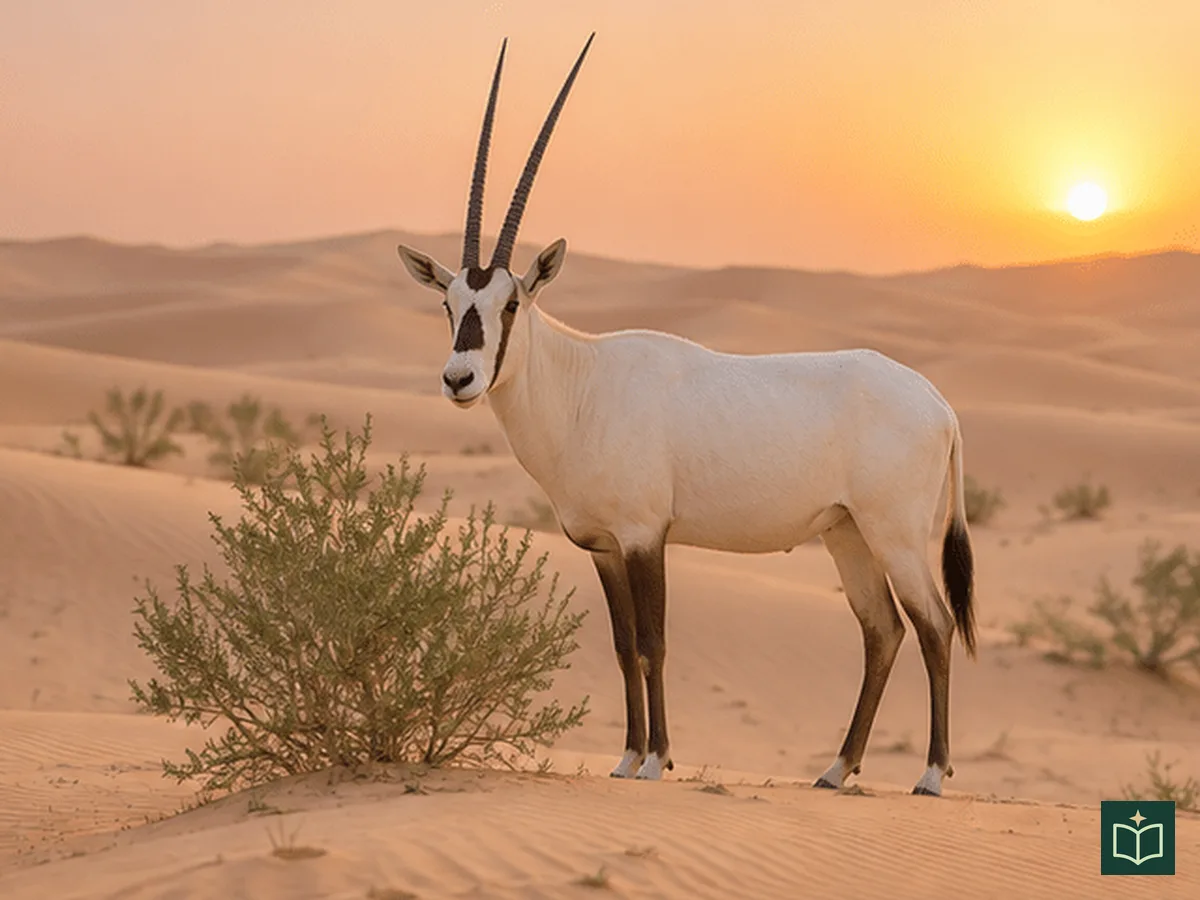
The Arabian Peninsula is home to some striking horned animals. The Arabian oryx, the UAE's iconic desert antelope, carries long, nearly straight, ringed horns in both males and females, which can reach around 50 to 70 centimetres. Seen in profile, the pair can appear as one, which some writers have linked to legends of the unicorn. The species was declared extinct in the wild in 1972, then restored through captive breeding programmes, including in the UAE, and reintroduced to protected areas. The Arabian gazelle and the sand gazelle also carry ringed horns. None of the region's native hoofed mammals grow antlers, since wild deer are absent from most of Arabia.
Exceptions to the rules
Nature blurs the categories at the edges. Reindeer, called caribou in North America, are the only deer in which females regularly grow antlers, which help them compete for food in winter. The North American pronghorn has horns with a bony core, like bovids, but sheds and regrows the keratin sheath each year, making it a curious hybrid. Giraffes have ossicones, bony knobs covered in skin and hair that are present from birth and never shed. Rhinoceros horns are different again: they are made of compacted keratin fibres with no bony core at all, attached to the skin rather than the skull, which is why poachers can remove them.
Why the difference matters
The two strategies carry different costs. Regrowing antlers every year demands large amounts of calcium, phosphorus and energy, which deer draw partly from their own skeletons, so antler size reflects a male's health and the quality of his food. That makes antlers a reliable advertisement to females and rivals. Horns require less yearly investment but must last a lifetime, so damage is permanent. The terms also matter in conservation and trade. Shed antlers are collected legally in many countries, while illegal trade in rhinoceros horn drives poaching. Medical researchers study antler regeneration for clues to how bone and nerves might be regrown in people after injury.
Sources & further reading
Figures are rounded and widely published; check the linked organisations for the latest editions. These organisations do not endorse this website.