Sound is vibration
Sound travels as waves of pressure through air, water or solids. When a guitar string vibrates, it pushes and pulls the air around it, creating areas of higher and lower pressure that spread out. The number of vibrations per second is the frequency, measured in hertz, and we hear it as pitch. The size of the pressure changes is the amplitude, which we hear as loudness. A healthy young adult can hear frequencies from about 20 to 20,000 hertz.
The outer ear
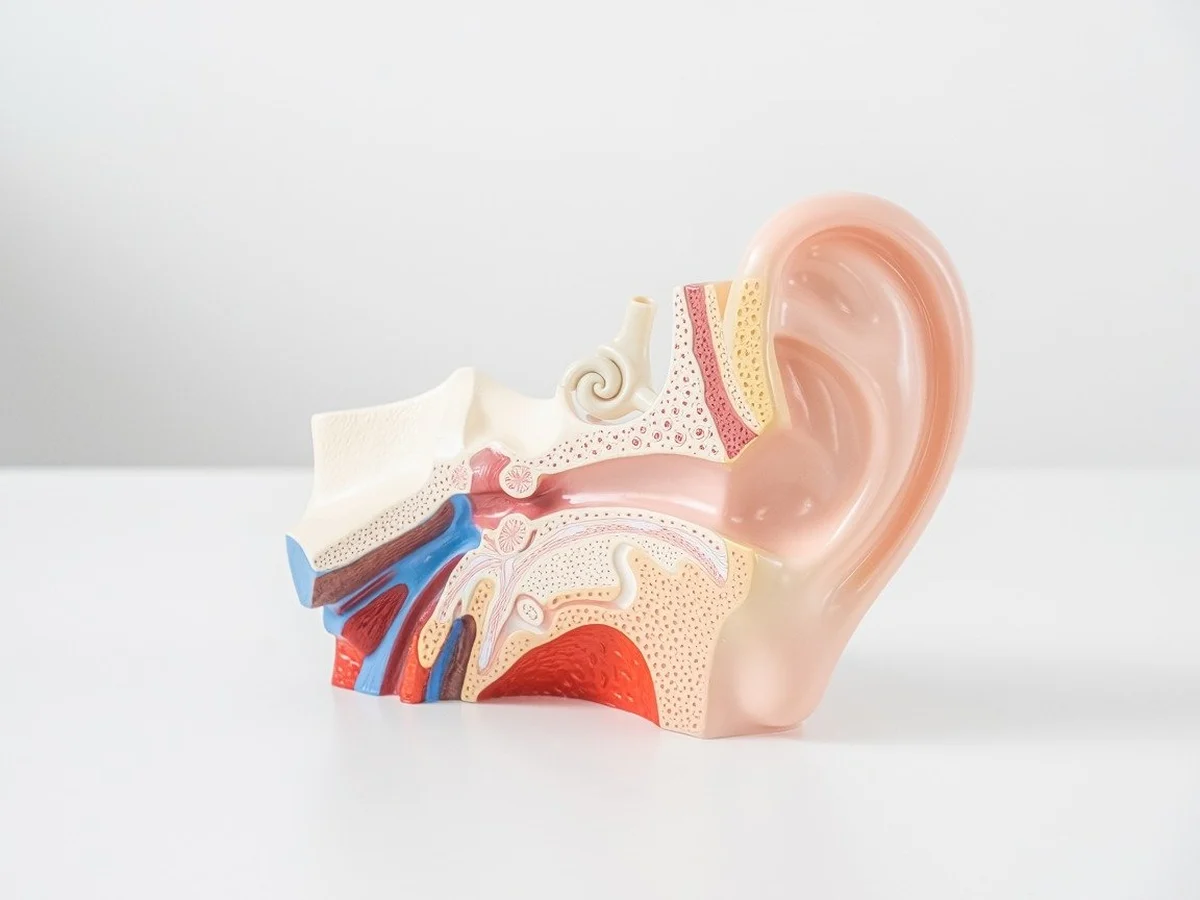
The visible part of the ear, called the pinna, acts like a funnel, gathering sound and directing it into the ear canal, a tube about 2.5 centimetres long. The pinna's curves also subtly change sounds depending on where they come from, which helps the brain work out whether a sound is in front, behind, above or below. The ear canal produces wax that traps dust and protects the skin, and it usually cleans itself without help.
The eardrum
At the end of the ear canal is the eardrum, or tympanic membrane, a thin, tight sheet of tissue about a centimetre across. When sound waves reach it, the eardrum vibrates in step with them, moving back and forth by tiny amounts. For very quiet sounds, the movement is smaller than the width of an atom. Behind the eardrum lies the middle ear, an air-filled space connected to the throat by the Eustachian tube, which balances pressure.
Three tiny bones
The middle ear contains three bones linked in a chain: the malleus, the incus and the stapes, often called the hammer, anvil and stirrup. The stapes, only about three millimetres long, is the smallest bone in the human body. Together they act as a lever system that passes vibrations from the eardrum to a small opening into the inner ear called the oval window, increasing the pressure about twentyfold so that sound can move efficiently into fluid.
The cochlea
The inner ear contains the cochlea, a snail-shaped spiral about the size of a pea, filled with fluid. When the stapes pushes on the oval window, waves travel through this fluid. Running along the cochlea is the basilar membrane, which is stiff and narrow at one end and wider and floppier at the other. High-pitched sounds make the stiff end vibrate most, while low-pitched sounds peak further along, so different places respond to different frequencies.
Hair cells
Sitting on the basilar membrane are about 15,000 sensory hair cells in each ear, arranged in rows. Each has a bundle of tiny projections on top. When the membrane moves, these bundles bend, opening channels that let charged particles flow into the cells. This creates electrical signals that are passed to the auditory nerve. Outer hair cells also change length to amplify faint sounds, which is why the cochlea itself can produce tiny sounds that doctors measure in hearing tests.
The brain listens
Signals travel along the auditory nerve to the brainstem and then to the auditory cortex in the temporal lobes. The brain compares the timing and loudness of sounds arriving at each ear to locate where they come from. It separates voices from background noise, recognises music and words, and links sounds to memories and emotions. We do not really hear with our ears alone; we hear with our brains, using information the ears provide.
Balance too
The inner ear has a second job. Next to the cochlea are three semicircular canals and two small sacs, together called the vestibular system. They contain fluid and hair cells that detect rotation, tilt and acceleration. This information helps you keep your balance and keeps your eyes steady when your head moves. When the signals from the inner ear and the eyes disagree, for example on a rocking boat, people can feel motion sickness.
Protecting your hearing
The World Health Organization estimates that more than 1.5 billion people live with some degree of hearing loss. Hair cells in the human cochlea do not regrow, so damage from loud noise is permanent. As a guide, sounds of 85 decibels, similar to heavy traffic, become risky with long exposure, and safe listening time falls quickly as volume rises. Turning down headphones, taking breaks, using ear protection at concerts and having regular checks all help protect hearing.
Sources & further reading
General information, not medical advice. See a doctor or audiologist about any change in hearing. Photograph: original AI-generated illustration (Adobe Firefly). Reference organisations do not endorse this website.