How venom is ranked
Scientists compare venom potency using a laboratory measure called the LD50, short for median lethal dose. It is the amount of venom, per kilogram of body weight, that kills half of a group of test mice. A lower number means a more potent venom. The values in this table come from tests in which venom dissolved in saline was injected under the skin, a commonly published method. Results vary with the method used, the population of snakes sampled and even the season. Injecting venom directly into a vein, for example, gives different numbers and can reshuffle the order. The ranking therefore shows broad patterns rather than exact positions.
The inland taipan
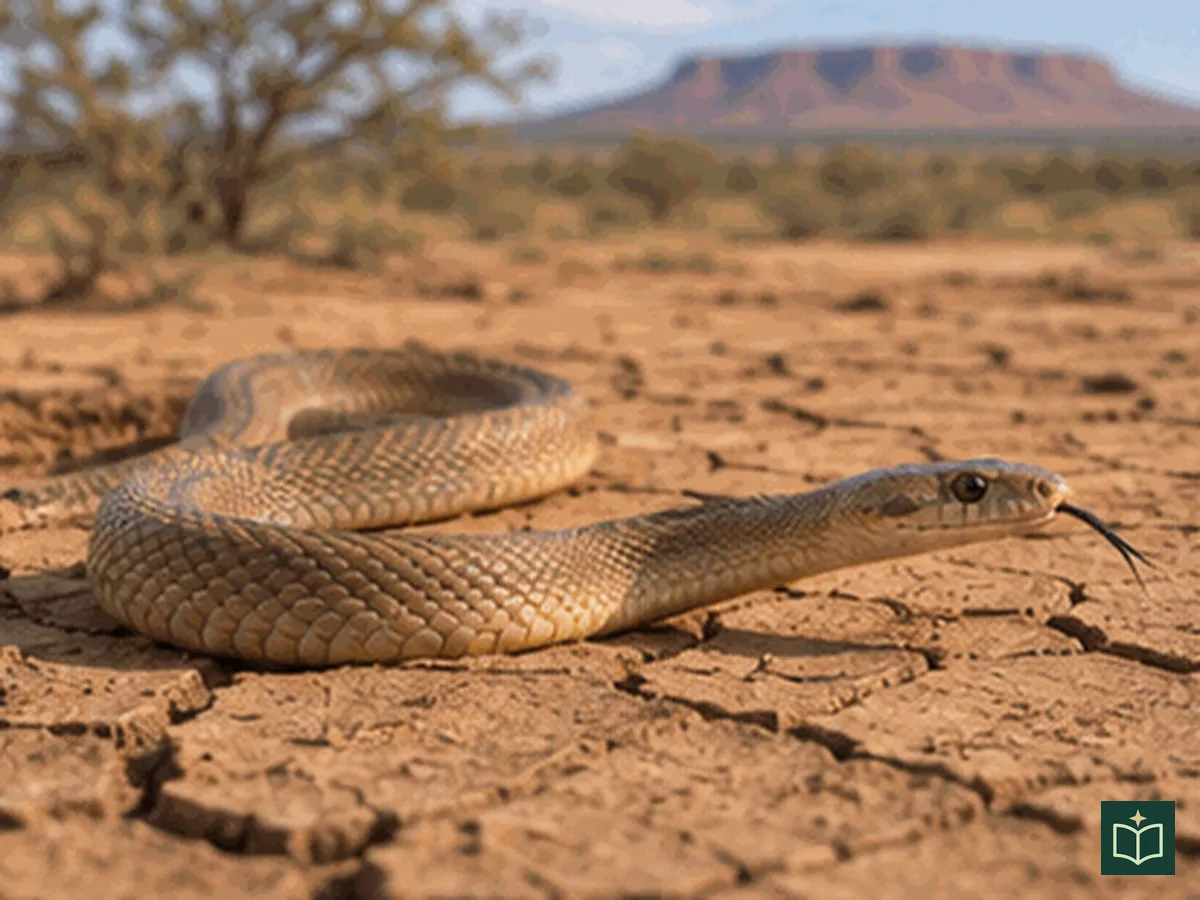
The inland taipan lives in the dry floodplains and cracked clay soils of central-eastern Australia. By the LD50 measure its venom is the most potent of any land snake, and a single bite contains enough to kill many people. Its venom contains nerve toxins that cause paralysis and other components that stop blood from clotting. It evolved to kill rodents quickly in their burrows, before they can bite back. Yet the snake is shy and lives in remote country with few people. Very few bites have been recorded, mostly among people handling the snakes, and no deaths are known among those who received prompt antivenom treatment.
Australia’s dangerous neighbours
Australia dominates the table. Besides the inland taipan, it is home to the eastern brown snake, the coastal taipan and the Central Ranges taipan. The eastern brown snake lives in farmland and on the edges of towns, which brings it into more frequent contact with people, and it causes many of Australia’s serious bites. Even so, Australia records only a few snakebite deaths in a typical year. That is because of good first aid, fast ambulance services and widely available antivenom, first developed in Australia in the twentieth century. Pressure bandages that slow the spread of venom through the lymph system are a key part of first aid there.
Venom at sea
Several sea snakes and sea kraits appear in the table. They live in warm coastal waters of the Indian and Pacific oceans and feed mainly on fish and eels, which their potent venom subdues quickly. The yellow-bellied sea snake drifts across open ocean and is the most widespread snake in the world. The beaked sea snake is common in coastal waters from the Gulf to Australia and is responsible for most serious sea snake bites, often to fishermen sorting nets. Several sea snake species live in the waters off the UAE, Oman and other Gulf states, where they are usually seen washed up on beaches after storms.
The deadliest snakes
The snakes that kill the most people are not the most venomous. The World Health Organization estimates that snakebite kills between about 81,000 and 138,000 people every year, mostly in rural South Asia and sub-Saharan Africa. In India, most deaths are caused by four species known as the big four: the spectacled cobra, the common krait, Russell’s viper and the saw-scaled viper. These snakes live close to farms and villages, and bites often happen in fields or at night. Saw-scaled vipers also occur across the Arabian Peninsula, including the UAE and Oman. The WHO lists snakebite envenoming as a neglected tropical disease.
Why danger depends on people
A snake’s threat to humans depends on more than its venom. How much venom it injects, how readily it bites, where it lives and how often people meet it all matter. So does access to treatment. Many deaths happen far from hospitals, where antivenom is scarce, expensive or poorly stored, and where traditional remedies may delay proper care. Survivors can be left with lasting disabilities, including amputations. Anyone bitten by a snake should keep still, remove rings and tight items, and seek medical help immediately rather than cutting the wound or applying a tourniquet. This is general information, and local medical advice should always be followed.
Sources & further reading
- World Health Organization · Snakebite envenoming ↗
- Australian Museum · Inland Taipan ↗
- Britannica · Taipan ↗
Figures are rounded and widely published; check the linked organisations for the latest editions. These organisations do not endorse this website.