What the series measures
The reactivity series lists metals in order of how readily they react with water, oxygen and acids. At its heart is one property: how easily a metal atom gives up its outermost electrons to form a positive ion. Metals that lose electrons easily react vigorously; those that hold on tightly barely react at all. Chemists find the order with simple experiments, such as dropping metals into water or dilute acid, or placing one metal in a solution of another’s salt to see if it displaces it. This table shows ten common metals in order, with the typical behaviour that places each one. Rubidium, between caesium and potassium, is left out for simplicity.
The alkali metals
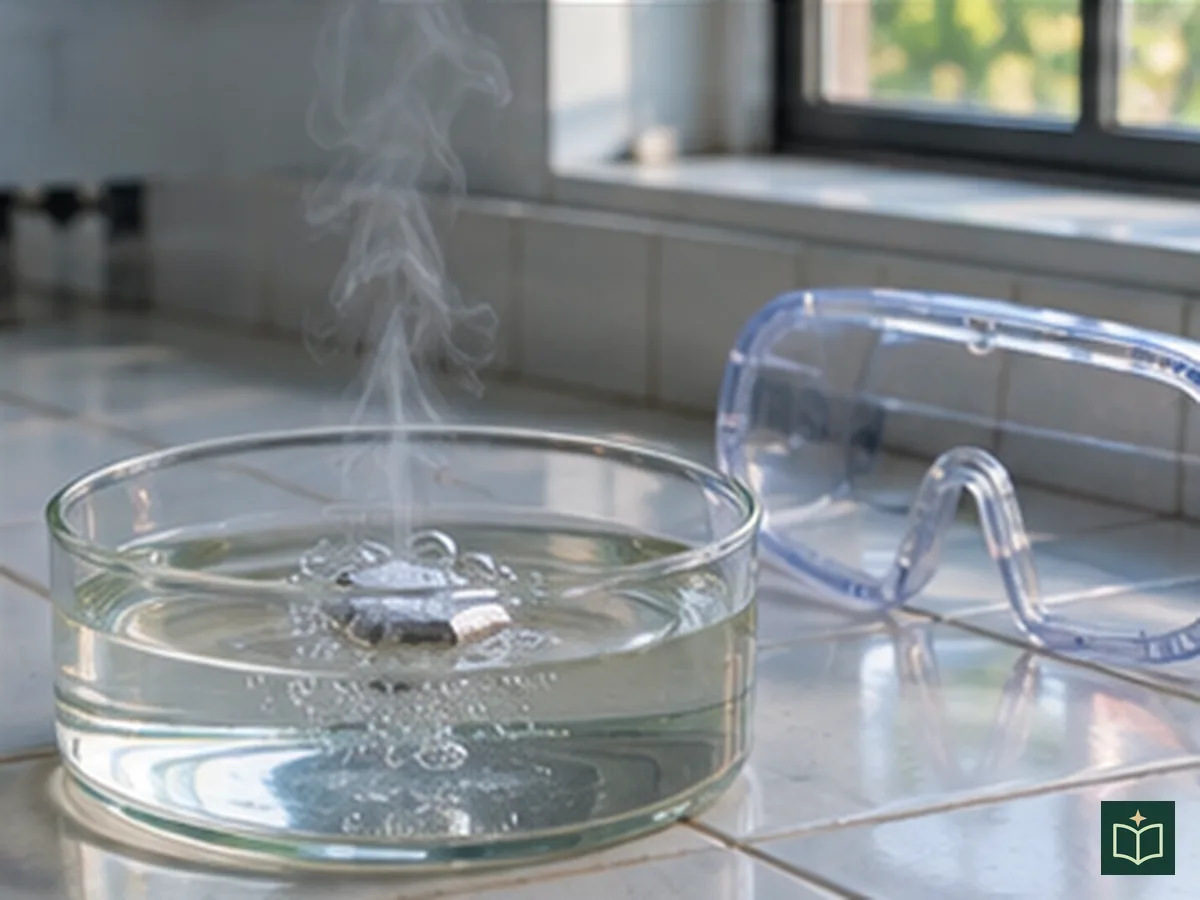
Caesium, potassium, sodium and lithium belong to the alkali metals, group 1 of the periodic table. Each has a single outer electron that it loses very easily. They react with water to release hydrogen and form strong alkalis, and they are stored under oil to keep air and moisture away. Reactivity increases down the group: lithium fizzes steadily, sodium melts into a skating ball, potassium bursts into a lilac flame and caesium reacts explosively. The reason is size. Larger atoms hold their outer electron farther from the nucleus and shielded by more inner electrons, so it is lost more easily. Francium, below caesium, is too rare and radioactive to test.
The middle of the series
Calcium and magnesium, from group 2, have two outer electrons and react less violently. Calcium bubbles steadily in cold water, while magnesium reacts slowly with cold water but burns with a brilliant white flame in air and reacts readily with steam. Aluminium, zinc and iron react with dilute acids, releasing hydrogen. Iron combines with oxygen and water to form rust, a slow but costly reaction. Carbon and hydrogen, though not metals, are often added to the series as reference points, because metals below carbon can be extracted by heating their ores with it, as in a blast furnace. That rule shaped the history of metalworking.
The aluminium puzzle
Aluminium sits fairly high in the reactivity series, above zinc and iron, yet aluminium window frames and drinks cans do not corrode away. The reason is a thin, tough layer of aluminium oxide that forms almost instantly on its surface and seals the metal underneath. Remove that layer and aluminium’s reactivity becomes obvious. In the thermite reaction, powdered aluminium strips oxygen from iron oxide so fiercely that it produces molten iron, a process used to weld railway tracks. Aluminium’s high reactivity also explains why it was once more expensive than gold: it could not be extracted by heating with carbon and needed electrolysis, developed commercially only in 1886.
The noble end
At the bottom of the series lie copper, silver, gold and platinum. They do not react with water or dilute acids, and gold and platinum resist even most strong acids; gold dissolves in aqua regia, a mixture of nitric and hydrochloric acids. That is why these metals are often found as native metal in nature and were among the first used by people. In the Gulf, gold’s resistance to tarnish underpins its role in jewellery and savings: a gold bangle stays bright for generations. Lithium is a notable oddity. By electrode potential it is the strongest reducing agent, but it reacts with water more slowly than sodium or potassium.
Why it matters
The reactivity series is practical chemistry. It explains how metals are extracted: the most reactive, such as aluminium and sodium, need electrolysis, while iron and copper can be smelted with carbon. It underpins corrosion protection: coating steel with zinc, called galvanising, works because the more reactive zinc corrodes first, protecting the iron. Ships and pipelines in the Gulf’s salty waters use blocks of zinc or aluminium as sacrificial anodes for the same reason. The series also predicts how batteries behave, since a cell’s voltage depends on the gap in reactivity between its two metals. Lithium’s place at the extreme is why it powers modern batteries.
Sources & further reading
Figures are rounded and widely published; check the linked organisations for the latest editions. These organisations do not endorse this website.