Measuring the main span
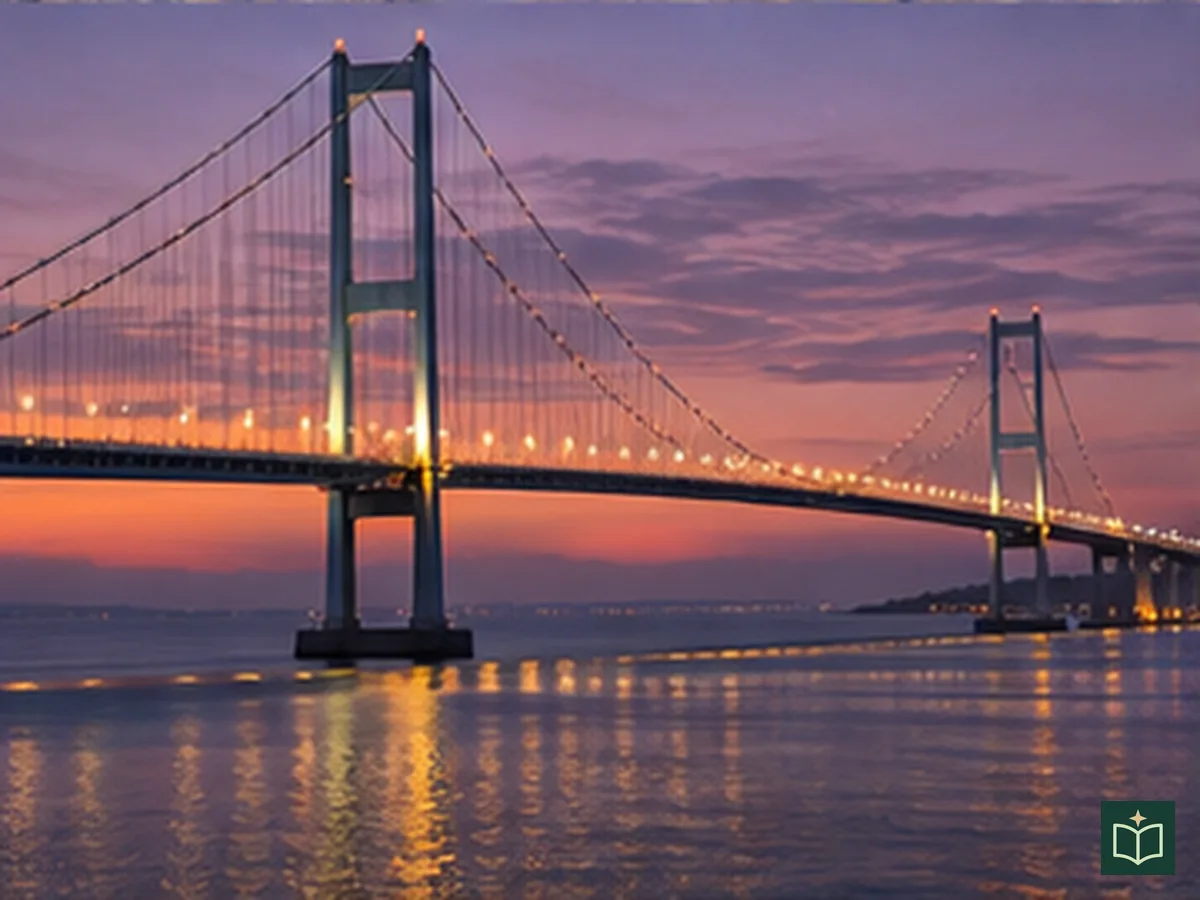
Suspension bridges are ranked by main span: the distance between the two towers that support the main cables. That is a test of engineering rather than of length overall, and it is where suspension bridges dominate all other types. The record holder since 2022 is the Çanakkale 1915 Bridge across the Dardanelles in Türkiye, with a main span of about 2,023 metres. Its length was chosen as a symbol of the Turkish Republic’s centenary in 2023, and the 1915 in its name recalls the Gallipoli campaign. It took the record from Japan’s Akashi Kaikyō Bridge, which had held it since 1998 with a span of about 1,991 metres. This table covers completed bridges as of 2025.
How the cables work
In a suspension bridge, the deck hangs from vertical cables, called hangers, attached to two main cables draped over tall towers. The main cables carry the load in tension and pass it to the towers, which press down into their foundations, and to massive anchorages at each end, which resist the pull. Steel wire is extremely strong in tension, so a cable can carry enormous weights over long distances while weighing relatively little. The main cables of the Akashi Kaikyō Bridge each contain about 37,000 high-strength wires. The longer the span, the more the cables themselves weigh, which sets a practical limit on how far a bridge can reach.
Wind, the hidden enemy
Long, slender decks are vulnerable to wind. In 1940 the Tacoma Narrows Bridge in Washington state twisted itself apart in a moderate wind only months after opening, a failure caused by aerodynamic instability. Since then engineers have tested designs in wind tunnels and shaped decks to let air flow smoothly around them. Many modern long-span bridges use streamlined steel box girders or split decks with a gap down the middle, as on the Çanakkale and Xihoumen bridges. Earthquakes are another concern: the 1995 Kobe earthquake moved the towers of the Akashi Kaikyō Bridge apart, lengthening its main span by about a metre while it was still under construction.
China’s long-span boom
Five of the ten bridges in this table are Chinese, most completed in the past fifteen years as the country linked river cities and coastal islands. The Yangsigang Bridge in Wuhan, opened in 2019, carries a double-deck road over the Yangtze. The Shenzhen–Zhongshan Bridge, opened in 2024, is part of a crossing of the Pearl River estuary that also includes an undersea tunnel. The Ningyang Yangtze River Bridge near Nanjing opened in 2025. Even longer spans are under construction: the Zhangjinggao Yangtze River Bridge, expected to open later in the decade, is designed with a main span of about 2,300 metres, roughly 277 metres longer than the current record.
Europe and Türkiye
Denmark’s Great Belt East Bridge, opened in 1998, links the islands of Funen and Zealand and is the longest suspension span in Europe outside Türkiye. Türkiye has two entries: as well as Çanakkale, the Osman Gazi Bridge across the Gulf of İzmit, opened in 2016, shortens the drive between Istanbul and İzmir. South Korea’s Yi Sun-sin Bridge, opened in 2012, connects an industrial port region on the south coast. Just outside the table come China’s Runyang Bridge and the Humber Bridge in England, which held the world record from 1981 until 1998 with a span of about 1,410 metres, showing how quickly records have been broken since.
Why spans keep growing
Longer spans let bridges cross deep straits and busy shipping channels without piers in the water, which would be costly to build and dangerous to ships. Advances in steel wire strength, computer modelling, wind-tunnel testing and construction methods have pushed records forward. The Gulf has no long suspension bridges, partly because its shallow waters favour causeways and short spans, but engineers in the region follow these projects closely as cities grow over water. Proposals such as a crossing of the Strait of Messina in Italy, with a planned span of more than three kilometres, show how far designers believe the technology can go.
Sources & further reading
Figures are rounded and widely published; check the linked organisations for the latest editions. These organisations do not endorse this website.