What counts as a building
Ranking the world’s oldest buildings means deciding what a building is. This list includes structures that still survive in substantial form, with walls, chambers or towers that can be seen and in many cases entered, rather than foundations known only from excavation. Dates come from radiocarbon dating of material found inside or beneath the structures and are approximate, often spanning several centuries of construction and use. The two oldest entries, Göbekli Tepe and the Tower of Jericho, are excavated monuments rather than complete buildings, so some lists treat them separately. If only intact roofed structures are counted, the oldest are the great chambered tombs of western France.
Göbekli Tepe and Jericho
Göbekli Tepe, on a hill near Şanlıurfa in south-eastern Türkiye, contains circular enclosures of massive carved limestone pillars, some more than five metres tall and decorated with foxes, snakes, boars and birds. The oldest date to about 9500 BC, built by people who still lived mainly by hunting and gathering. Its discovery overturned the idea that monumental building came only after farming. The Tower of Jericho, a solid stone tower about eight metres high with an internal staircase, was built around 8000 BC. Its purpose is still debated: proposals include defence, flood protection, ritual or marking the solstice. Both sites are among the oldest known monumental architecture.
Brittany’s great cairns
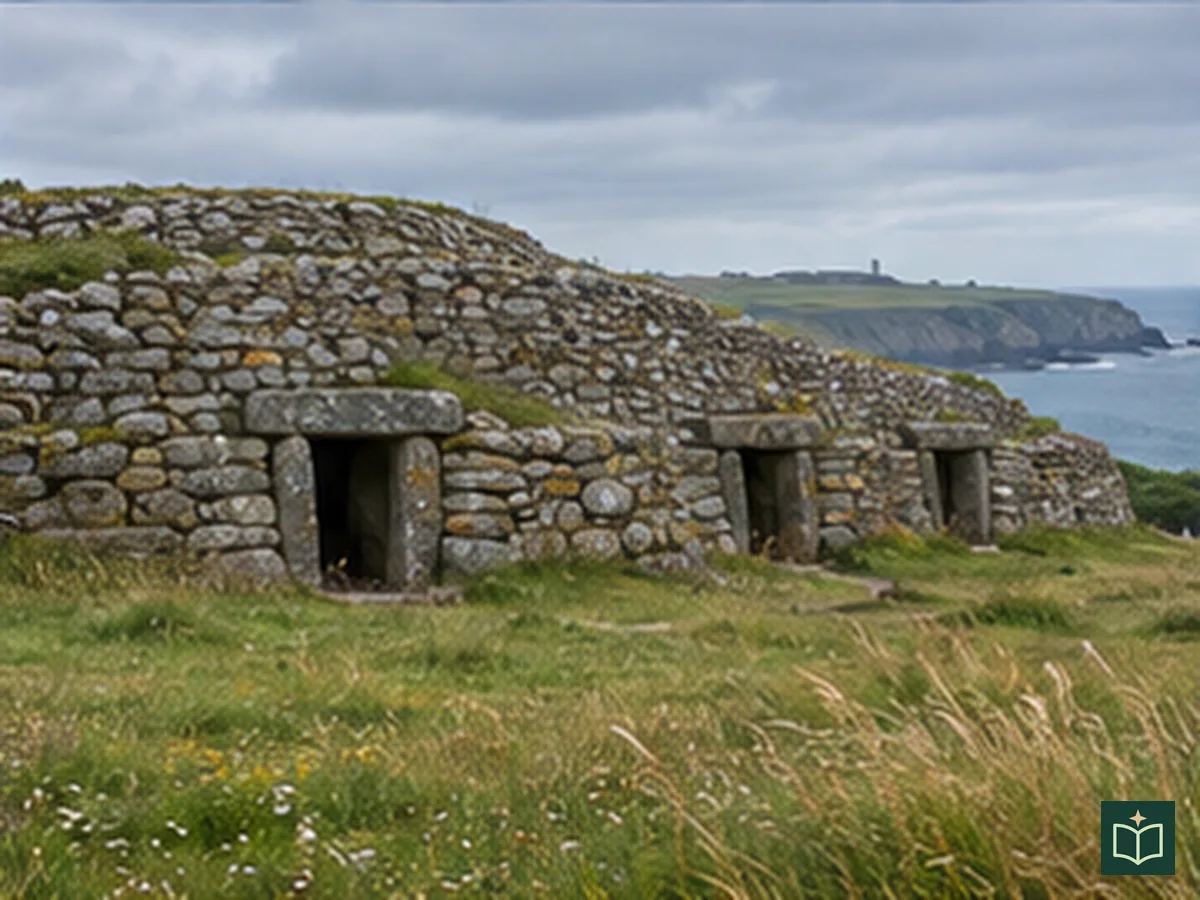
Barnenez, on the north coast of Brittany, is one of the oldest and largest megalithic monuments in Europe. Built around 4800 BC, it is a long stone cairn, about 75 metres long, containing eleven separate passage graves, each with a corridor leading to a burial chamber. It was nearly destroyed in the 1950s when it was used as a quarry for road stone, until archaeologists intervened. The tumuli of Bougon in western France and Saint-Michel at Carnac, near the famous stone alignments, are of similar age. They show that farming communities along Europe’s Atlantic coast were investing enormous effort in monuments to the dead.
Homes and tombs in the British Isles
The Knap of Howar, on the island of Papa Westray in Orkney, is a pair of stone houses built around 3700 BC and one of the oldest standing houses in northern Europe. Its stone furniture, including cupboards and hearths, survives because Orkney had few trees and people built in stone. West Kennet Long Barrow, near Avebury in England, is a chambered tomb used for centuries. La Hougue Bie, in Jersey, is a passage grave under a mound later topped by a medieval chapel. Newgrange in Ireland, around 3200 BC, is aligned so that the rising sun at the winter solstice lights its inner chamber.
The temples of Malta
The Ġgantija temples on the island of Gozo, built around 3600 BC, are among the oldest free-standing stone temples in the world. Their walls, made of huge limestone blocks, rise up to about six metres, and local legend said they were built by giants, giving them their name. They belong to a group of Maltese megalithic temples, including Ħaġar Qim, Mnajdra and Tarxien, that together form a UNESCO World Heritage Site. The temples were built by farming communities over more than a thousand years. Their curved, lobed plans and carved decoration show a sophisticated local tradition that developed independently of building traditions elsewhere in the Mediterranean.
Older than the pyramids
Every structure in this table is older than the Great Pyramid of Giza, completed around 2560 BC. Barnenez predates it by more than two thousand years. That challenges the common image of Egypt as the birthplace of monumental architecture. In Arabia too, archaeologists have identified thousands of mustatils, large rectangular stone structures in north-western Saudi Arabia dated to around 5000 BC, though most survive as low walls rather than standing buildings. New discoveries and better dating continue to push the story of architecture further back. Lists like this one change as excavation continues, which is a reminder of how much of early human history still lies underground.
Sources & further reading
Figures are rounded and widely published; check the linked organisations for the latest editions. These organisations do not endorse this website.