Height is not everything
Ranking mountains by elevation favours peaks that sit on already-high ground. Many Himalayan summits are really shoulders or subsidiary tops of bigger mountains, standing only a few hundred metres above the saddle that links them. Prominence corrects for that. Imagine flooding the world until a summit becomes an island, then slowly lowering the water. The prominence is the height of the summit above the lowest point, called the key col, at which its island joins land containing a higher peak. A mountain with high prominence is a genuinely independent giant, while a high summit with low prominence is effectively a satellite of something bigger close by.
The continental champions
By definition, the highest point of a landmass has a prominence equal to its full elevation, because there is no higher ground to connect to. That is why continental summits dominate this table. Everest’s prominence equals its height, about 8,849 metres. Aconcagua, the highest point in the Americas, follows at about 6,960 metres. Kilimanjaro, the roof of Africa, rises roughly 5,885 metres above its key col. Antarctica’s Vinson Massif and Puncak Jaya, the summit of New Guinea, each have a prominence equal to their elevations of a little under 4,900 metres. Island high points behave the same way, which is why Hawaii’s Mauna Kea also ranks highly on longer lists.
Surprises on the list
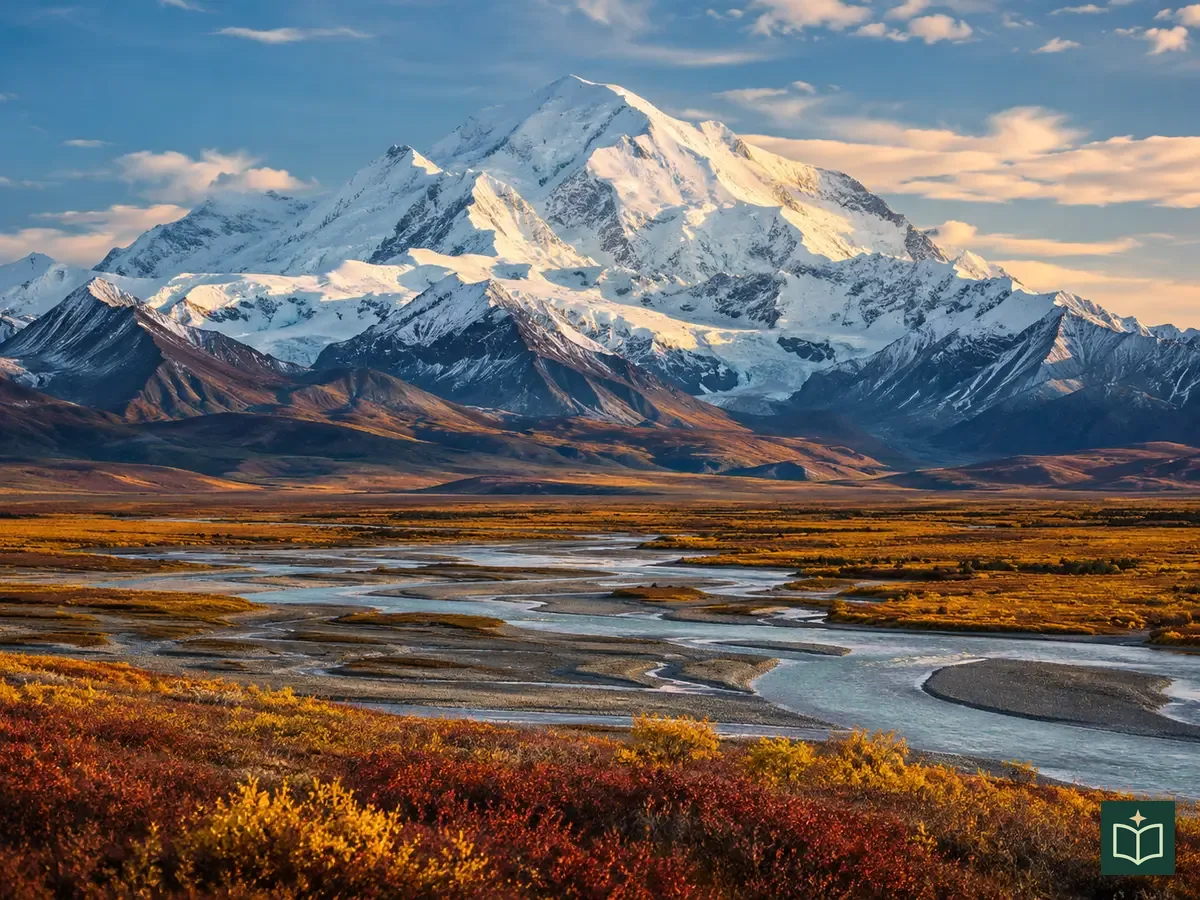
Denali, in Alaska, is about 6,190 metres high, yet its prominence of roughly 6,140 metres places it third in the world. It rises from lowland close to sea level, giving it one of the largest base-to-summit rises of any mountain on land. Pico Cristóbal Colón, fifth, crowns Colombia’s Sierra Nevada de Santa Marta, an isolated range that climbs steeply from the Caribbean coast to permanent snow. Mount Logan, Canada’s highest point, and Mexico’s Pico de Orizaba, a dormant volcano, complete a strong showing for the Americas. Mount Elbrus, a volcano in the Caucasus and Europe’s highest summit, takes tenth place. K2 does not appear here at all.
Disputed figures
Prominence depends on two measurements, the summit and the key col, so errors can compound. Cols often lie in remote passes or beneath glaciers, and their elevations may come from older maps rather than modern surveys. Pico Cristóbal Colón shows the difficulty: it and nearby Pico Simón Bolívar have been measured at slightly different heights over the years, and some surveys suggest they are almost exactly tied. Ice thickness matters too, because a col or summit on a glacier changes as the ice grows or melts. Lists compiled by different researchers therefore vary by tens of metres, which is why the figures in this table are rounded to the nearest ten.
A tool for climbers and mapmakers
The idea of prominence was popularised by hill-walking communities and cartographers who wanted a consistent way to decide what counts as a separate mountain. In Britain, for example, the list of hills known as Marilyns uses a minimum prominence of 150 metres. Climbers use the concept to judge how independent a summit is, while geographers pair it with isolation, the distance to the nearest higher point. Neither measure replaces elevation; each answers a different question. Elevation tells you how thin the air will be at the top. Prominence tells you how dramatically a mountain stands out from the land around it, and therefore how imposing it looks from below.
Close to home
Readers in the UAE have a useful example on their doorstep. Jebel Jais, in Ras Al Khaimah, is the country’s highest mountain at roughly 1,900 metres, and its true summit lies just across the border in Oman. Because the Hajar range continues south-east and rises to about 3,000 metres at Jebel Shams in Oman, Jebel Jais is connected to higher ground through a series of saddles. Its prominence is therefore far smaller than its height. The same logic explains the global list. The most prominent peaks on Earth are those that stand alone above their surroundings, not simply those that happen to stand tall on top of an already lofty range.
Sources & further reading
Figures are rounded and widely published; check the linked organisations for the latest editions. These organisations do not endorse this website.