Plunging off a table mountain
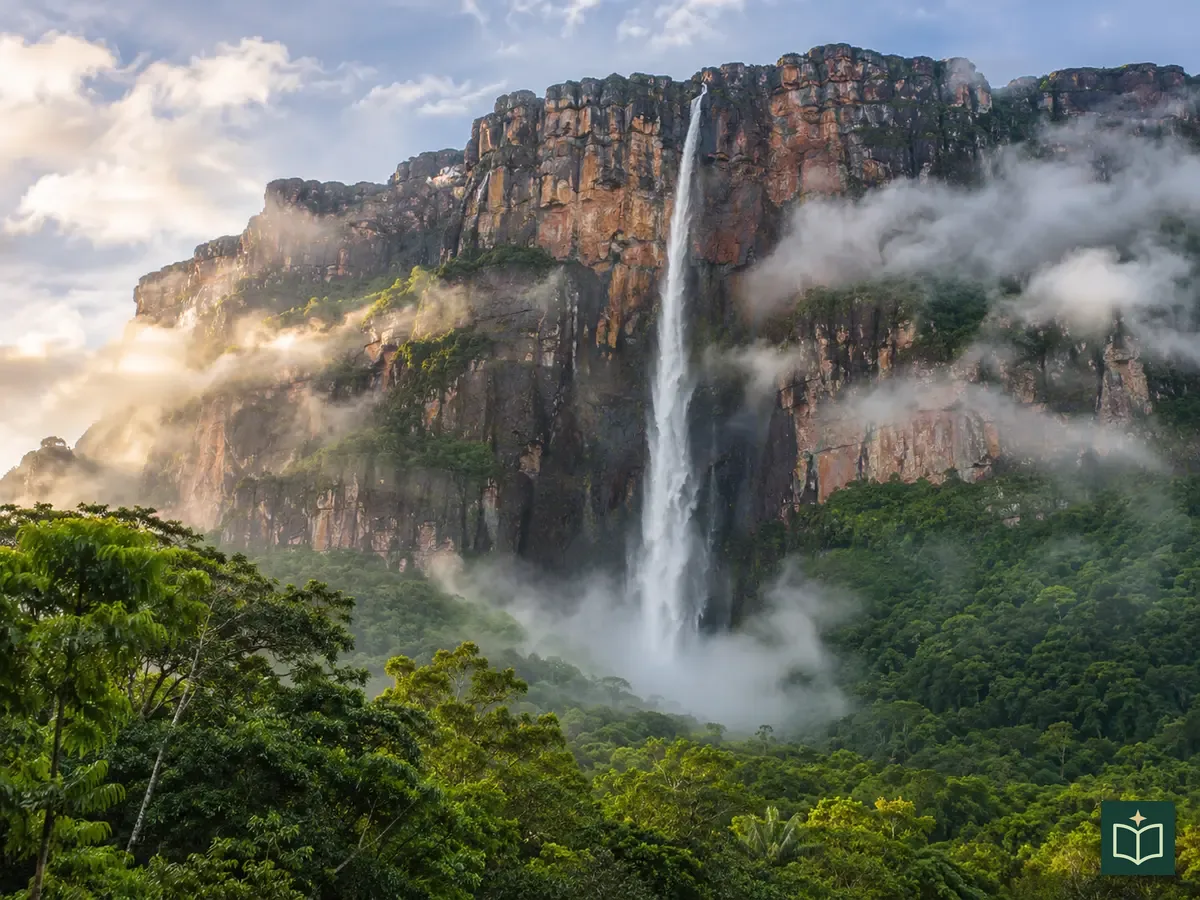
Angel Falls, known in Venezuela as Kerepakupai Merú, pours off the edge of Auyán-tepui, a flat-topped sandstone mountain in Canaima National Park. Its total height of about 979 metres is roughly 150 metres more than the height of the Burj Khalifa, and its single uninterrupted drop of about 807 metres is the longest known anywhere. In the dry season the flow can shrink so much that much of the water turns to mist before it reaches the bottom. The falls became widely known abroad after the American aviator Jimmie Angel flew over them in the 1930s, although the Indigenous Pemón people of the region had known them for generations.
What counts as a waterfall?
No single international body certifies waterfall heights, so rankings depend on definitions. Some lists include steep cascades where water slides down rock rather than falling freely through the air; others count only near-vertical drops. A fall made of several tiers can be treated as one feature or as several separate ones. Flow matters too. Some entries are seasonal or ephemeral, running strongly only after heavy rain or during spring snowmelt and dwindling to a trickle at other times. Most rankings, including this one, use total height from the top lip to the base of the final drop, which is why multi-tiered falls in steep terrain feature so prominently.
A contested second place
South Africa’s Tugela Falls, in the Drakensberg mountains, is usually listed at about 948 metres over five distinct drops. Some surveyors have argued that, measured in a different way, it is actually taller than Angel Falls, while others have placed it lower; the debate has not been settled. Peru’s Tres Hermanas, third, and Yumbilla, fifth, lie in remote, forested terrain, and their heights rest on relatively few surveys. Yumbilla in particular was measured and publicised only in the early 21st century. Readers should therefore treat the order of positions two to ten as provisional and the figures as rounded estimates rather than precise, agreed values.
Islands and fjords
Several of the tallest falls tumble down sea cliffs and glacial valleys rather than river gorges. Olo‘upena and Pu‘uka‘oku drop down the north coast of Molokai in Hawaii, which has some of the tallest sea cliffs in the world. Their flow comes from heavy rainfall on the island’s upper slopes. Norway’s Vinnufossen and Balåifossen pour down the steep sides of valleys carved by ice-age glaciers and are fed largely by melting snow. Browne Falls in New Zealand’s Fiordland follows a similar pattern, spilling from a mountain lake towards the sea. James Bruce Falls in western Canada is fed by snowmelt and flows mainly in late spring and summer.
Height versus power
Tall is not the same as big. The highest waterfalls usually carry modest volumes of water, because they form where small streams meet sheer drops. The falls that move the most water are much lower and wider. Victoria Falls, on the border between Zambia and Zimbabwe, is about 108 metres high but roughly 1.7 kilometres wide, forming one of the largest curtains of falling water in the world. Iguazu, between Argentina and Brazil, and Niagara, between Canada and the United States, are similarly broad. Waterfalls also move: the lip of Niagara Falls has retreated roughly 11 kilometres upstream since it formed at the end of the last ice age.
Waterfalls in a dry region
Permanent waterfalls are rare in the Arabian Peninsula, which has no permanent rivers, but seasonal ones do appear. In southern Oman, the summer monsoon, known locally as khareef, turns the hills around Salalah green and sends water cascading through places such as Wadi Darbat, drawing large numbers of visitors from across the Gulf. In the UAE, heavy winter rain can briefly send water pouring down wadis in the Hajar Mountains. These short-lived falls illustrate the same physics as Angel Falls on a smaller scale: rainfall gathered on high ground, a sudden change in slope and gravity doing all the rest.
Sources & further reading
Figures are rounded and widely published; check the linked organisations for the latest editions. These organisations do not endorse this website.