Defining an island
An island is land surrounded by water and smaller than a continent. The awkward case is Australia, which is encircled by sea but is usually classed as a continent because it sits on its own continental plate and is far larger than any comparable landmass. Most geographers therefore draw the line between Australia, at about 7.6 million square kilometres, and Greenland, at about 2.13 million. This table follows that convention and gives each island’s land area, including permanent ice but excluding surrounding islets. Surveys trace coastlines at different levels of detail, especially on heavily indented shores, so published figures differ slightly and the values here are rounded.
Greenland and the map illusion
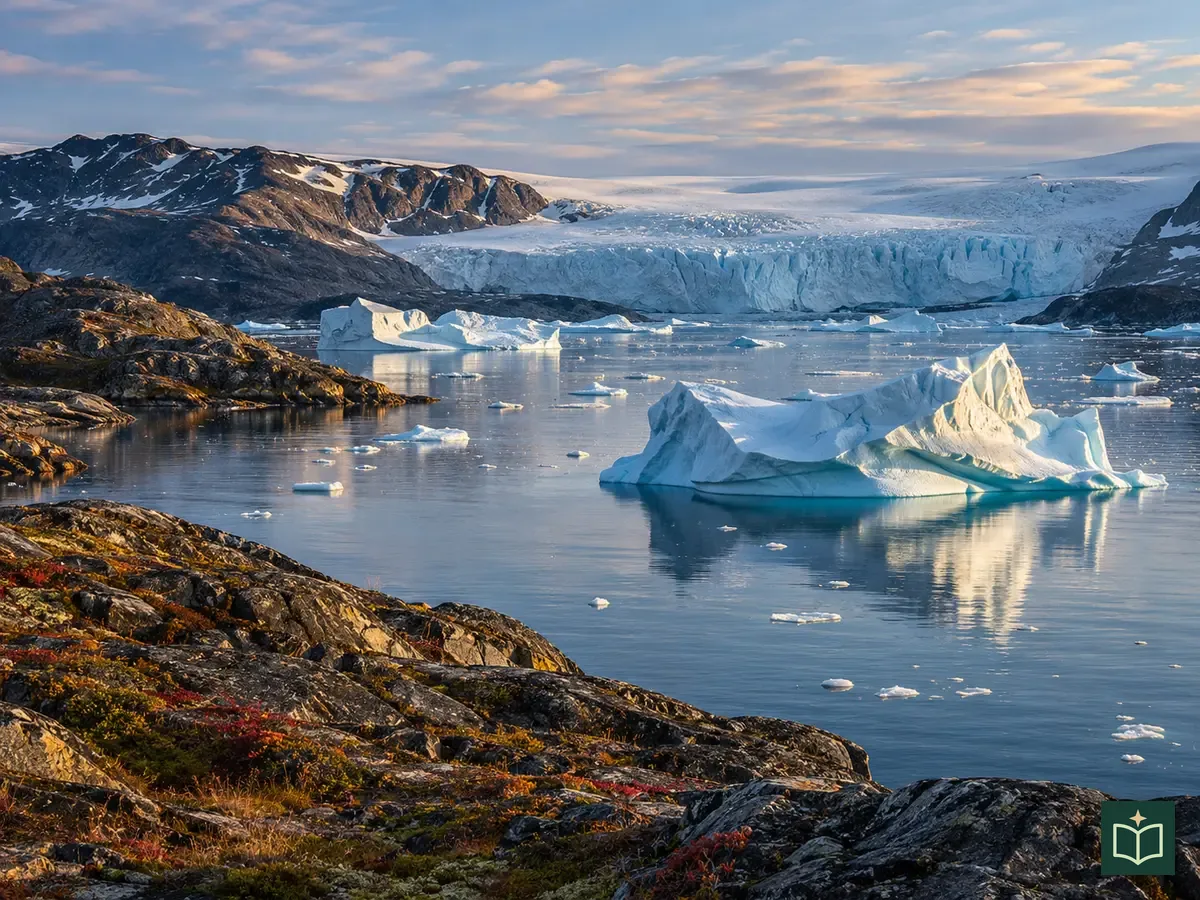
Greenland is more than two and a half times the size of New Guinea, yet it is home to only about 56,000 people. Most of its surface lies beneath an ice sheet; if all of that ice melted, global sea level would rise by roughly seven metres. Politically, Greenland is a self-governing territory within the Kingdom of Denmark, while geologically it belongs to the North American plate. On the familiar Mercator world map Greenland appears roughly as large as Africa. The projection stretches land near the poles, and in reality Africa is about fourteen times larger. Equal-area maps give a far more honest picture of how big the island is.
The tropical giants
New Guinea and Borneo, second and third, are covered by some of the most biodiverse rainforest on Earth. New Guinea is divided between Indonesia in the west and Papua New Guinea in the east, and its summit, Puncak Jaya, is the highest island peak in the world at about 4,880 metres. Borneo is unusual in being shared by three countries: Indonesia, Malaysia and Brunei. Sumatra, sixth, is also Indonesian. These islands rise from shallow continental shelves. During the last ice age, when sea levels were around 120 metres lower, Borneo and Sumatra were joined to mainland Asia and New Guinea was connected by dry land to Australia.
Madagascar and the Arctic
Madagascar, fourth, has been separated from mainland Africa for well over 100 million years and from India for tens of millions. That long isolation produced wildlife found nowhere else, including all of the world’s lemurs and most of its chameleon species. Three of the remaining entries lie in the Canadian Arctic: Baffin Island in fifth place, Victoria Island in eighth and Ellesmere Island in tenth. All three are sparsely populated, partly glaciated and frozen for much of the year. Their coastlines are cut by long fjords and inlets, which makes their exact areas harder to measure than those of rounder islands and explains why sources disagree slightly.
Size is not population
The most populous islands in the table are not the largest. Honshu, Japan’s main island and seventh on the list, is home to about 100 million people and contains Tokyo, Osaka and Kyoto. Great Britain, ninth, has well over 60 million inhabitants. Java, which misses this top ten at roughly 130,000 square kilometres, holds more than 150 million people and is the most populous island in the world. Greenland, by contrast, has fewer people than many Dubai neighbourhoods. Climate, soils, history and access to trade routes explain where people settle far better than land area does, which is why the two rankings barely overlap at all.
Islands nearer the Gulf
No island in or near the Gulf comes close to this list. Qeshm, in the Strait of Hormuz and belonging to Iran, is the largest island in the Gulf at about 1,500 square kilometres. Socotra, part of Yemen and lying in the Arabian Sea, covers roughly 3,600 square kilometres and is famous for its unusual dragon’s blood trees. Both would fit inside Greenland hundreds of times over. Yet the largest islands matter well beyond their regions. Greenland’s ice influences global sea level, Borneo’s and New Guinea’s forests store vast amounts of carbon, and Madagascar’s wildlife is a living laboratory for the study of evolution.
Sources & further reading
Figures are rounded and widely published; check the linked organisations for the latest editions. These organisations do not endorse this website.