The oldest battery idea
Gravity storage is as simple as winding a grandfather clock. Lift a weight and you store energy; let it fall in a controlled way and you get the energy back. Pumped hydro, which moves water between two reservoirs, is by far the largest application and holds most of the world's stored grid energy. Engineers are now testing solid versions that do not need two lakes and a mountain. Electric motors lift heavy objects when electricity is plentiful, and the same machines, run backwards as generators, lower them to supply power when demand rises. The attraction is a system with no chemical wear and almost no losses while the energy is stored.
Mass, gravity and height
The physics fits on one line: energy equals mass multiplied by gravitational acceleration, about 9.81 metres per second squared, multiplied by height. Lifting one tonne by 100 metres stores about 0.98 megajoules, or roughly 0.27 kilowatt-hours, enough to run a large air conditioner for a few minutes. Storing one megawatt-hour at that height needs about 3,700 tonnes. The numbers are modest because gravity is weak compared with the chemical bonds in a battery or a fuel. Gravity systems therefore need either very heavy masses, great heights, or both. Pumped hydro succeeds because water is cheap and reservoirs hold millions of tonnes of it.
Towers, trains and shafts
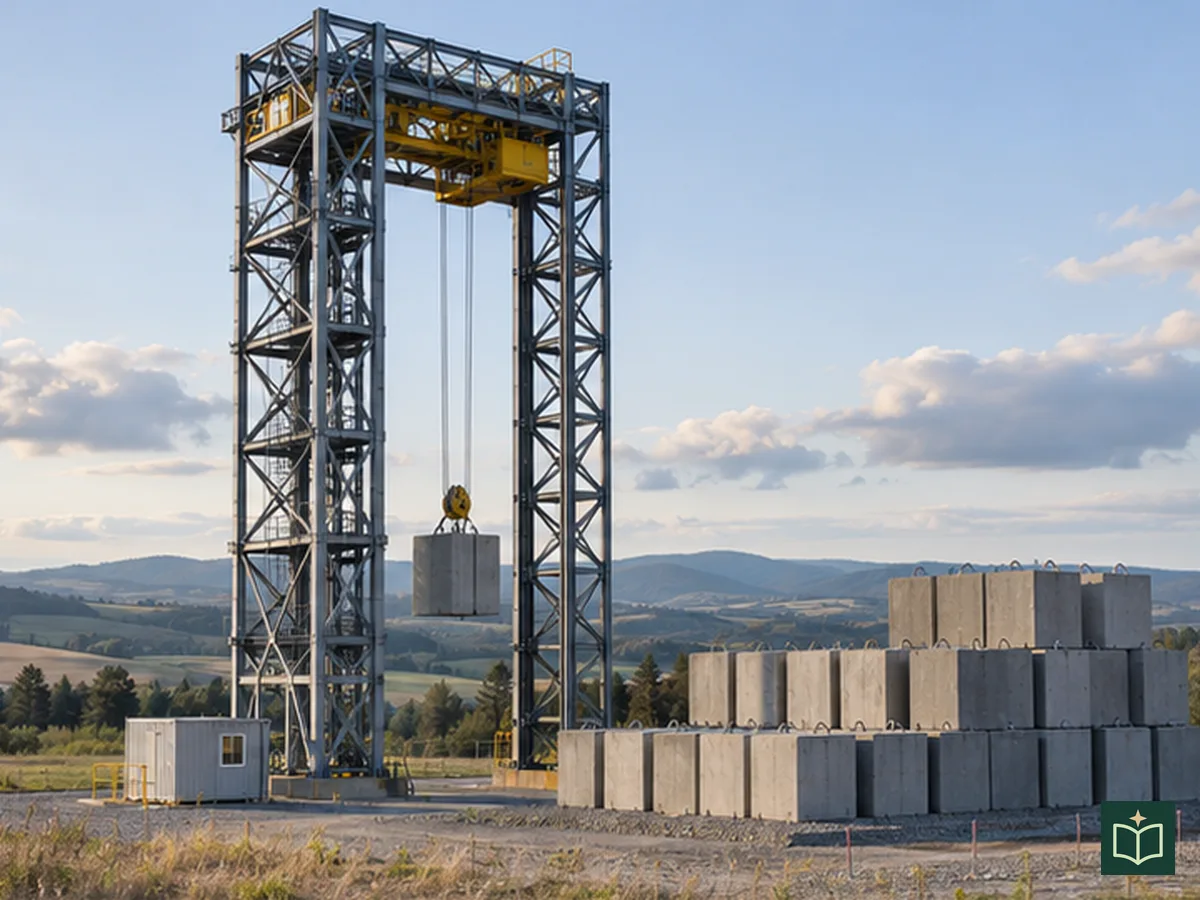
Three solid designs stand out. Crane or building systems stack and unstack composite blocks weighing tens of tonnes each inside a tall structure, under computer control. Rail systems push heavy cars up a slope with electric locomotives and let them roll back down, regenerating as they brake, an approach piloted in the United States. Shaft systems hang weights of hundreds of tonnes in disused mine shafts, using depths that can exceed a kilometre. A 500-tonne weight lowered 1,000 metres releases about 1.4 megawatt-hours. Developers in Europe, the US and China have built demonstration units, and claimed round-trip efficiencies, typically around 80 per cent or more, compare well with batteries.
Seconds-fast, years-long
Gravity systems have genuine strengths. Electric motors can respond within seconds, so they can help balance grid frequency as well as shift energy. The stored energy does not leak away over days, unlike heat stores or some batteries. Steel, concrete and cables last decades, with little loss of capacity, and the materials are abundant and recyclable. Some designs propose filling blocks with waste soil or demolition rubble. Old mine shafts offer ready-made depth near former industrial areas that often already have grid connections, while turning a liability into an asset. Unlike pumped hydro, solid gravity storage does not need water, which matters in arid regions such as the Gulf.
The size problem
The main limit is energy density. A 35-tonne block raised 100 metres stores under 10 kilowatt-hours, about the capacity of a small home battery. Reaching hundreds of megawatt-hours requires tens of thousands of blocks, very tall structures or deep shafts, and the steel and concrete cost money and carry embodied emissions. Lithium-ion batteries, whose prices have fallen sharply, now dominate short-duration storage of a few hours. Gravity designs must beat them on lifetime cost rather than on simplicity alone. Several early projects have been scaled back or redesigned as developers learned how hard it is to build heavy, precise machinery cheaply at large scale.
Where it may fit
Solid gravity storage is still early in its commercial life, and its role is uncertain. Its most promising niches are places with ready-made height, such as deep mines, steep terrain or tall buildings, and uses that value long life and fast response over compactness. Some proposals combine storage with skyscraper design, using lift shafts to move weights during off-peak hours. Others aim to reuse coal-mining regions as their economies change. Whatever happens to individual companies, the physics will not change: storing energy as height is clean and durable, but it needs either very large masses or very large drops to matter at grid scale.
Sources & further reading
Figures are rounded and widely published; check the linked organisations for the latest editions. These organisations do not endorse this website.