A crust made of a few ingredients
There are more than 5,000 recognised mineral species, yet a small number make up almost all of Earth’s crust. Geologists estimate their shares by combining analyses of thousands of rock samples with the known volumes of different rock types. A widely cited estimate gives plagioclase feldspar about 39 per cent of the crust by volume, followed by alkali feldspar and quartz at about 12 per cent each and pyroxenes at about 11 per cent. Together with amphiboles, micas, clays and olivine, these silicate minerals make up more than nine-tenths of the crust. Carbonates and iron oxides account for most of the small remainder.
Why silicates dominate
Oxygen and silicon are the two most abundant elements in the crust, so it is no surprise that most minerals combine them. The basic unit is a small pyramid of four oxygen atoms around one silicon atom. These units can stand alone, link into chains, join into sheets or connect in three-dimensional frameworks. Olivine uses separate units, pyroxenes and amphiboles form chains, micas and clays form sheets, while feldspars and quartz build frameworks. Metals such as aluminium, iron, magnesium, calcium, sodium and potassium fill the gaps. The structure controls each mineral’s shape, hardness and the way it breaks, which is how geologists identify them.
Feldspar, the unsung majority
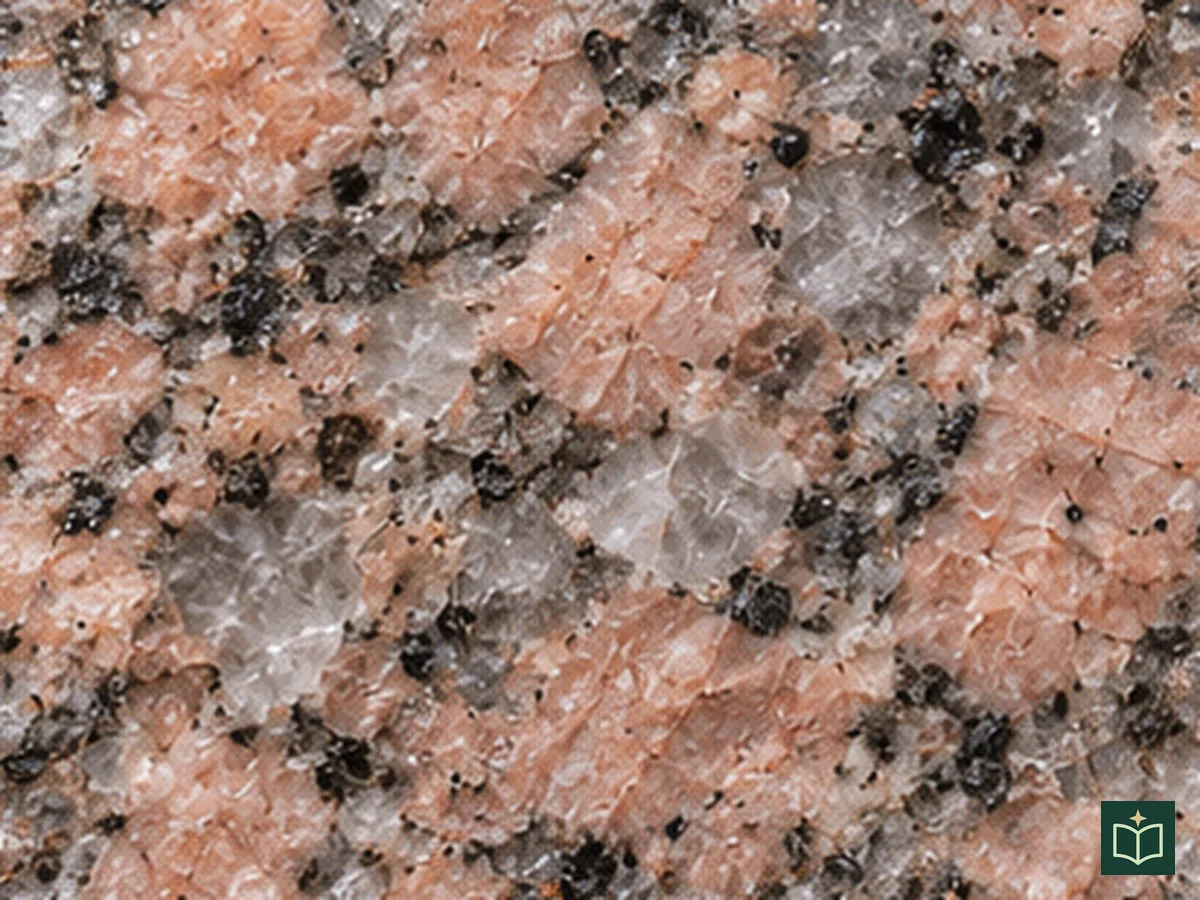
Feldspars are the commonest minerals on Earth, yet few people recognise them. They are the pale pink, white or grey crystals in granite kitchen worktops, and they form much of basalt, the dark rock of the ocean floor. Plagioclase is rich in sodium and calcium, while alkali feldspar is rich in potassium. Both crystallise from cooling magma. At the surface they break down slowly in rain and become clay minerals, which is why clays appear in the table too. Feldspar is mined for glass and ceramics, where it lowers melting temperatures, so it is present in many bathroom tiles, plates and bottles.
Quartz and the desert
Quartz is less abundant than feldspar in the crust as a whole, but it is far more common at the surface. It is hard, and it resists chemical weathering, so it survives while other minerals break down. Over millions of years, grains of quartz are carried by rivers and wind and pile up as sand. That is why most of the world’s desert dunes and beaches are largely quartz. In the Arabian deserts, many dunes owe their reddish colour to a thin coating of iron oxide on quartz grains. Near the coasts of the UAE, sands also contain shell fragments and other carbonate grains from the sea.
Dark minerals of the deep
Pyroxenes, amphiboles and olivine are rich in iron and magnesium and are usually dark green or black. They are most abundant in the oceanic crust and in the mantle below it. Normally these rocks are hidden, but in a few places slabs of ocean floor have been pushed up onto land. The Hajar Mountains of Oman and the UAE contain one of the best exposed examples on Earth, known as the Semail ophiolite. Its rocks are rich in olivine and pyroxene and react with water and carbon dioxide to form carbonate minerals, which is why scientists study them as a natural way of locking away carbon.
Limits of the estimate
These percentages are approximate. The crust is hard to sample, especially beneath the oceans and deep under continents, so estimates rely on models of what lies below the surface. Different studies give slightly different figures, and some classify minerals in broader or narrower groups. The order at the top is well established, but the small values at the bottom of the table, such as calcite and magnetite, are close enough that their positions could swap in other estimates. The ranking also describes the crust only. The mantle beneath it, which makes up most of Earth’s volume, is dominated by olivine and related high-pressure minerals instead.
Sources & further reading
Figures are rounded and widely published; check the linked organisations for the latest editions. These organisations do not endorse this website.