Two kinds of primate
Monkeys and apes are both primates, an order of mammals that also includes lemurs, lorises and tarsiers. Apes, known scientifically as hominoids, comprise gibbons, often called lesser apes, and the great apes: orangutans, gorillas, chimpanzees, bonobos and humans. Monkeys are divided into two groups. Old World monkeys live in Africa and Asia and include baboons, macaques and colobus monkeys. New World monkeys live in Central and South America and include capuchins, howler monkeys and marmosets. Apes are more closely related to Old World monkeys than New World monkeys are, sharing a common ancestor with them roughly 25 to 30 million years ago.
How to tell them apart
The quickest test is the tail. Nearly all monkeys have one, and some New World species can grip with it like an extra hand. No ape has a tail. Apes generally have larger bodies and larger brains relative to body size, and their shoulders are highly mobile, allowing them to hang and swing beneath branches. Gibbons are expert swingers, moving through forests at speed. Monkeys usually move on all fours along the tops of branches, with narrower chests and arms of similar length to their legs. Apes tend to have longer arms than legs, broad chests and an upright posture when sitting.
Examples from Arabia and beyond
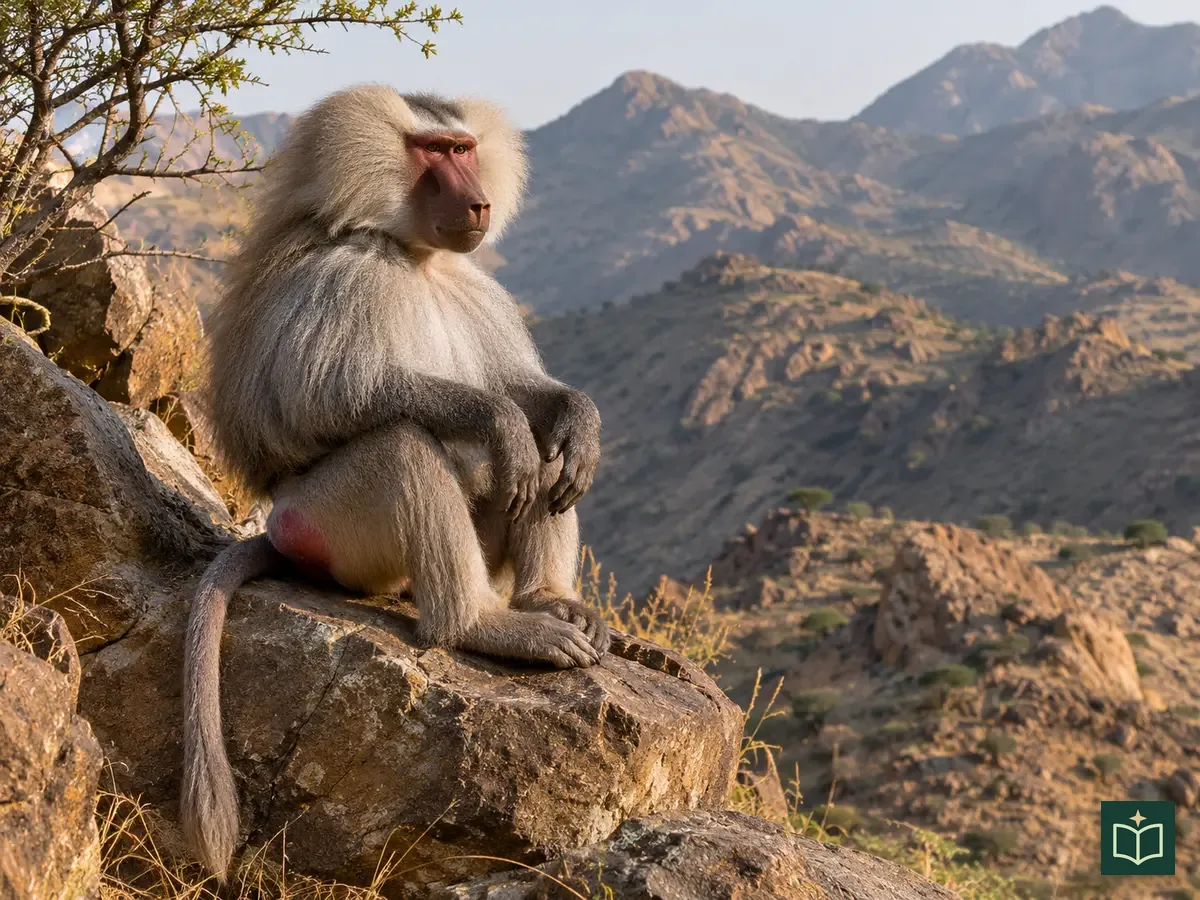
The Arabian Peninsula is home to one wild primate, the hamadryas baboon, an Old World monkey found in the mountains of south-western Saudi Arabia and Yemen as well as in the Horn of Africa. Ancient Egyptians revered the species as a symbol of the god Thoth. Its tail, doglike muzzle and four-legged gait mark it clearly as a monkey. Great apes, by contrast, live naturally only in the forests of equatorial Africa and the islands of Borneo and Sumatra. Visitors to zoos in the Gulf can often compare both: baboons or macaques in one enclosure and orangutans or chimpanzees in another.
Where they are similar
Monkeys and apes share the features that define primates. Both have forward-facing eyes that give good depth perception, grasping hands with nails rather than claws, and opposable thumbs, at least in most species. Both have relatively large brains for their body size and long periods of childhood dependence. Both are highly social, living in groups with complex relationships, and both communicate through calls, facial expressions and gestures. Many species in both groups use tools or solve problems in the wild and in experiments. Both are also threatened by similar pressures, including deforestation, hunting and the illegal wildlife trade. Their similarities reflect a shared ancestry.
Common misconceptions
The most common slip is calling chimpanzees or gorillas monkeys. Another is the idea that humans evolved from chimpanzees or any living ape. Instead, humans and chimpanzees share a common ancestor that lived roughly six to seven million years ago, and both lineages have evolved since. Some animals carry misleading names: the Barbary macaque, found in North Africa and Gibraltar, is often called the Barbary ape but is a monkey with a very short tail. Finally, intelligence does not divide neatly between the groups. Capuchin monkeys, for example, use stones to crack nuts, a skill once thought special to apes.
Why it matters
The distinction is more than terminology. It reflects evolutionary relationships that help scientists understand human origins, behaviour and disease, because primates share many biological traits with people. It also matters for conservation. All non-human great ape species are classed as endangered or critically endangered by the International Union for Conservation of Nature, and many monkey species face similar threats. Precise names help focus protection efforts and public awareness. For anyone visiting a zoo, a wildlife park or a forest, recognising monkeys and apes adds a richer understanding of the animals and of our own place in the primate family. It is a family worth protecting.
Sources & further reading
Figures are rounded and widely published; check the linked organisations for the latest editions. These organisations do not endorse this website.