Where Mleiha is
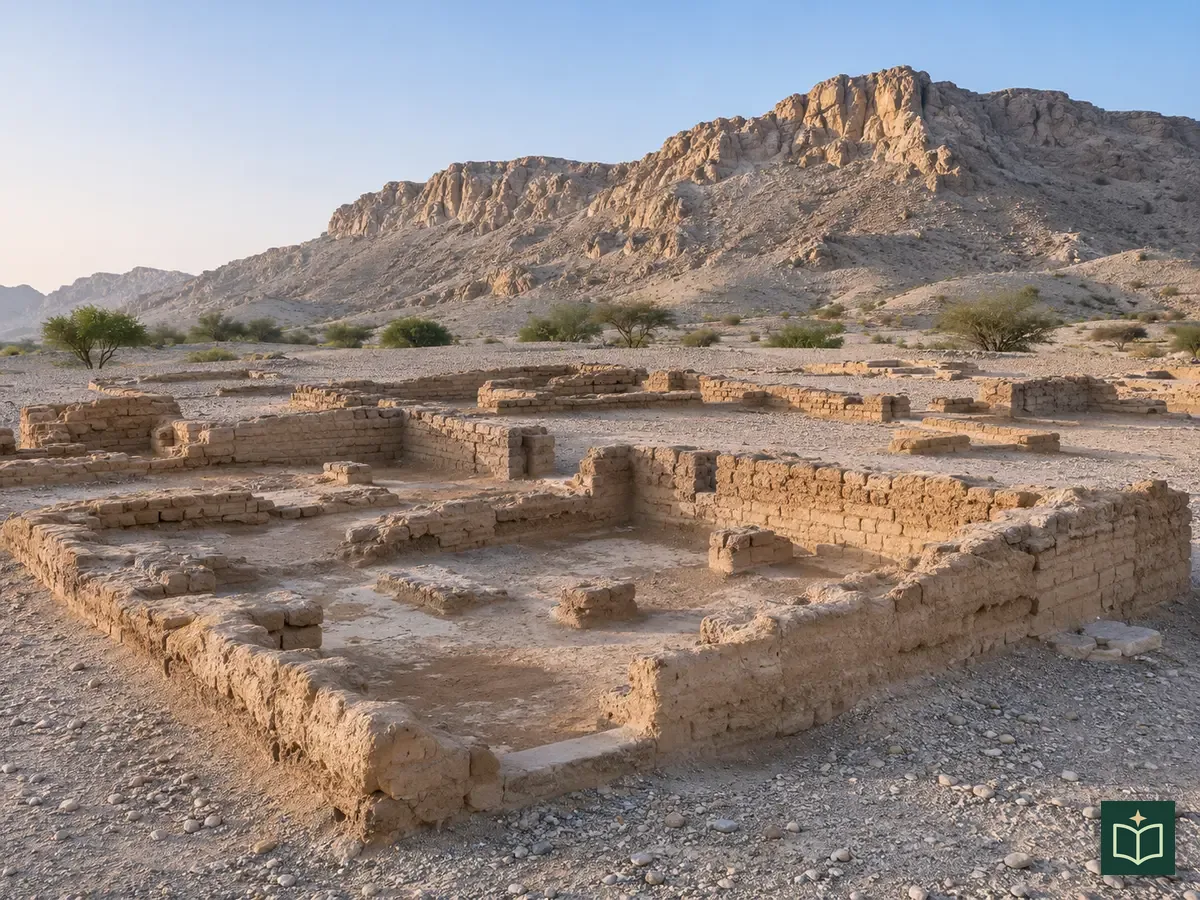
Mleiha lies on a gravel plain in the central region of the emirate of Sharjah, roughly between the Hajar mountains and the coast. Today it looks like quiet desert edged by low hills, but the area has attracted people for a very long time. Groundwater close to the surface made farming possible, and the plain sits on natural routes between the Gulf coast, the mountains and the Gulf of Oman. Archaeologists have worked here since the 1970s and 1980s, uncovering layers that range from Stone Age tools on nearby ridges to tombs, houses and forts of the late pre-Islamic period.
A very deep past
The surrounding landscape is famous in prehistory. At Jebel Faya, a limestone ridge close to Mleiha, excavations uncovered stone tools that researchers dated to around 125,000 years ago, published in 2011. Those finds feed a wider debate about when and by which routes early modern humans left Africa and moved across Arabia. Later periods are also present: a Bronze Age stone tomb of the Umm an-Nar type and Iron Age remains show that people kept returning. The site therefore offers an unusually long sequence of human activity in one small area of the UAE. Few places in the region preserve such a long and layered human story.
The town at its height
Mleiha is best known for its flourishing between roughly the third century BCE and the third century CE. In this period the settlement had mudbrick houses, workshops and at least one substantial fortified building with corner towers. Pottery, glass and other imported objects show contacts with Mesopotamia, the Mediterranean world, Persia and South Arabia. Its people farmed, kept animals and took part in trade that likely included goods moving by caravan to and from coastal ports such as ed-Dur, in today’s Umm al-Quwain, which was active in the same era. Together, the inland town and the coastal port formed part of a connected regional economy with links far beyond Arabia.
Coins with a local name
One of Mleiha’s most important finds is evidence of minting. Archaeologists recovered coin moulds and coins of a local type, modelled on the silver coins of Alexander the Great but carrying a ruler’s name, often read as Abi’el, written in Aramaic script. Many Hellenistic-style imitations circulated in Arabia after Alexander’s conquests, but finding the tools of production on site shows that coins were actually made here. That implies an authority able to control metal, guarantee value and run a local economy, rather than a small village relying only on barter. It also shows that the town’s rulers wanted to display their own identity, borrowing a famous foreign design but adding their own name.
Horses and camels in the graves
Burials at Mleiha include the remains of horses and camels, sometimes laid out with care and occasionally with harness fittings. Such burials suggest that these animals held high status, perhaps linked to warfare, transport or the prestige of their owners. Large tomb structures with stone foundations also point to social hierarchy. Interpretation needs caution: we have no long written texts from Mleiha explaining its beliefs or politics, so archaeologists reconstruct them from objects, building plans and comparison with sites elsewhere in Arabia. Some identifications, including the reading of names on coins, continue to be refined. New techniques, such as isotope analysis, may reveal more.
Visiting and why it matters
Today the area is presented to the public through an archaeological centre and protected sites, and the wider Faya landscape has received international recognition for its prehistoric record. For residents of the UAE, Mleiha challenges the idea that the region’s history begins with pearling or oil. It shows an inland town that was connected, literate enough to stamp names on coins and wealthy enough to build forts and elaborate graves. As excavations continue, the site is helping to fill a long gap between the Bronze Age world of Magan and the arrival of Islam in the seventh century. It remains a work in progress.
Sources & further reading
Figures are rounded and widely published; check the linked organisations for the latest editions. These organisations do not endorse this website.