An ancient harvest
The warm, shallow waters of the Arabian Gulf hold extensive oyster beds, and pearls from them have been prized for thousands of years. Pearls have been found at Neolithic sites in the region, and later writers from the Roman world to medieval travellers praised Gulf pearls. Ibn Battuta described pearl divers in the fourteenth century. By the nineteenth and early twentieth centuries, pearling was the backbone of the coastal economies of what are now Bahrain, Qatar, Kuwait, the UAE and parts of Saudi Arabia, employing a large share of the male population every summer. Coastal towns grew up around the trade, its boats and its markets.
How a dive worked
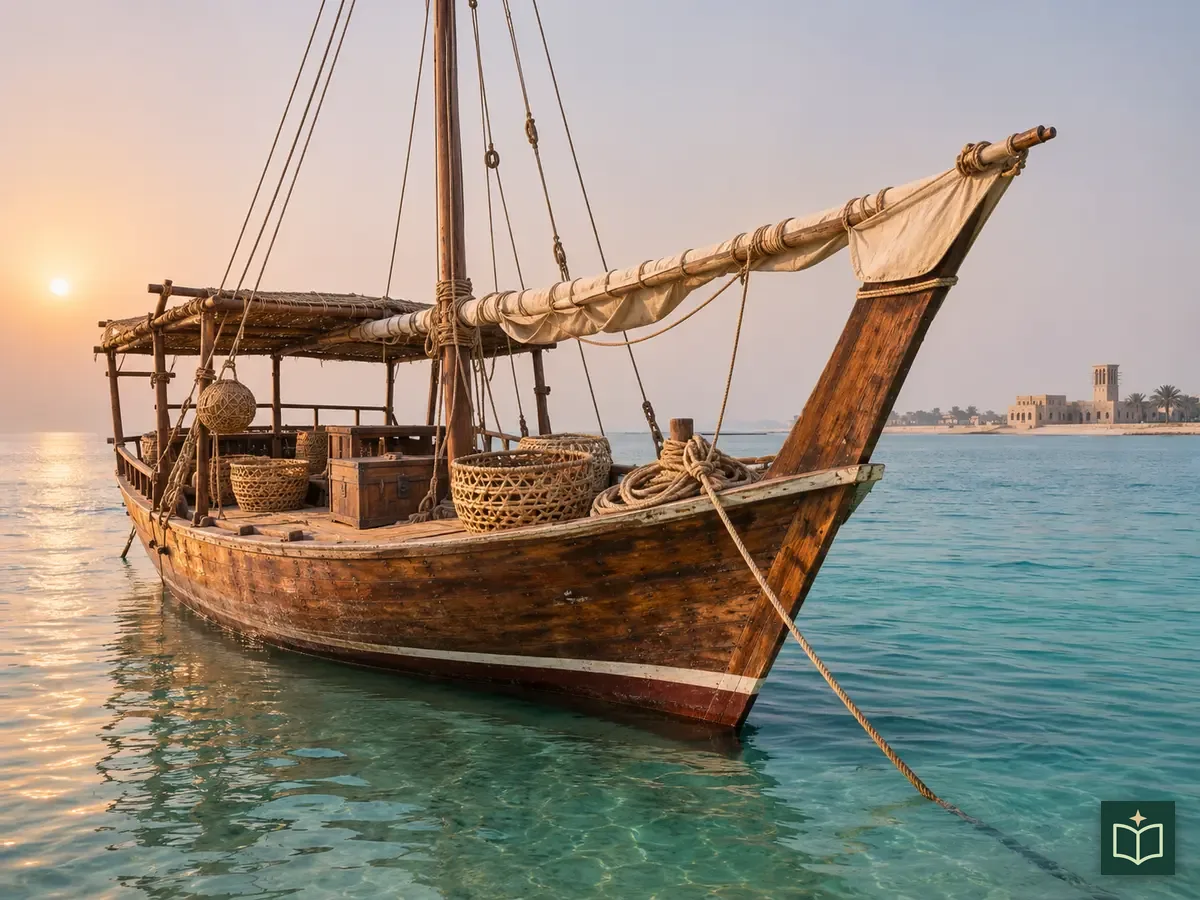
Each boat carried a crew under a captain, the nakhuda. The divers, called ghais, wore a clip on the nose and leather finger guards, and descended on a rope weighted with a stone. On the seabed they gathered oysters into a basket hung around the neck, usually for around a minute, before tugging the rope. A partner on deck, the saib, then hauled them up quickly. Divers repeated this many times a day, resting between rounds. Oysters were piled on deck and opened, often the next morning, under the captain’s watchful eye. Anything of value was recorded and stored securely until the boat returned to port.
A season at sea
The main season ran through the hottest months, roughly from June to September, when the water was warm enough for long hours of diving. Fleets left together and stayed out for weeks, returning to shore only for supplies. Food was simple, usually rice, dates, fish and coffee, and divers ate little before diving. The work was dangerous: ear damage, exhaustion, jellyfish and sharks were constant risks. The end of the season was celebrated on shore, and its departures and returns shaped songs, poetry and community traditions still performed today. Boat songs, led by a singer called the nahham, helped crews keep time while hauling and rowing.
A chain of credit
Pearling ran on debt. Before the season, captains advanced money to crews to support their families, and merchants advanced funds to captains for boats and supplies. Catches were then sold to pearl merchants, the tawawish, who graded the pearls and sold them on, often to traders in Bombay, from where they reached jewellers in Europe and elsewhere. If a season was poor, debts carried over, and in some cases they could pass to a diver’s heirs. Reforms in the twentieth century, including in Bahrain, tried to regulate these arrangements and protect divers. The arrangement gave security in good years but could trap families in bad ones.
Why the industry collapsed
Two blows came almost together. In Japan, techniques for culturing pearls by inserting a nucleus into oysters became commercial in the early twentieth century, producing round pearls in large numbers at lower cost. Then the Great Depression from 1929 cut demand for luxury goods in Europe and America. Prices for natural Gulf pearls fell sharply, and many families faced hardship. Within a generation, the discovery and export of oil transformed the region’s economies and offered other work. By the mid-twentieth century, commercial pearl diving had largely ended. A trade that had lasted thousands of years disappeared in little more than a generation, leaving many skills to survive only in memory.
What survives
Pearling remains central to identity across the Gulf. In 2012 UNESCO inscribed Bahrain’s Pearling, Testimony of an Island Economy, which includes oyster beds, merchants’ houses and the seashore of Muharraq. Museums in Dubai, Abu Dhabi, Doha and Kuwait tell the story, and traditional dhow races and heritage dives keep skills alive. The history is also a lesson in economic risk: a whole region depended on a single natural product, and when technology and global demand changed, its main industry faded within a few decades. That memory helps explain the Gulf’s modern interest in diversification. Pearls taught the region how quickly fortunes can turn.
Sources & further reading
Figures are rounded and widely published; check the linked organisations for the latest editions. These organisations do not endorse this website.