Daylight at midnight
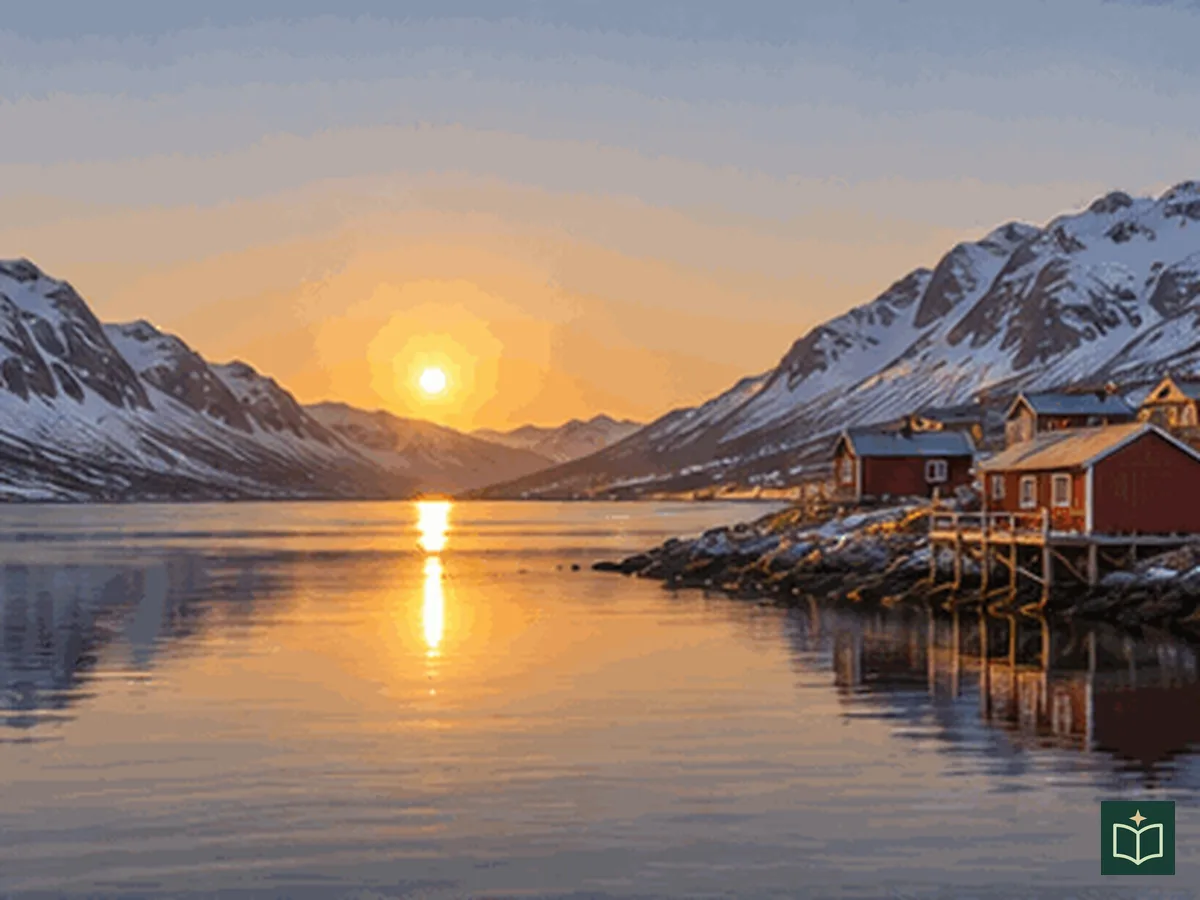
In the far north of Norway, Sweden, Finland, Russia, Alaska, Canada and Greenland, there are weeks in summer when the Sun circles the sky without setting. At midnight it hangs low above the northern horizon, then climbs again. In winter the same places pass weeks when it never rises. These are the midnight sun and the polar night. They occur beyond the Arctic Circle, at about 66.5 degrees north, and in the south beyond the Antarctic Circle. The phenomenon is a direct, visible consequence of the fact that Earth spins on a tilted axis while it orbits the Sun once a year.
The tilt that makes it happen
Earth’s axis leans about 23.4 degrees from upright relative to its orbit, and it keeps pointing in the same direction in space all year. Around the June solstice, the Northern Hemisphere is tipped towards the Sun. The boundary between day and night then reaches past the North Pole by 23.4 degrees, so every place north of about 66.5 degrees stays in sunlight through a full rotation. At the December solstice the arrangement reverses: the north is tipped away and those same latitudes remain in darkness, while Antarctica enjoys constant light. The polar circles are defined by this geometry, sitting 23.4 degrees from each pole.
Longer towards the pole
On the Arctic Circle itself, the Sun in theory stays up for just one day at midsummer and stays down for one day at midwinter. Move further north and the periods lengthen. In Tromsø, northern Norway, at almost 70 degrees north, the midnight sun lasts from about late May to late July, and the Sun does not rise from late November to mid-January. In Longyearbyen on Svalbard, at 78 degrees north, the Sun stays up continuously for around four months. At the North Pole there is roughly one long day and one long night a year, each lasting close to six months.
Why summer wins slightly
Midnight sun lasts a little longer than polar night, and it can be seen slightly south of the Arctic Circle. Two effects explain this. The atmosphere bends sunlight, lifting the Sun’s image by about half a degree near the horizon, so it appears visible when it is technically just below. And the Sun is a disc, not a point: day begins when its upper edge appears. Polar night is also rarely pitch black. For much of it the Sun lies only a few degrees below the horizon, giving hours of blue twilight around midday. Only nearer the poles, and in midwinter, does true darkness last around the clock.
A comparison from the Gulf
In the UAE, at about 25 degrees north, the tilt has a much gentler effect. Around the June solstice, Dubai gets roughly 13 hours and 40 minutes of daylight; in December, about 10 and a half hours. The difference between the longest and shortest days is barely three hours. On the equator, days and nights stay close to 12 hours all year. In Tromsø, the same planetary tilt produces a swing from 24 hours of daylight to none at all. This contrast explains why prayer and fasting times, which are tied to sunrise and sunset, require special conventions for communities living at very high latitudes.
Living with extremes
Millions of people live in the far north, including in cities north of the Arctic Circle such as Murmansk, Norilsk and Tromsø. The light cycle shapes daily life. In summer, plants grow quickly in the continuous light, animals breed and people often stay active late into the night; blackout blinds help with sleep. In winter, some residents experience low mood and disrupted body clocks, and towns use bright artificial lighting to compensate. The return of the Sun is celebrated in many northern communities. For scientists, the long polar night offers uninterrupted darkness for observing auroras, and the long day provides around-the-clock sunlight for studying ice, ecosystems and the atmosphere.
Sources & further reading
Figures are rounded and widely published; check the linked organisations for the latest editions. These organisations do not endorse this website.