Wind transfers energy
Almost all ocean waves are made by wind. When air moves across calm water, small variations in pressure and friction raise tiny ripples. Those ripples give the wind something to push against, so they grow into wavelets, then into larger waves. Each wave carries energy taken from the air. What travels is mostly energy, not water: as a wave passes, water near the surface moves in roughly circular loops and ends up almost where it started. A floating bottle bobs up, forward, down and back. Only when waves reach shallow water or break does water move significantly towards the shore, carrying surfers and spray with it.
Three things set the size
Three factors determine how large wind waves become. The first is wind speed: stronger winds transfer energy faster. The second is duration, how long the wind blows. The third is fetch, the distance of open water over which the wind blows in a constant direction. A strong wind blowing briefly, or across a small lake, produces only choppy waves, however fierce it feels. Given enough time and fetch, waves reach a limit for that wind speed, a state oceanographers call a fully developed sea. The Southern Ocean, where westerly gales circle the globe with no land to stop them, produces the largest regular waves on Earth.
From sea to swell
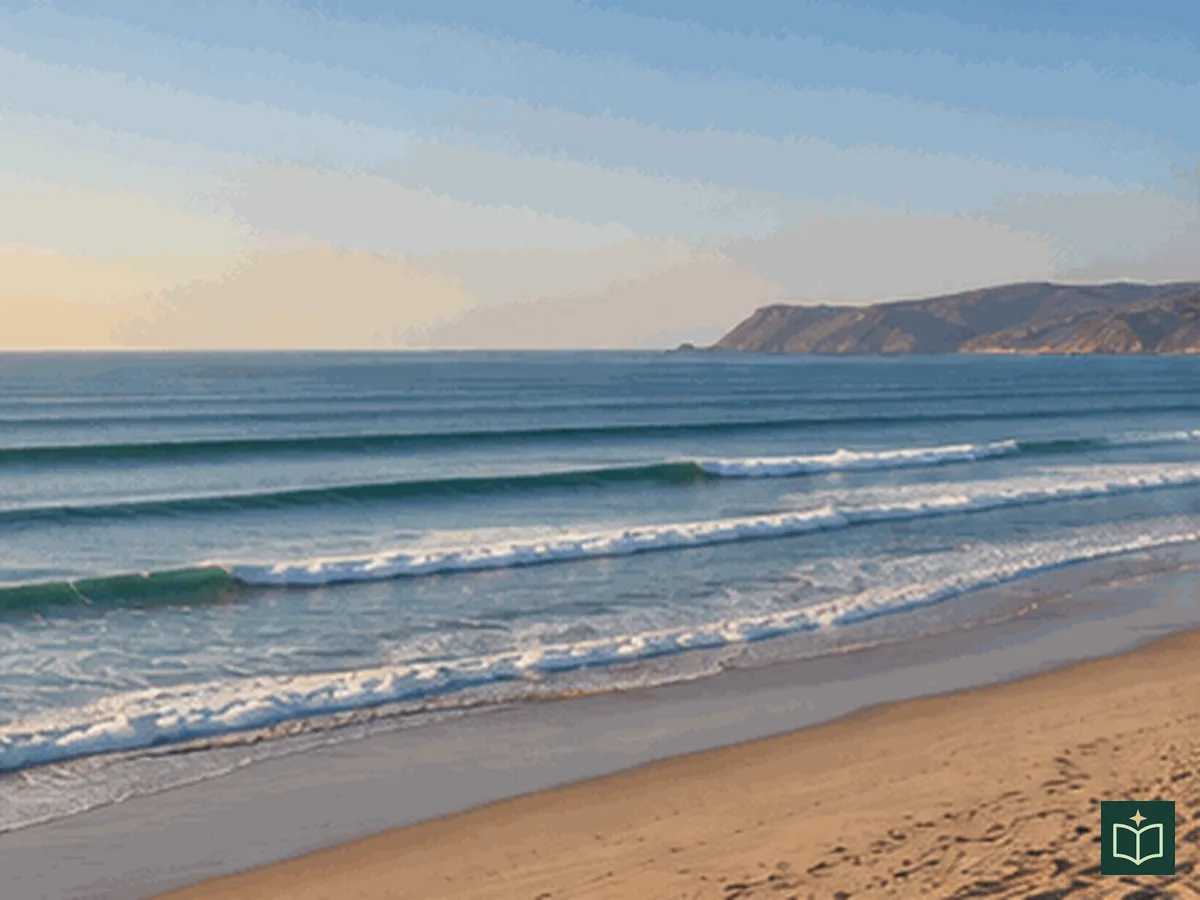
Inside a storm, the sea is a confused mix of waves of many sizes and directions. As waves travel away from the wind that made them, they begin to sort themselves out. Longer waves travel faster in deep water, so they outrun shorter ones, while small, choppy waves lose energy quickly. What remains is swell: smooth, regular waves with long intervals between crests, known as the period. Swell can cross whole oceans. In the 1960s, oceanographer Walter Munk and colleagues tracked swell generated by storms near Antarctica all the way across the Pacific to Alaska, more than 10,000 kilometres away.
Doing the arithmetic
In deep water, wave speed depends on the period. Each crest moves at about 1.56 metres per second for every second of period. A swell with a 15-second period therefore travels at around 23 metres per second, or roughly 84 kilometres per hour. The energy of a group of waves moves at half that speed, about 42 kilometres per hour. At that rate a swell takes roughly four days to cover 4,000 kilometres. That is why forecasters can warn surfers and harbours days in advance: once satellites and buoys detect a distant storm’s waves, their arrival time can be calculated with surprising accuracy.
Waves in the Gulf and the Arabian Sea
The Gulf shows how limited fetch shapes the sea. It is shallow and enclosed, so most of the time waves are short and gentle. When a strong shamal wind blows down its length from the north-west, the long fetch can build rough seas several metres high, disrupting shipping and closing beaches along the UAE coast. The Arabian Sea is different. During the south-west monsoon, from about June to September, persistent winds blowing across a wide stretch of ocean send powerful swell onto the coasts of Oman, India and Pakistan, closing many small harbours and making those months unsuitable for traditional fishing boats.
Why waves matter
Waves shape coastlines, building beaches in calm seasons and stripping them in storms. They determine safe routes and schedules for ships, the design of offshore oil and gas platforms, and the placement of breakwaters and ports. Forecasting waves helps prevent drownings from rip currents and protects coastal communities during storms. The highest wave height measured by a buoy, around 19 metres, was recorded in the North Atlantic in 2013, a reminder of how much energy wind can pour into the sea. Scientists watch long-term wave records too, because changes in storm tracks and winds may alter where the biggest waves strike.
Sources & further reading
Figures are rounded and widely published; check the linked organisations for the latest editions. These organisations do not endorse this website.