Breaking without overload
Bend a paperclip back and forth and it snaps, even though a single bend does no harm. That is fatigue: damage that builds up under repeated loading. Engineers estimate that it causes a large share of mechanical failures in machines and structures. Its danger lies in the numbers. A component can be loaded far below the stress needed to break it in one go, perhaps a third or half of its strength, and still fail after thousands or millions of repetitions. Aircraft wings flex in turbulence, bridges vibrate under traffic, crankshafts turn millions of times and pressure vessels fill and empty. Each cycle adds a little damage.
How the crack grows
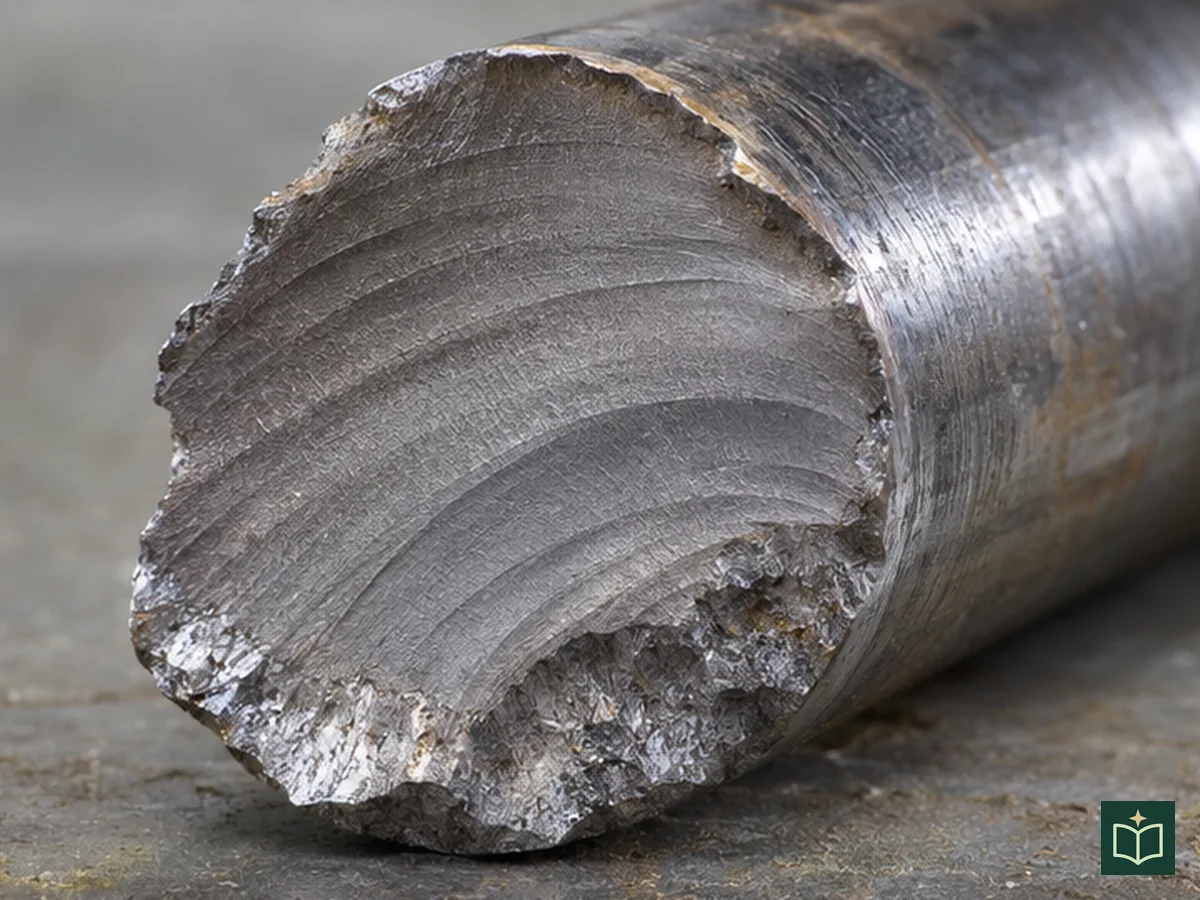
Fatigue begins at a point where stress concentrates: a rivet hole, a sharp corner, a weld, a machining mark or a speck of corrosion. Tiny slips in the metal’s crystals there gradually open a microscopic crack. With every subsequent cycle the crack tip advances a minute distance, sometimes less than a micrometre. Under a microscope the fracture surface shows fine striations, one per cycle, and to the eye it often displays curved beach marks where loading changed. The crack can grow unnoticed for most of a part’s life. When the remaining sound metal becomes too small to carry the load, the final fracture is sudden and brittle-looking.
Railways and the S-N curve
Fatigue first became a public concern on the railways. In 1842 a locomotive axle broke near Versailles in France, derailing a train and killing dozens of passengers. Engineers puzzled over why sturdy iron axles cracked in service. In the 1850s and 1860s the German railway engineer August Wöhler tested axles under repeated rotating loads and plotted stress against the number of cycles to failure, now called an S-N curve. He found that many steels have an endurance limit, a stress below which they seem to survive indefinitely. Aluminium alloys, by contrast, have no clear limit, so they eventually fail under any repeated load.
The lesson of the Comet
The de Havilland Comet, the world’s first jet airliner, entered service in 1952. Its pressurised cabin let passengers fly high above the weather, but it also meant the fuselage expanded and relaxed like a balloon on every flight. In January 1954 a Comet broke up over the Mediterranean near Elba, and in April another fell near Naples. Investigators placed a whole Comet fuselage in a water tank at Farnborough in England and pressurised it again and again. After about 3,000 cycles it split open, with cracking from the corner of a cutout. Wreckage recovered from the sea showed a similar crack near a roof window.
Designing for cracks
The Comet inquiries changed aircraft engineering. Designers learned that stress concentrates sharply at the corners of openings, and that tests must reproduce real loading cycles. Later airliners used rounded windows and thicker skins around cutouts, and adopted fail-safe structures in which a crack in one part cannot bring down the whole. Today’s approach, damage tolerance, assumes cracks exist and schedules inspections to find them before they grow dangerous. Cycles, not hours, set the timetable. A short-haul jet making six flights a day for 25 years experiences about 54,750 pressurisation cycles; a long-haul jet making one or two daily flights builds up roughly 13,000 to 18,000.
Fatigue today
Fatigue remains a central concern wherever metal is loaded repeatedly. Engineers fight it by smoothing corners, polishing surfaces and shot-peening them with tiny balls to squeeze the surface into compression, which resists crack opening. Inspectors use ultrasound, eddy currents and dye penetrants to find cracks invisible to the eye. Accidents still occur: in 1988 an ageing Boeing 737 in Hawaii lost a section of its roof after many small fatigue cracks linked up, prompting stricter programmes for older aircraft. For bridges, wind turbines, offshore platforms and pipelines alike, the principle is the same. Design life is counted in cycles, and cracks are expected, measured and managed.
Sources & further reading
Figures are rounded and widely published; check the linked organisations for the latest editions. These organisations do not endorse this website.