A problem of dilution
Most metal ores are mostly rock. A typical copper ore today contains well under 1% copper, locked in mineral grains scattered through worthless quartz, feldspar and clay. Smelting all that rock directly would waste enormous amounts of energy. Mines therefore first make a concentrate, a powder rich in the valuable mineral, to send to smelters. For heavy minerals such as gold or tin oxide, gravity methods like panning can work. But copper, lead and zinc sulphides are often only slightly heavier than waste rock and very finely grained. Froth flotation, developed in the early twentieth century, solved that problem and made huge low-grade deposits worth mining.
Making grains hate water
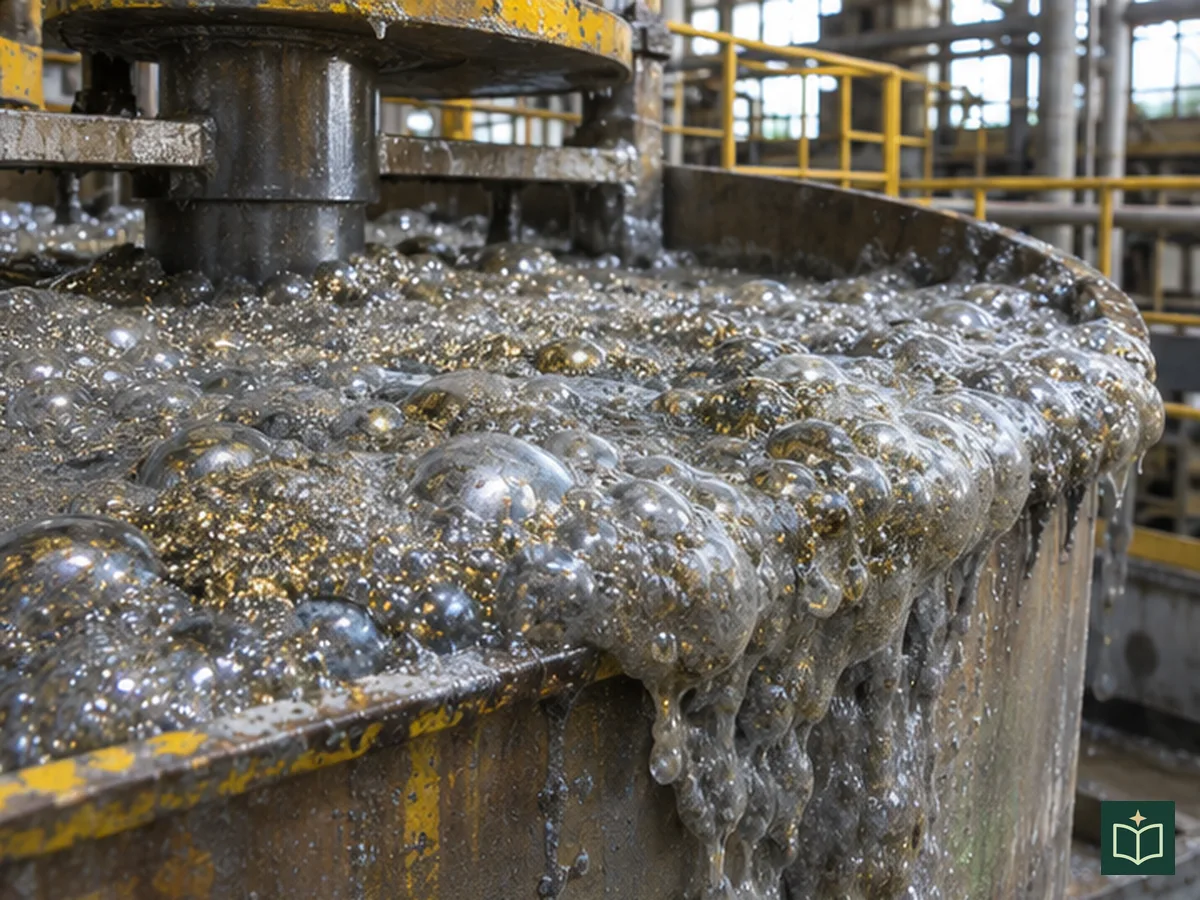
Flotation exploits surface chemistry rather than weight. Ore is ground to a fine powder, roughly a tenth of a millimetre, and mixed with water into a slurry. Chemicals called collectors, such as xanthates, attach selectively to sulphide mineral surfaces and leave them coated with an oily, water-repellent layer. Waste minerals stay wettable. When air is blown into the slurry, water-repellent grains stick to bubbles and rise, while wetted rock particles remain below. A frother, such as pine oil or a synthetic alcohol, keeps the bubbles small and stable enough to form a thick froth, which overflows the tank and is skimmed off as concentrate.
Choosing what floats
Real ores contain several valuable minerals, plus pyrite, an iron sulphide usually not wanted. Operators control which grains float by adjusting conditions. Lime raises the slurry’s alkalinity and stops pyrite floating. Depressants prevent particular minerals from attaching to bubbles, while activators help others to do so: a small dose of copper sulphate lets zinc sulphide pick up collector. In a lead-zinc mine, lead may be floated first, then zinc in a second circuit. Molybdenite is often separated from copper concentrate the same way. Flotation plants run as chains of cells, with rougher stages to catch most of the mineral and cleaner stages to upgrade it.
The numbers at a mine
Flotation transforms the scale of the problem. Suppose a mine processes 80,000 tonnes of ore a day at 0.6% copper. That ore contains 480 tonnes of copper. If flotation recovers 88% of it, 422 tonnes of copper report to the froth. At a concentrate grade of 28% copper, that copper is carried in about 1,509 tonnes of concentrate. More than 98% of the ore’s mass, some 78,500 tonnes, is left behind as tailings, a fine wet waste stored in dams. The smelter, meanwhile, needs to process only about 1,500 tonnes a day instead of 80,000. That reduction is why flotation underpins modern copper supply.
From oily rags to factories
Observations that oil attracts sulphide minerals go back to the nineteenth century, and an American, Carrie Everson, patented an oil-based separation method in 1886. The breakthrough came in the early 1900s at Broken Hill in Australia, where vast heaps of zinc-rich waste defied gravity methods. Engineers at the company Minerals Separation and rivals developed froth processes that used small amounts of oil and air bubbles, and recovered the zinc. Xanthate collectors, introduced in the 1920s, made flotation far more selective and cheap. Within a few decades flotation had spread across the world’s mines, and today it handles billions of tonnes of ore each year.
Beyond the mine
Flotation’s principle reaches well beyond metals. Phosphate rock for fertiliser, coal, potash and lithium minerals are all upgraded by flotation. Paper recyclers float ink particles off pulped paper, and water treatment plants, including some in the Gulf’s desalination systems, use dissolved air flotation to lift algae and oil from seawater before it reaches membranes. The method also brings challenges. Tailings dams must be engineered and monitored carefully, because failures can be catastrophic, and flotation chemicals and water use need managing. Researchers are working on coarser-particle flotation and recycling of process water to cut energy and waste as ore grades continue to fall.
Sources & further reading
- Britannica · Mineral processing ↗
- Britannica · Copper processing ↗
- USGS · Copper statistics and information ↗
Figures are rounded and widely published; check the linked organisations for the latest editions. These organisations do not endorse this website.