A strange metal
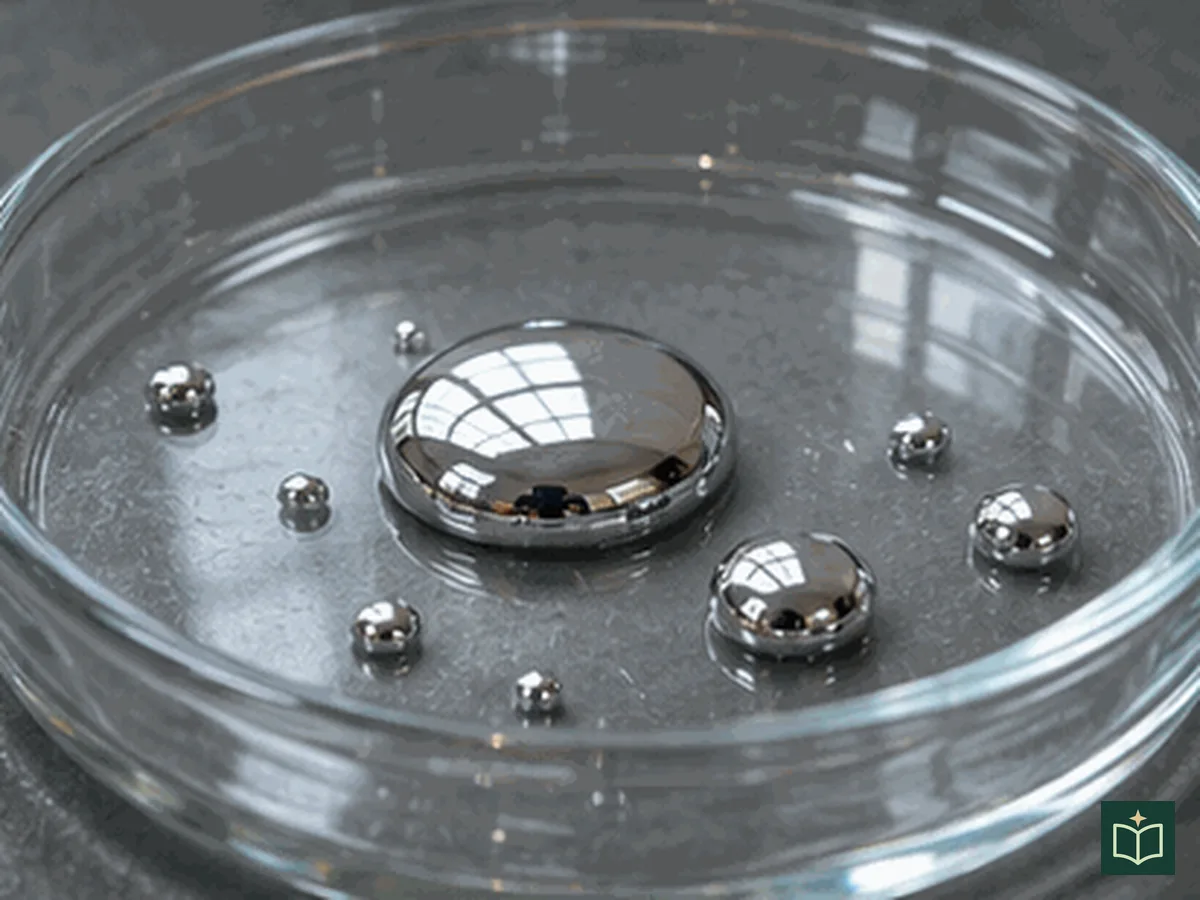
Metals are usually solid because their atoms share a sea of loosely held outer electrons that binds them tightly together. Mercury is the exception. It melts at about −38.8 °C and boils at about 357 °C, so on any ordinary day it is a heavy, shining liquid. Two other metals come close: caesium melts at about 28 °C and gallium at about 30 °C, so both would be liquid on a summer afternoon in the Gulf. But at a standard room temperature of 20 to 25 °C, mercury is the only metal that pours. It is also dense, about 13.5 times heavier than water, so steel bolts float on it.
Why the electrons matter
The explanation lies in mercury’s outer electrons. Each atom has a completely filled outer shell, with two electrons in its 6s orbital, a stable arrangement that makes it reluctant to share. Mercury is also heavy, with 80 protons, and its innermost electrons travel at a large fraction of the speed of light. Einstein’s relativity says such fast electrons behave as if they are heavier, which draws the 6s orbital closer to the nucleus and holds those electrons even more tightly. With little to contribute to the shared electron sea, mercury atoms bond weakly, almost like the atoms of a noble gas such as xenon.
Relativity melts a metal
In 2013 researchers tested this idea with computer simulations of mercury’s melting point. When they switched off relativistic effects in the calculations, mercury became a solid that melted roughly 100 degrees higher, well above room temperature. When the effects were switched on, the calculated melting point came close to the measured −38.8 °C. The same physics helps explain why gold, mercury’s neighbour on the periodic table, is yellow rather than silvery. It is one of the clearest everyday examples of relativity changing chemistry. Without it, thermometers, barometers and old dental fillings would have looked very different, and mercury would sit on a shelf as a soft grey solid.
Instruments built on mercury
Mercury’s heaviness and steady expansion made it ideal for measurement. In 1643 Evangelista Torricelli and Vincenzo Viviani filled a glass tube with mercury, inverted it in a dish and found that air pressure held up a column about 760 millimetres high, the first barometer. Water, about 13.5 times less dense, would need a column of roughly 10.3 metres. That is why pressure is still quoted in millimetres of mercury, the unit used for blood pressure. Daniel Fahrenheit built mercury thermometers in the early eighteenth century. It served in switches, while its vapour, energised by current, emits ultraviolet light that phosphors turn into visible fluorescent light.
A toxic legacy
Mercury’s usefulness came at a cost. Liquid mercury is poorly absorbed if swallowed, but its vapour is readily breathed in and damages the brain, nerves and kidneys. In water, bacteria convert mercury into methylmercury, which builds up through food chains in fish. In the 1950s, a chemical factory at Minamata, Japan, released mercury into the bay; thousands of people who ate local fish suffered severe neurological harm, now called Minamata disease. Mercury is also released by burning coal and, above all, by small-scale gold mining, where it is used to capture gold. The World Health Organization ranks mercury among the chemicals of greatest public health concern.
The treaty phasing it out
The Minamata Convention on Mercury, adopted in 2013 and in force since 2017, commits its parties to cut mercury use and emissions. It banned new mercury mines, set phase-out dates for the manufacture, import and export of many mercury-added products, including most thermometers, blood pressure gauges, batteries, switches and several types of lamp, and later meetings added more fluorescent lamps to the list. Dental amalgam is being phased down rather than banned outright. Digital thermometers and LED lighting have made most of these products easy to replace. Anyone who breaks an old mercury thermometer should ventilate the room and follow local guidance rather than vacuuming the droplets.
Sources & further reading
Figures are rounded and widely published; check the linked organisations for the latest editions. These organisations do not endorse this website.