Two ways into the ground
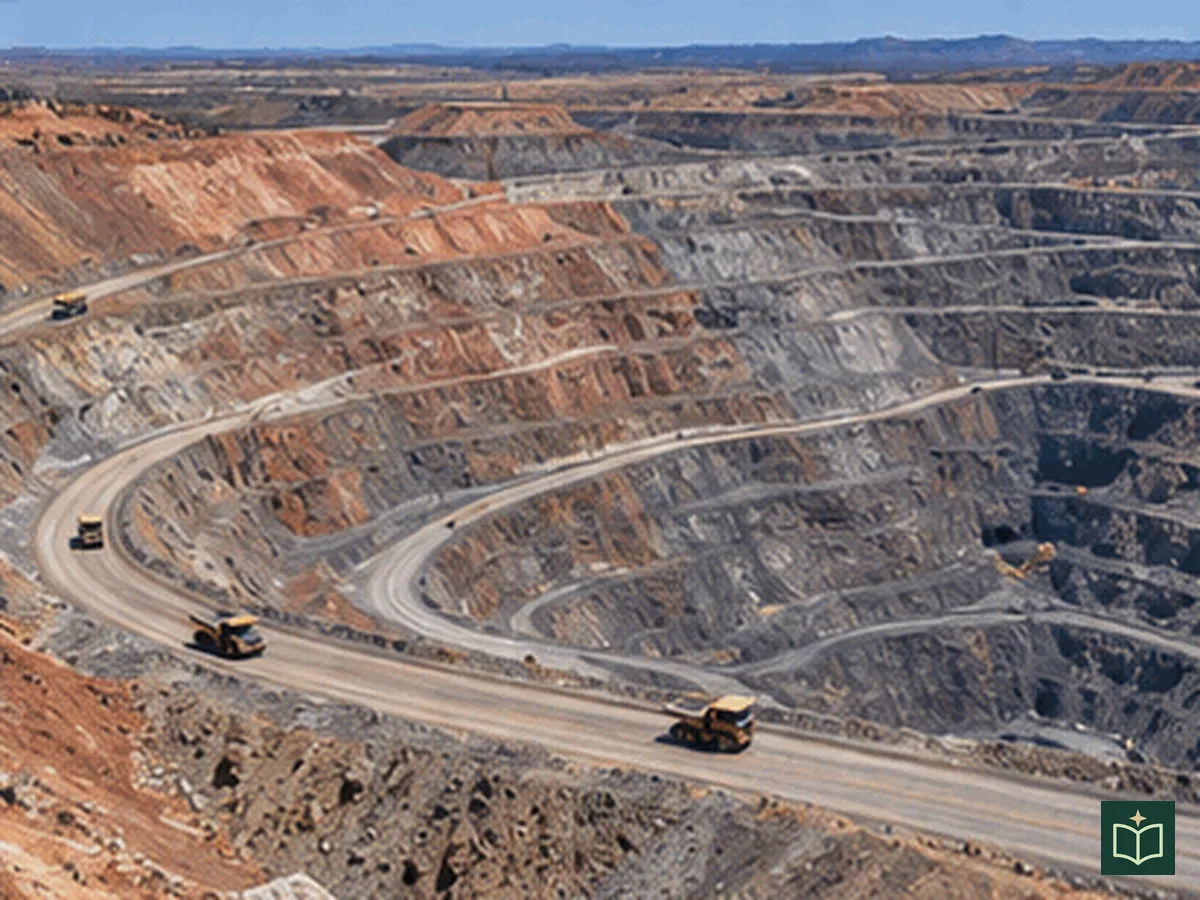
There are two broad ways to reach an ore body. Open-pit mining removes everything from the surface downward, cutting a series of steps called benches. Holes are drilled and blasted, and huge shovels load the broken rock into haul trucks that can carry 300 tonnes or more. Underground mining instead reaches the ore through shafts or sloping tunnels, called declines, and extracts it with less disturbance of the rock above. Most of the world’s copper, iron ore and much of its gold comes from open pits, while many rich, narrow or deep deposits are mined underground. Quarries for aggregate, such as those in the Hajar Mountains, are simple open pits.
The strip ratio
An open pit cannot only take ore. To keep the walls stable, it must slope outward, so the deeper it goes, the wider it gets and the more barren rock, or overburden, must be removed. The strip ratio measures this: tonnes of waste moved for each tonne of ore. A pit that moves 40 million tonnes of waste to reach 10 million tonnes of ore has a strip ratio of four to one. Ratios rise as a pit deepens. Low-grade ore near the surface suits open pits; rich ore far down, or in thin veins and steep layers, usually favours underground methods that follow the ore and leave most waste in place.
A simple break-even
A worked example, with round illustrative numbers, shows how miners compare the two. Suppose moving any tonne of rock in the pit costs AED 10, whether ore or waste, and mining the same ore underground costs AED 50 a tonne with little waste. At a strip ratio of s, each tonne of ore from the pit costs 10 times one plus s. At s equals four, that is AED 50, the same as underground. Below four, the pit wins; above it, tunnelling is cheaper. If processed ore were worth AED 100 a tonne, the pit could in principle carry up to nine tonnes of waste per tonne of ore before losing money.
Block caving: underground at pit scale
Traditional underground methods, such as cut-and-fill or stoping, extract ore in carefully supported rooms and can be slow and costly. Block caving brings underground mining closer to open-pit scale. Engineers dig a level of tunnels beneath a large, low-grade ore body and blast an undercut. The unsupported rock above then fractures and collapses under its own weight, and the broken ore flows down into drawpoints, where loaders collect it. As ore is drawn out, the cave climbs upward, sometimes for hundreds of metres. The method suits big, uniform deposits, needs years of development before production, and often leaves a crater-like subsidence zone at the surface.
When a pit goes underground
Many of the largest mines eventually switch methods. Chuquicamata in Chile, one of the world’s biggest copper pits, began moving production to an underground block cave in 2019 after more than a century of open-pit mining. Grasberg in Indonesia made a similar transition around the same time. Both followed the same logic: the pits had become so deep that removing more waste cost more than tunnelling beneath them. Transitions are complex and expensive, because the underground mine must be built while the pit still operates, and output can dip for years. Some mines run both methods side by side for a long period.
Beyond cost
Cost per tonne is not the only factor. Open pits recover more of the ore and are generally safer, with no risk of being trapped underground, but they leave large holes, waste dumps and a bigger footprint on the landscape and water. Underground mines disturb less land but face ventilation, heat, rock stress and ground-support challenges, and need more skilled labour. Permits, nearby towns, groundwater, energy use and closure plans all shape the decision. Increasingly, automation is blurring the line, with driverless trucks in pits and remotely operated loaders underground. The best method for a deposit can also change as prices, technology and knowledge improve.
Sources & further reading
Figures are rounded and widely published; check the linked organisations for the latest editions. These organisations do not endorse this website.