The hottest job in the engine
A jet engine compresses air, burns fuel in it and expands the hot gas through a turbine that drives the compressor and fan. The hotter the gas entering the turbine, the more work and thrust each kilogram of air gives, so engine designers have pushed temperatures ever higher. In modern engines, gas reaching the first row of turbine blades can exceed 1,500 °C. Those blades spin thousands of times a minute, and centrifugal force pulls on each one with a load of several tonnes. They must survive this for thousands of hours. Ordinary steels would soften and stretch within minutes, which is why turbines rely on nickel superalloys.
What makes a superalloy
A nickel superalloy is mostly nickel with around ten other elements, such as chromium, cobalt, aluminium, titanium, tantalum, tungsten and rhenium. Its secret is a two-part microstructure. A matrix of nickel-rich crystal is filled with tiny cubes of a compound, nickel aluminide, making up well over half the volume. These cubes block the movement of defects that let metal deform, and unusually they grow stronger as temperature rises, up to about 800 °C. The main enemy is creep, the slow stretching of metal under steady load at high temperature. A blade that creeps a fraction of a millimetre can rub the engine casing, so resisting creep is everything.
One crystal, no weak joints
Most metals are made of countless small crystals, or grains, and at high temperature the boundaries between them are where creep and cracking start. Engineers first cast blades with long grains aligned along the blade, a method called directional solidification, introduced in the late 1960s. Then they removed the boundaries altogether. In single-crystal casting, molten alloy in a ceramic mould is slowly withdrawn from a furnace so that it solidifies from one end, and a spiral-shaped passage called a grain selector lets only one crystal grow into the blade. Without grain boundaries, alloy designers could drop elements added to strengthen them, raising the melting point further.
Cooling and coatings
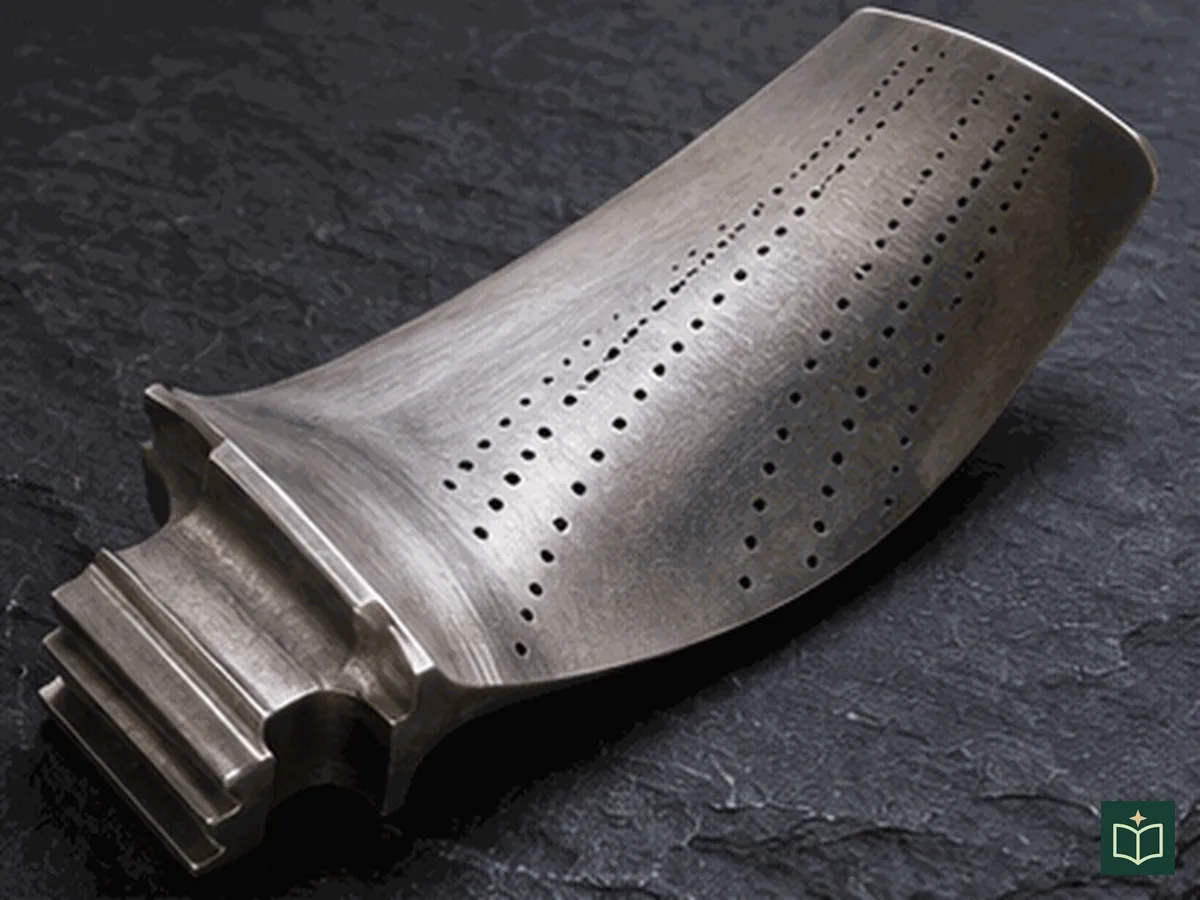
Even so, the alloy melts at roughly 1,300 to 1,350 °C, below the gas around it. The answer is cooling. Air bled from the compressor, still several hundred degrees but far cooler than the combustion gas, is piped into hollow blades through winding internal channels. It then escapes through hundreds of tiny holes drilled by laser or electrical discharge, forming a thin protective film of cooler air over the surface. On top of the metal sits a thermal barrier coating, a layer of zirconia ceramic a fraction of a millimetre thick, bonded by a metallic layer rich in aluminium that resists oxidation.
How close to the limit
These measures keep the metal far cooler than the gas, but still extraordinarily hot. Suppose the gas is at 1,600 °C and the blade metal is held at 1,100 °C, a gap of 500 degrees achieved by cooling and coating. If the alloy melts at 1,350 °C, the metal is working at about 85% of its melting temperature measured on the absolute scale, 1,373 kelvin against 1,623 kelvin. Few structural materials anywhere carry heavy loads that close to melting. That is why blades are inspected regularly with borescopes, small cameras pushed into the engine, and replaced on a schedule rather than run until they fail.
Rhenium, ceramics and what comes next
Each generation of single-crystal alloy has squeezed out more temperature. Second- and third-generation alloys added rhenium, one of the rarest elements in Earth’s crust, at around 3% and then 6%, which makes them expensive and has prompted recycling of old blades. Later alloys added ruthenium. Engine makers are now introducing ceramic matrix composites, made of silicon carbide fibres in a silicon carbide matrix, into some hot parts; they are lighter and tolerate higher temperatures, though they are less tough than metal. Higher turbine temperatures mean lower fuel burn and emissions, so every gain in these materials matters for the cost and carbon footprint of flying.
Sources & further reading
Figures are rounded and widely published; check the linked organisations for the latest editions. These organisations do not endorse this website.