Trees in the tide
Mangroves are trees and shrubs that grow in the intertidal zone of tropical and subtropical coasts, where seawater floods them once or twice a day. Around 70 species are usually counted, drawn from different plant families that independently evolved ways to survive salt, heat and oxygen-poor mud. They occur in more than 100 countries, with the largest areas in Indonesia, Brazil, Australia and the Sundarbans of Bangladesh and India. On the Arabian Peninsula, mangroves grow along parts of the Gulf, Red Sea and Arabian Sea coasts, close to the northern limit of where the trees can survive, which makes these forests unusually hardy.
Living with salt
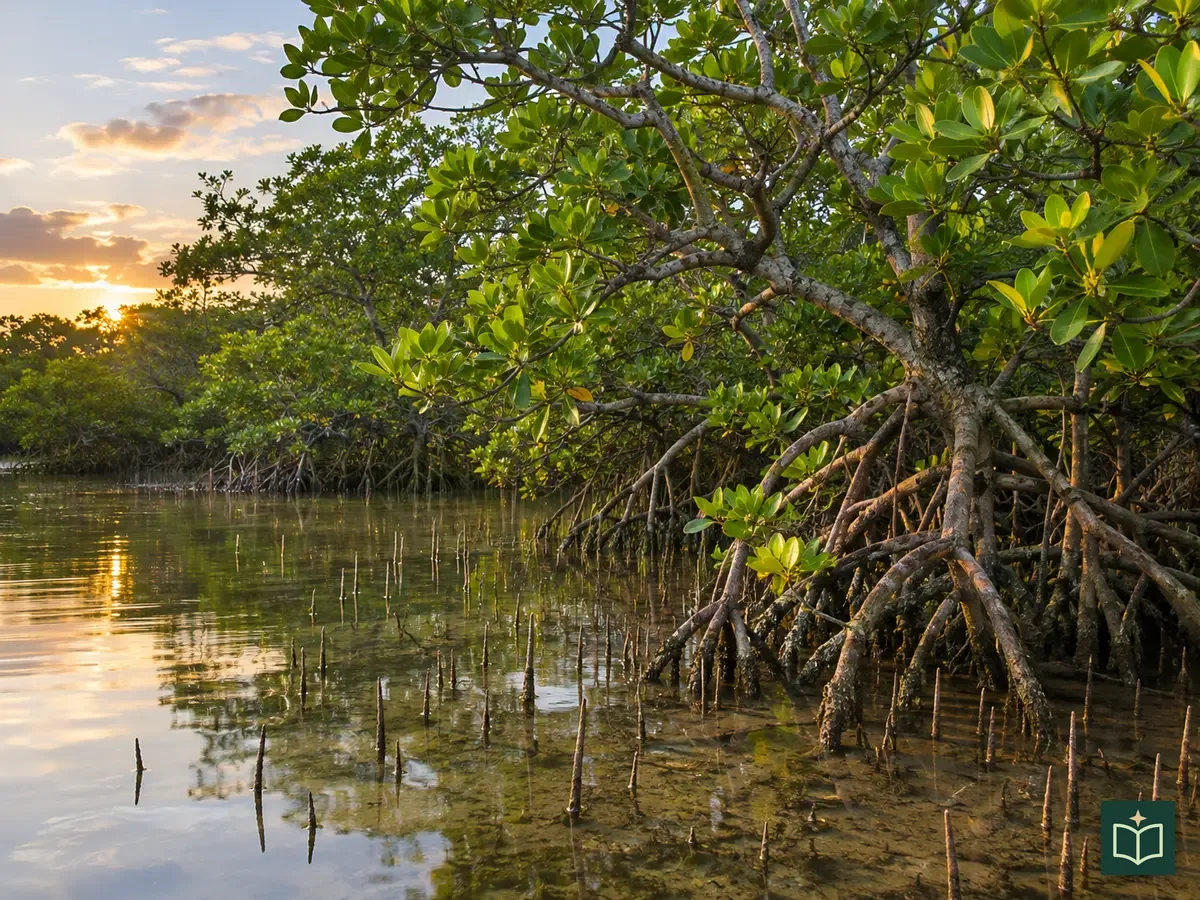
Seawater would kill most land plants, so mangroves use several strategies. Some species exclude most salt at the roots through a fine filtering process. Others, including the grey mangrove, Avicennia marina, also excrete excess salt through glands on their leaves, which can sometimes be seen as tiny white crystals. Because waterlogged mud contains little oxygen, many mangroves send up pneumatophores, pencil-like roots that poke above the surface and take in air. Others are braced by arching prop roots. Some species produce seedlings that begin growing while still attached to the parent tree, then drop into the water and float until they lodge in suitable mud.
The mangroves of the UAE
The grey mangrove is the dominant species in the UAE and is among the most tolerant of heat and salinity. Notable stands grow around Abu Dhabi, including the Eastern Mangroves and protected areas around Marawah and nearby islands, as well as at Ras Al Khor in Dubai, in Umm Al Quwain and at Khor Kalba on the east coast. They endure summer water temperatures and salinities that would stress mangroves in most other places. The UAE has set a goal of planting 100 million mangroves by 2030, combining nurseries, seeding trials and coastal restoration, and visitors can kayak through some of the forests on marked routes.
Carbon in the mud
Mangroves are part of what scientists call blue carbon, alongside seagrass meadows and salt marshes. Their trees capture carbon dioxide as they grow, but most of their carbon is stored in the waterlogged soil beneath them, where low oxygen slows decomposition. Over centuries, organic-rich sediment can accumulate to depths of several metres. Studies have found that mangroves can store several times more carbon per hectare than many tropical land forests, mainly because of this soil. When mangroves are cleared, for example for aquaculture ponds, much of that buried carbon can be released, which is why their protection features in many national climate plans.
Nurseries and natural defences
The tangled roots of mangroves slow the water and provide shelter for young fish, crabs and shrimp, making mangroves important nurseries for coastal fisheries. Birds use them for feeding and nesting, including herons, kingfishers and migrating shorebirds. Mangroves also reduce the energy of waves and can lower the height of storm surges, protecting coastlines from erosion. They are not a complete barrier against the largest tsunamis or cyclones, and the degree of protection depends on the width and health of the forest, but well-maintained mangrove belts can complement engineered sea defences while also providing habitat and shade. Some coastal projects now combine both approaches deliberately.
Loss and recovery
Globally, mangrove area declined significantly in the late twentieth century, as forests were cleared for shrimp farms, rice paddies, ports and housing. Losses have slowed in recent years and restoration efforts have grown, though planting does not always succeed. Experience shows that restoring the right tidal flow and choosing suitable locations matter more than the number of seedlings planted. Sea-level rise poses a further question: mangroves can keep pace with gradual rises by trapping sediment, but only if they have room to move inland. In the Gulf, coastal development can block that retreat, which makes planning for future shorelines especially important.
Sources & further reading
- NOAA Ocean Service · What is a mangrove forest? ↗
- Global Mangrove Watch ↗
- Environment Agency – Abu Dhabi ↗
Figures are rounded and widely published; check the linked organisations for the latest editions. These organisations do not endorse this website.