An archipelago off the Horn of Africa
Socotra is the largest of four main islands in an archipelago in the Arabian Sea, lying about 240 kilometres east of the Horn of Africa and roughly 380 kilometres south of the Arabian Peninsula. The archipelago belongs to Yemen. The main island is about 130 kilometres long and rises from coastal plains and limestone plateaus to the granite Haggeher Mountains, which reach around 1,500 metres. Its climate is hot and dry, shaped by the south-west monsoon, which brings strong winds in summer, and by the north-east monsoon in winter. UNESCO inscribed the archipelago on the World Heritage List in 2008.
How isolation shaped it
Socotra is a fragment of continental crust that was once joined to the Arabian Peninsula. As the Gulf of Aden began to open, roughly 20 to 30 million years ago, it became separated from the mainland. Plants and animals that remained, or that later arrived by wind, sea or birds, evolved in isolation. The islands’ varied terrain, from coast to mountain, and the stress of drought, heat and seasonal gales favoured unusual forms: swollen trunks that store water, umbrella-shaped crowns that shade the ground and reduce evaporation, and tough, leathery leaves. The result is one of the most distinctive floras on Earth.
Dragon’s blood and desert roses
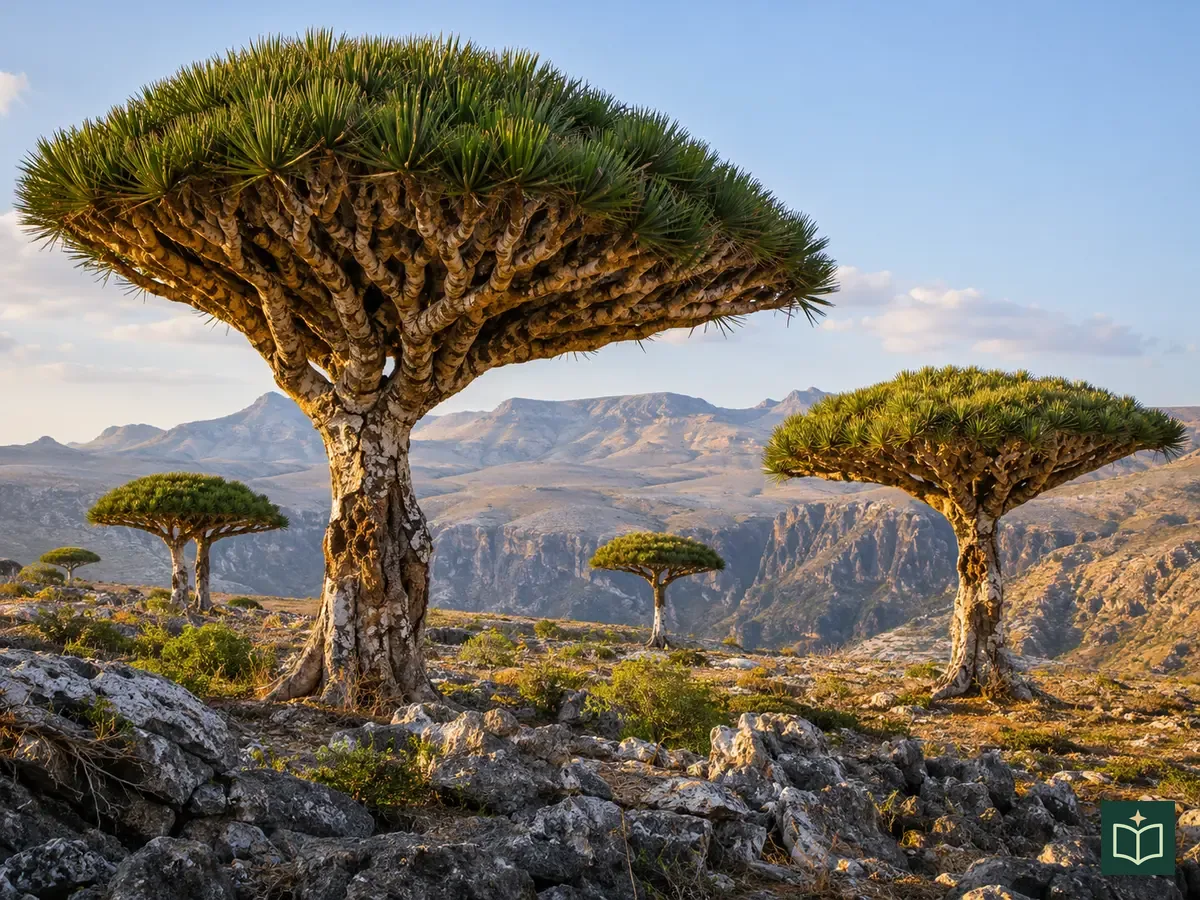
The best-known Socotran plant is the dragon’s blood tree, Dracaena cinnabari, whose dense, upturned canopy looks like an open umbrella. Its red resin has been traded since ancient times as a dye, varnish and medicine. The island also hosts a Socotran form of the desert rose, Adenium obesum, with a bloated, bottle-like trunk, as well as the cucumber tree and several species of frankincense and myrrh. According to UNESCO, around 37 percent of Socotra’s roughly 825 plant species, 90 percent of its reptile species and 95 percent of its land snail species occur nowhere else. Birds and reef life add further richness.
People and culture
People have lived on Socotra for thousands of years, raising goats, cattle and camels, fishing, and harvesting dates and resins. Islanders speak Soqotri, a Modern South Arabian language related to Mehri and other languages of southern Arabia but distinct from Arabic, with a rich tradition of oral poetry. Ancient traders from Egypt, Greece, India and the Gulf knew the island, and inscriptions in a large cave record visits by sailors around two thousand years ago. Customary grazing and harvesting rules historically helped manage scarce resources, and local knowledge remains important for conservation planning on the islands today. Many islanders also speak Arabic.
Pressures on a fragile system
Socotra’s ecosystems face several pressures. Dragon’s blood trees are regenerating poorly in many areas, as goats eat young seedlings and conditions appear to have become drier. In 2015, two cyclones, Chapala and Megh, struck the islands within days of each other, damaging communities and uprooting many trees. Road building, construction and introduced species also affect habitats. Conservationists have established nurseries and fenced areas to protect seedlings, and the property’s condition is reviewed through UNESCO’s World Heritage monitoring process. Balancing local livelihoods, development and conservation is a continuing challenge for the islands and their inhabitants. Political instability on the mainland has made long-term conservation planning harder, and visitor numbers remain small but have been growing.
Why it matters
Islands like Socotra are natural experiments that help biologists understand how species adapt and diversify. Its plants offer insights into drought tolerance that could become more relevant as climates change, and its reptiles, snails and insects remain under study, with new species still being described. For the wider region, Socotra is a reminder that the Arabian Sea and its coasts hold remarkable biodiversity, not only deserts and oil fields. Its long-term future depends on secure livelihoods for its inhabitants, careful management of tourism and grazing, and sustained support for the scientific and conservation work already under way. Few places on Earth repay that effort so richly.
Sources & further reading
Figures are rounded and widely published; check the linked organisations for the latest editions. These organisations do not endorse this website.