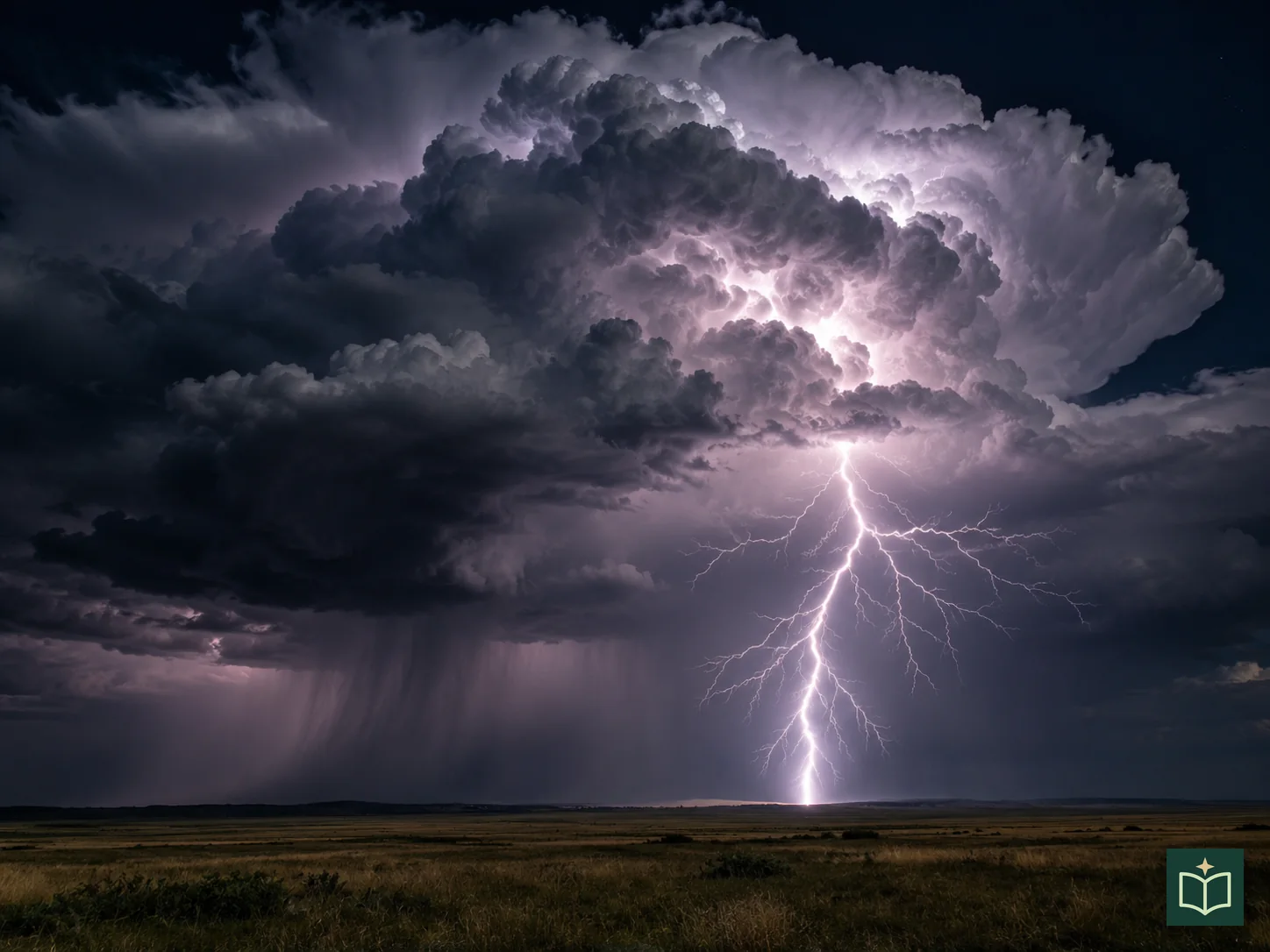
A storm that separates charge
Inside a thunderstorm, strong updrafts carry water droplets high enough to freeze. Small ice crystals and soft hail, called graupel, collide constantly. In these collisions, charge is transferred: the lighter crystals tend to become positive and are carried to the top of the cloud, while the heavier graupel becomes negative and gathers in the middle and lower regions.
The path down
Air is normally a good insulator, but when the charge difference grows large enough, it breaks down. A faint, branching stepped leader inches downward from the cloud. As it nears the ground, a streamer rises to meet it, often from a tall object. When they connect, a powerful return stroke races up the channel. That stroke is the bright flash we see.
Hotter than the Sun’s surface
The return stroke heats the narrow channel to around 30,000°C in microseconds. The air expands so violently that it creates a shock wave we hear as thunder. Most lightning actually stays within or between clouds; cloud-to-ground strikes are a minority. A single flash often contains several strokes, which is why lightning can appear to flicker.
Staying safe
Light reaches you almost instantly while sound travels about one kilometre every three seconds, so the gap between flash and thunder tells you how far away the strike was. Safety agencies advise that if you can hear thunder, you are close enough to be struck. A building with wiring and plumbing, or a hard-topped car, offers good protection.
Sources & further reading
- NOAA National Severe Storms Laboratory · Lightning basics ↗
- US National Weather Service · Lightning safety ↗
Figures are rounded and widely published; check the linked organisations for the latest editions. These organisations do not endorse this website.