Two ways to make a picture
Every colour screen builds images from tiny dots called pixels, each made of red, green and blue subpixels. How those subpixels produce light is the key difference. A liquid crystal display, or LCD, uses a backlight, today usually a panel of LEDs, behind several layers: polarising filters, a layer of liquid crystals and colour filters. The crystals twist when voltage is applied, controlling how much light passes through each subpixel. An organic light-emitting diode, or OLED, display has no backlight. Each subpixel contains thin layers of carbon-based compounds that glow when an electric current flows, so the light is produced exactly where it is needed.
Contrast and colour
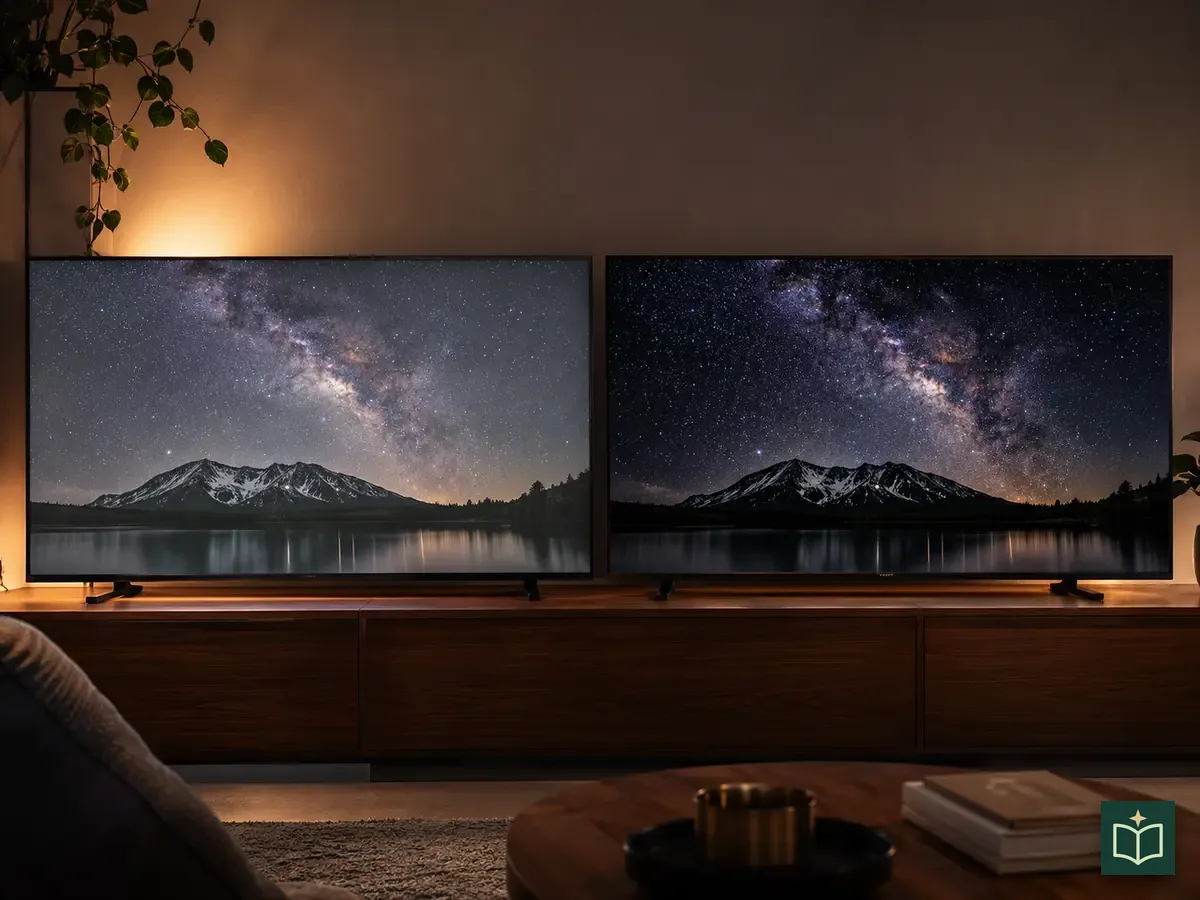
Because an LCD's backlight is always on, some light leaks through even when a pixel should be black, giving dark scenes a slightly grey look. Modern LCDs reduce this with local dimming, splitting the backlight into zones that can dim independently, though bright objects on dark backgrounds can produce a faint halo. OLED pixels switch off entirely, producing true black and very high contrast. OLEDs also respond faster, reducing blur, and keep colours accurate at wide viewing angles. LCDs, however, can often reach higher sustained brightness across the whole screen, which helps in very bright rooms or outdoors under strong sun.
Phones, televisions and sunlight
Most high-end smartphones now use OLED screens because they are thin, flexible and efficient when showing dark content. Flexible OLEDs made foldable phones possible. Many televisions, laptops and monitors still use LCDs, which are cheaper to make in large sizes. For a living room in a bright apartment in Dubai, with large windows and strong daylight, a bright LCD may cope better with glare, while an OLED shines in darker rooms for films. Variations blur the categories: so-called QLED televisions are LCDs with a quantum-dot layer for richer colour, while mini-LED designs use thousands of tiny backlight zones to improve contrast.
Where they are similar
Despite their different principles, both technologies share a great deal. Both use red, green and blue subpixels and the same digital signals, so they display the same content and resolutions, from HD to 4K and beyond. Both are controlled by a thin-film transistor layer that switches each pixel on and off. Both can support high refresh rates and high dynamic range formats. Both are covered by protective glass and touch sensors in phones and tablets. In everyday use, a good LCD and a good OLED can look very similar, and quality varies more between budget and premium models than between the two technologies.
Limits and misconceptions
OLEDs have weaknesses. Their organic materials age, and blue subpixels degrade fastest, so static elements such as logos or status bars displayed for long periods can leave faint permanent marks, known as burn-in. Manufacturers reduce the risk with pixel shifting and other techniques, and normal use rarely causes problems. A common misconception is that the LED in LED television means it is an OLED. In fact, most LED televisions are LCDs with an LED backlight. Another is that OLED always saves battery. It does for dark content, because black pixels are off, but bright white screens can consume as much power as an LCD.
Why it matters
Screens are among the most used objects in daily life, and their technology affects comfort, battery life, cost and design. Understanding the difference helps when choosing a television for a bright or dark room, a laptop for outdoor work or a phone for long battery life. It also explains industry trends. Manufacturers are developing new approaches, such as microLED, which uses tiny inorganic LEDs as self-lit pixels and promises OLED-like contrast without burn-in, though at high cost. For now, LCD and OLED remain the two pillars of display technology, each suited to different needs, budgets and viewing conditions. Both will be around for years.
Sources & further reading
Figures are rounded and widely published; check the linked organisations for the latest editions. These organisations do not endorse this website.