Leaving out the Sun
The Sun is in a category of its own. At about 1.39 million kilometres across, it is roughly ten times wider than Jupiter and contains about 99.8% of all the mass in the solar system. This table therefore ranks the next largest bodies, planets and moons alike, by equatorial diameter. Seven of the eight planets appear, together with two moons, Ganymede and Titan, which edge out Mercury, the smallest planet. Pluto, at about 2,380 kilometres, is far too small to qualify; it is smaller than seven moons, including our own. Diameters come from spacecraft and telescope measurements and are rounded.
The gas giants
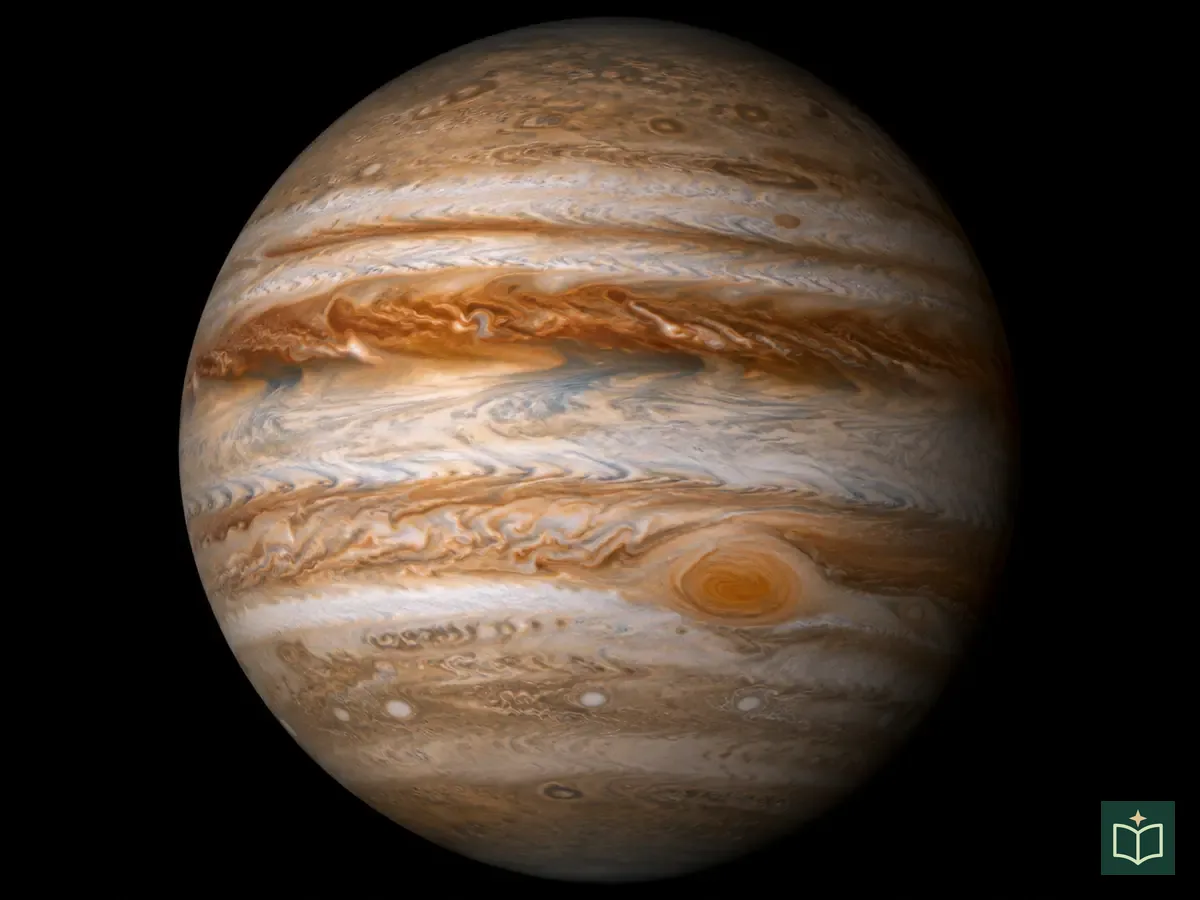
Jupiter and Saturn are made mostly of hydrogen and helium, the same ingredients as the Sun. They have no solid surface; their atmospheres become denser with depth until the gas behaves like a liquid. Jupiter is the largest planet by far, and its Great Red Spot is a storm wider than Earth that has been observed for centuries. Saturn is famous for its rings, which are not included in its diameter here, and it is so low in density that, on average, it is less dense than water. Both planets spin quickly, completing a rotation in about 10 to 11 hours, which flattens them noticeably at the poles.
The ice giants
Uranus and Neptune are roughly four times wider than Earth. Astronomers call them ice giants because, beneath their hydrogen and helium atmospheres, they contain large amounts of water, ammonia and methane in hot, dense forms. Methane in their upper atmospheres absorbs red light, giving both planets a bluish colour. Uranus spins on its side, with its axis tilted by about 98 degrees, probably after a giant collision long ago. Neptune is slightly smaller than Uranus but more massive and denser. Only one spacecraft, Voyager 2, has visited either planet, in 1986 and 1989, so much about them remains uncertain and new missions are under discussion.
The rocky worlds
Earth is the largest of the four rocky planets, but only just: Venus is about 95% of Earth’s diameter and similar in mass, which is why it is sometimes called Earth’s twin. Its thick carbon dioxide atmosphere, though, creates surface temperatures of around 460 °C, hot enough to melt lead. Mars is about half Earth’s diameter, and its thin atmosphere and cold surface make it very different despite signs that it once had flowing water. Mercury, the smallest planet, is barely larger than our Moon. It has a very large iron core, which makes it one of the densest bodies in the solar system despite its small size.
Moons that beat a planet
Ganymede and Titan are both wider than Mercury, yet each has less than half of Mercury’s mass. The reason is composition: the two moons contain large amounts of ice, while Mercury is made of dense rock and iron. This is a useful reminder that size and mass are different measures. If they orbited the Sun on their own, Ganymede and Titan would easily qualify as planets by size. They are classed as moons because they orbit planets. Since 2006, the International Astronomical Union has defined a planet as a body that orbits the Sun, is round under its own gravity and has cleared its orbital neighbourhood.
Why equators matter
Planets that spin quickly bulge at the equator. Saturn is the most flattened: its equatorial diameter is about 120,500 kilometres, while its diameter from pole to pole is only about 108,700, a difference of roughly 10%. Jupiter shows a smaller but still clear bulge. Sources that give mean diameters instead of equatorial ones produce slightly different figures, though the ranking stays the same. These worlds are being studied by spacecraft from many countries. The UAE’s Hope probe has orbited Mars since 2021, studying its atmosphere and weather, and Japan, China, Europe, India and the United States all operate or plan missions to planets and moons on this list.
Sources & further reading
Figures are rounded and widely published; check the linked organisations for the latest editions. These organisations do not endorse this website.