The magnitude scale
Astronomers describe brightness with magnitudes, a system inherited from ancient Greek astronomy, in which the brightest stars were first magnitude and the faintest visible were sixth. The modern scale is logarithmic: a difference of five magnitudes equals a factor of 100 in brightness, and the brightest objects have negative values. This table lists apparent magnitude, how bright each star looks from Earth, and excludes the Sun and the planets. Venus, Jupiter and, at times, Mars and Mercury outshine every star. Values come from precise satellite and ground-based measurements and are among the most stable figures in astronomy, apart from the stars whose brightness genuinely varies.
Close or powerful
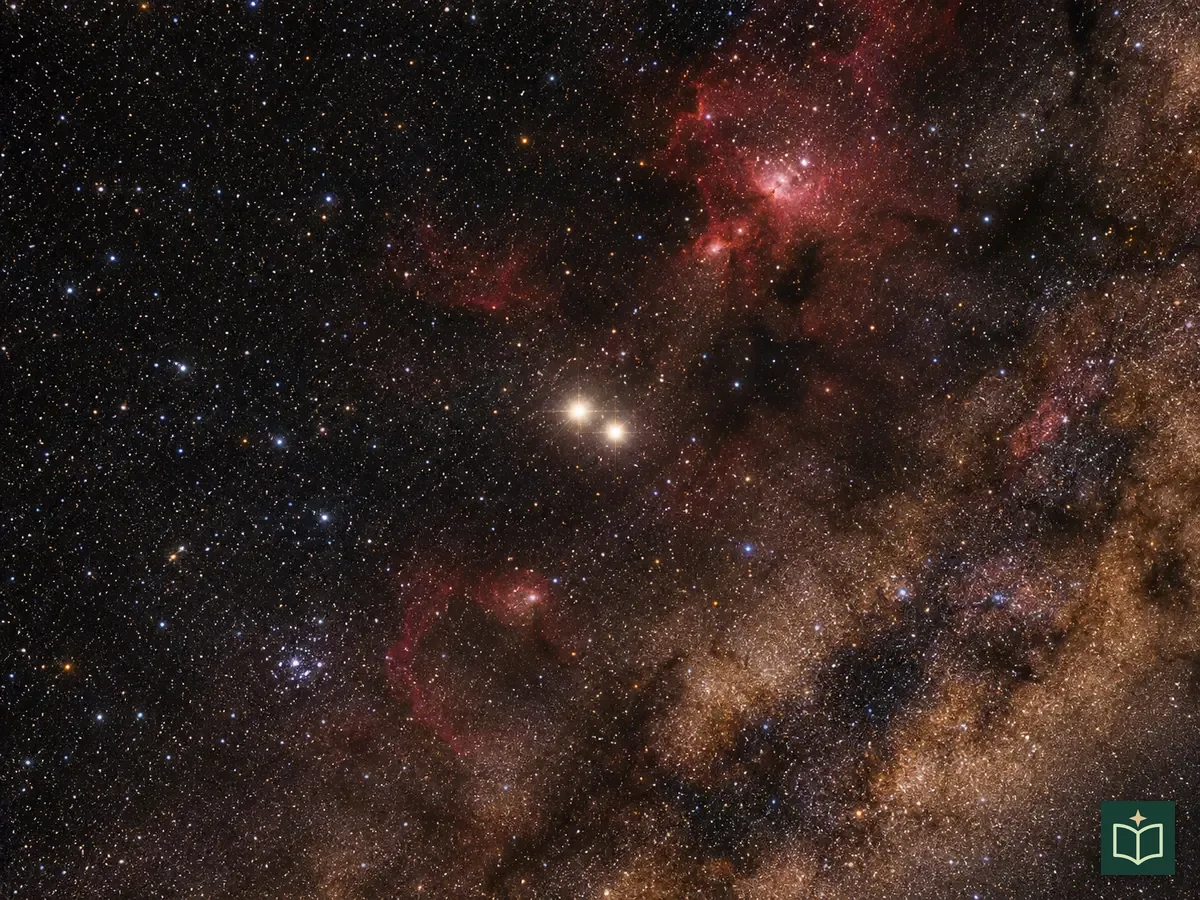
A star can look bright because it is close, because it is extremely luminous, or both. Sirius, the brightest, is only about 8.6 light-years away and gives off around 25 times as much light as the Sun. Canopus, second, is roughly 300 light-years away, yet it still shines strongly because it is thousands of times more luminous than the Sun. Rigel, in Orion, is even more extreme: it lies hundreds of light-years away and is tens of thousands of times more luminous than the Sun. Alpha Centauri, by contrast, is bright mainly because it is the nearest star system to us, just over four light-years away.
Suhail and the southern stars
Canopus, Alpha Centauri and Achernar lie far to the south and are best seen from the southern hemisphere. From the Gulf, Canopus appears low over the southern horizon, and in Arab tradition its first appearance before dawn in late August, as Suhail, marks the beginning of the end of the summer’s worst heat. Alpha Centauri barely clears the horizon from UAE latitudes, and only from places with a clear southern view. Achernar rises a little higher. For observers in Europe or much of North America, these three stars never rise at all, which is why lists of the brightest stars visible from northern countries look quite different.
Names from Arabic
Many bright star names reached European languages through Arabic astronomy, often via medieval translations of the works of Ptolemy and of scholars such as Abd al-Rahman al-Sufi. Betelgeuse derives from an Arabic phrase associated with the hand or armpit of a central figure in the constellation, and Rigel comes from rijl, meaning foot. Achernar comes from a phrase meaning the end of the river, because it marks the southern tip of the constellation Eridanus. Vega derives from a phrase meaning the swooping eagle. These names are a lasting legacy of centuries of careful observation by astronomers in Baghdad, Damascus, Cairo and Córdoba.
Variable stars and close calls
Some stars change in brightness, so their positions in the ranking can shift. Betelgeuse, a red supergiant near the end of its life, typically varies between about magnitude 0.0 and 1.6. During the so-called Great Dimming of 2019 and 2020 it faded noticeably, which studies attributed largely to a cloud of dust it had shed. When it is faint, Hadar, also known as Beta Centauri, can take tenth place. The figure for Alpha Centauri combines its two main stars, which look like a single point to the naked eye. Treated separately, its brightest component would still rank among the top four, but Arcturus would move ahead of it.
Seeing them yourself
Bright city lights make fainter stars disappear, but the stars in this table are bright enough to see from most urban areas on a clear night. Darker skies reveal far more. Desert areas away from cities offer excellent conditions, which is why stargazing trips into the dunes have become popular in the UAE and across the region. A star chart or a free planetarium app helps to identify each one. For centuries, navigators in the Indian Ocean, including the celebrated 15th-century Arab pilot Ahmad ibn Majid, relied on bright stars like these to find their way across open water, long before satellite positioning existed.
Sources & further reading
Figures are rounded and widely published; check the linked organisations for the latest editions. These organisations do not endorse this website.