What counts as rainforest
Tropical rainforests grow near the equator where it is warm all year and rain is heavy and reliable, often 2,000 millimetres or more annually with no long dry season. They cover only a small share of Earth’s land but are thought to hold more than half of all land species. Measuring them is not simple, because forest boundaries blur into savanna, farmland and regrowth. This ranking uses figures for primary forest in 2020, compiled by the environmental news site Mongabay from satellite data produced by the University of Maryland and Global Forest Watch. Primary forest means mature forest that has not been cleared or heavily altered in recent history.
The Amazon
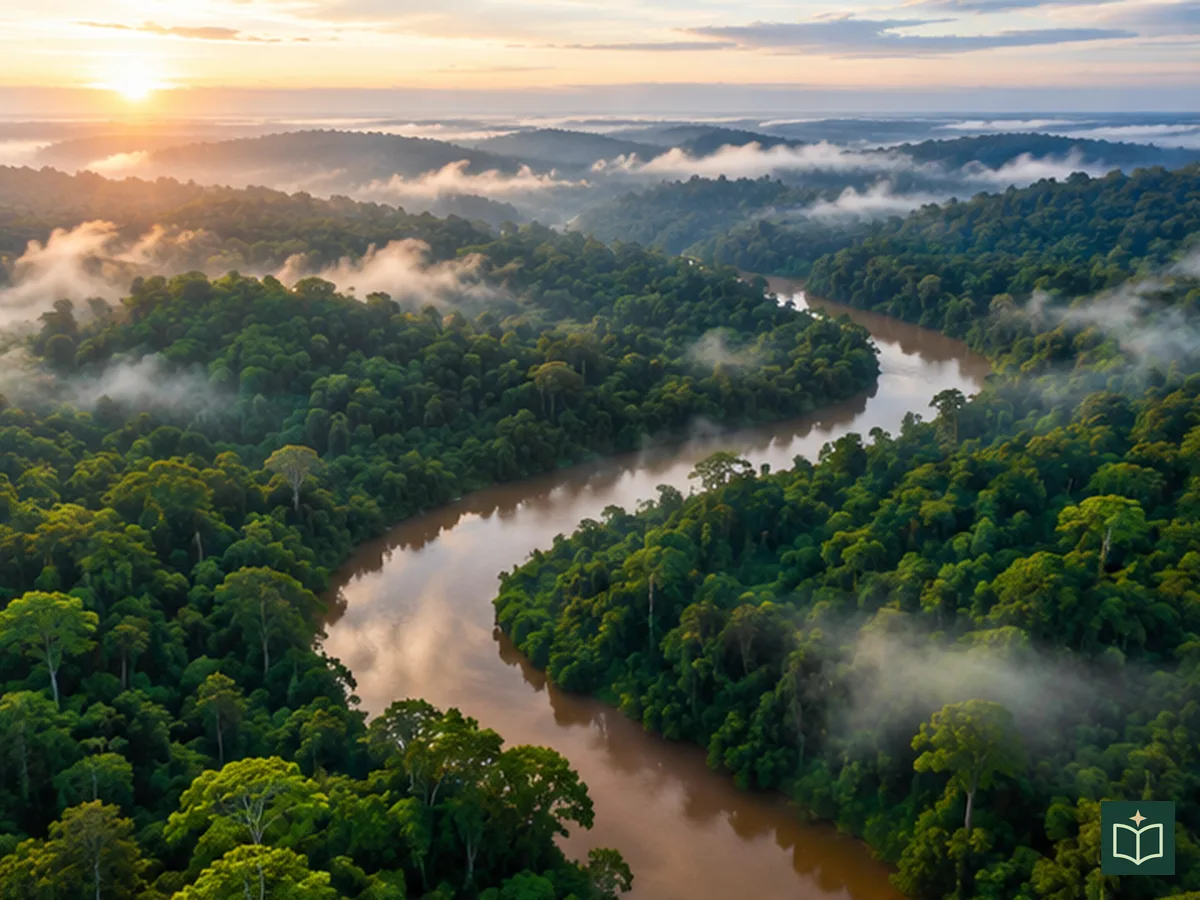
The Amazon rainforest spreads across nine countries, with about 60 per cent in Brazil. It contains about 526 million hectares of primary forest, or around 5.3 million square kilometres, roughly half of all the tropical primary forest left on Earth. The forest recycles much of its own rainfall, as trees release water vapour that falls again further west, and it stores vast amounts of carbon in its trees and soils. Clearing for cattle pasture, soya and logging has removed a large share of the original forest, especially along its southern and eastern edges. Scientists warn that further loss could push parts of the forest towards drier savanna.
The Congo Basin
The Congo Basin forest, centred on the Democratic Republic of the Congo and spreading into five neighbouring countries, is the second-largest rainforest, with about 168 million hectares of primary forest. It is home to forest elephants, gorillas, chimpanzees and bonobos, and to millions of people who depend on it for food and fuel. In 2017 scientists confirmed that its central swamps contain the world’s largest tropical peatland, holding billions of tonnes of carbon in waterlogged soil. Loss of primary forest has been lower than in the Amazon or Southeast Asia, but small-scale farming and charcoal production are slowly expanding into it.
New Guinea and Borneo
The island of New Guinea, shared by Indonesia and Papua New Guinea, holds the largest rainforest in the Asia-Pacific region, grouped here with the smaller rainforests of north-eastern Australia. It still has large areas of intact forest, including mountain forests rich in birds of paradise and tree kangaroos. Sundaland, which includes Borneo, Sumatra and the Malay Peninsula, was once covered by some of the tallest tropical forests in the world, but logging and plantations of oil palm and pulpwood have cleared much of the lowland forest since the 1970s. Borneo and Sumatra are the only homes of wild orangutans. Both regions hold thousands of plant species found nowhere else.
Smaller and threatened regions
Further down the table are regions that were once much larger. Brazil’s Atlantic Forest originally ran along much of the country’s coast but has been reduced over five centuries by farming and cities, and only scattered primary forest remains. West Africa’s Guinean forests have suffered similar losses. Mesoamerica’s forests stretch from southern Mexico to Panama, linking with the Chocó-Darién region of Colombia, one of the wettest places on Earth. Wallacea, the islands between Borneo and New Guinea such as Sulawesi, has species found nowhere else because it was never joined to either continent. Indo-Burma covers the forests of mainland Southeast Asia.
Why the ranking matters
Tropical forests influence weather far beyond their borders and store large amounts of carbon that is released when they are cleared or burned. Satellite monitoring now tracks forest loss almost in real time, allowing governments, companies and researchers to see where clearing is happening. Countries have pledged to halt deforestation, and tropical forests featured in climate negotiations including COP28, held in Dubai in 2023. Because this ranking measures primary forest, it changes as clearing continues. Regrowth can return tree cover, but it takes many decades, and often centuries, for a cleared area to recover the structure and diversity of old-growth rainforest.
Sources & further reading
Figures are rounded and widely published; check the linked organisations for the latest editions. These organisations do not endorse this website.