Trees between land and sea
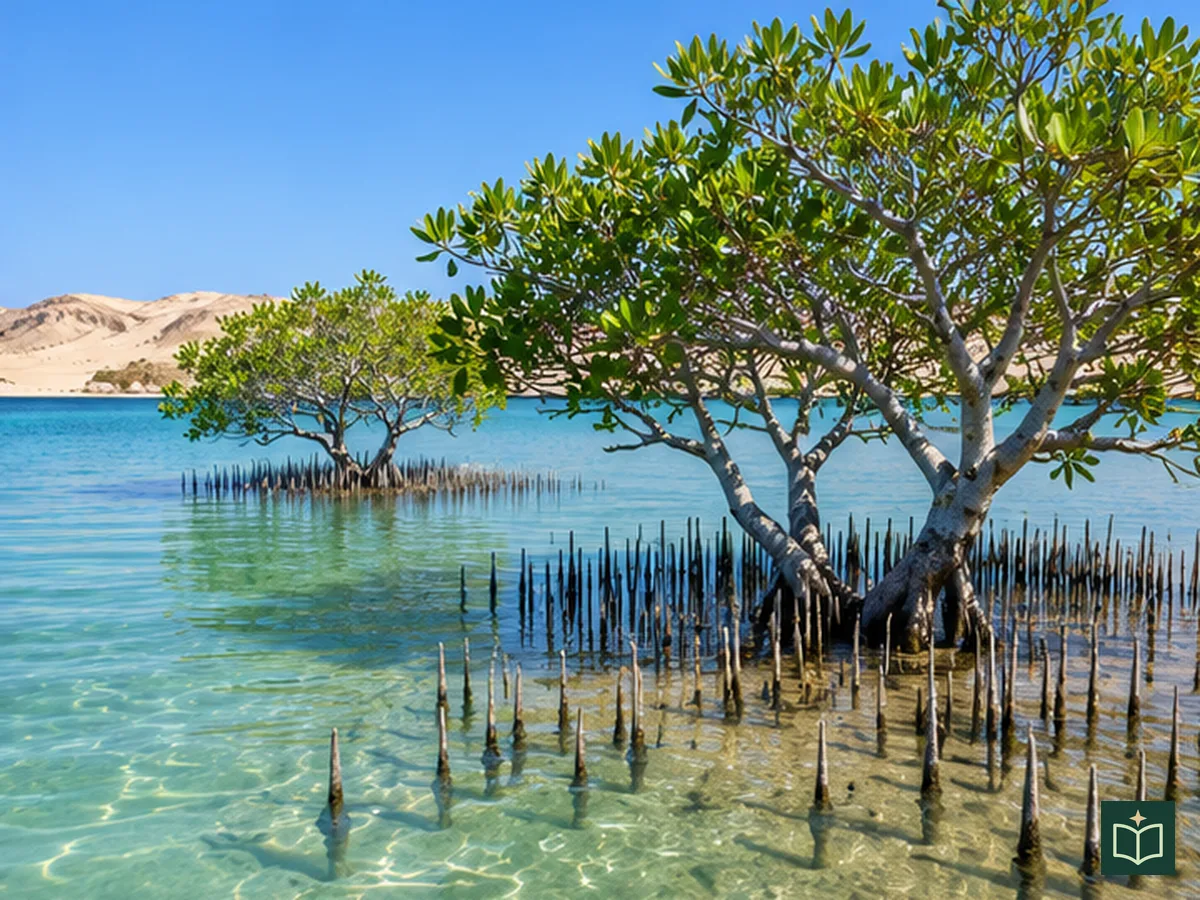
Mangroves are trees and shrubs that grow on tropical and subtropical coasts, rooted in mud that is flooded by the tide twice a day. Few plants can survive such salty, oxygen-poor ground. Mangroves cope by filtering salt at their roots, excreting it through their leaves or storing it in leaves that are later shed. Many species grow aerial roots, either arching stilt roots or pencil-like breathing roots called pneumatophores that poke up from the mud. Global Mangrove Watch, which maps mangroves from satellites, put the world total at about 137,600 square kilometres in 2010. This ranking lists countries by mangrove area from a 2014 study.
Indonesia leads
Indonesia has more mangroves than any other country, about 23,100 square kilometres in the study used here, roughly three times as much as second-placed Brazil. They line the coasts of thousands of islands, with the largest areas in Papua, Kalimantan and Sumatra. Many have been cleared over the past half century for shrimp and fish ponds, rice fields, oil palm and coastal development. Indonesia has launched large restoration programmes, but replanting is difficult, because young mangroves survive only where the ground lies at the right height in the tidal range and where water flows have not been cut off by ponds or embankments.
The Sundarbans
The Sundarbans, in the delta of the Ganges, Brahmaputra and Meghna rivers, is the largest single mangrove forest in the world. Including its rivers and creeks, it covers about 10,000 square kilometres, around 60 per cent in Bangladesh and the rest in India, and both parts are UNESCO World Heritage Sites. It is the only mangrove forest where tigers live, adapted to swimming between islands. The forest acts as a natural barrier against cyclones from the Bay of Bengal, reducing storm surges for millions of people inland. Country totals measured from satellites count only the tree canopy, which is why they are smaller than figures that include water.
Brazil, West Africa and the Americas
Brazil’s mangroves are concentrated along its northern coast, where the Amazon and other rivers deliver huge amounts of mud. The coasts of Pará and Maranhão hold one of the largest continuous mangrove belts in the world. In West Africa, Nigeria’s mangroves are centred on the Niger Delta, where oil spills and cutting for fuel wood have caused serious damage. Mexico and Venezuela have extensive mangroves on both Caribbean and Pacific coasts. Australia’s are mostly in the tropical north. In the Americas, red mangroves with arching stilt roots are especially common. Mangroves need warm water, so they disappear towards higher latitudes, and their southern and northern limits are shifting as oceans warm.
The Gulf’s grey mangroves
The Gulf has some of the toughest mangroves on Earth. Almost all are a single species, the grey mangrove, which tolerates water saltier than the open ocean and summer temperatures above 45°C. They grow mainly along sheltered lagoons and creeks in the UAE, Qatar, Bahrain, Saudi Arabia and Oman. Abu Dhabi has the largest stands in the UAE, including the Eastern Mangroves near the city, and planting programmes have expanded the area. The UAE has pledged to plant 100 million mangroves by 2030. The Gulf’s stands are small by global standards, but they shelter fish, crabs and birds in a region with little other coastal forest.
Why mangroves matter
Mangroves cover a tiny fraction of the world’s forests, yet they are among the most valuable ecosystems per hectare. Their roots trap sediment and slow waves, protecting shorelines from erosion and storms. They serve as nurseries for young fish and shrimp that support coastal fisheries. They also store large amounts of carbon, especially in waterlogged soils where dead material decays slowly; this is known as blue carbon, and per hectare it can exceed the carbon held by many forests on land. Global losses were rapid in the late twentieth century, but satellite monitoring suggests the rate of loss has slowed since the 2000s.
Sources & further reading
Figures are rounded and widely published; check the linked organisations for the latest editions. These organisations do not endorse this website.