Fourteen giants
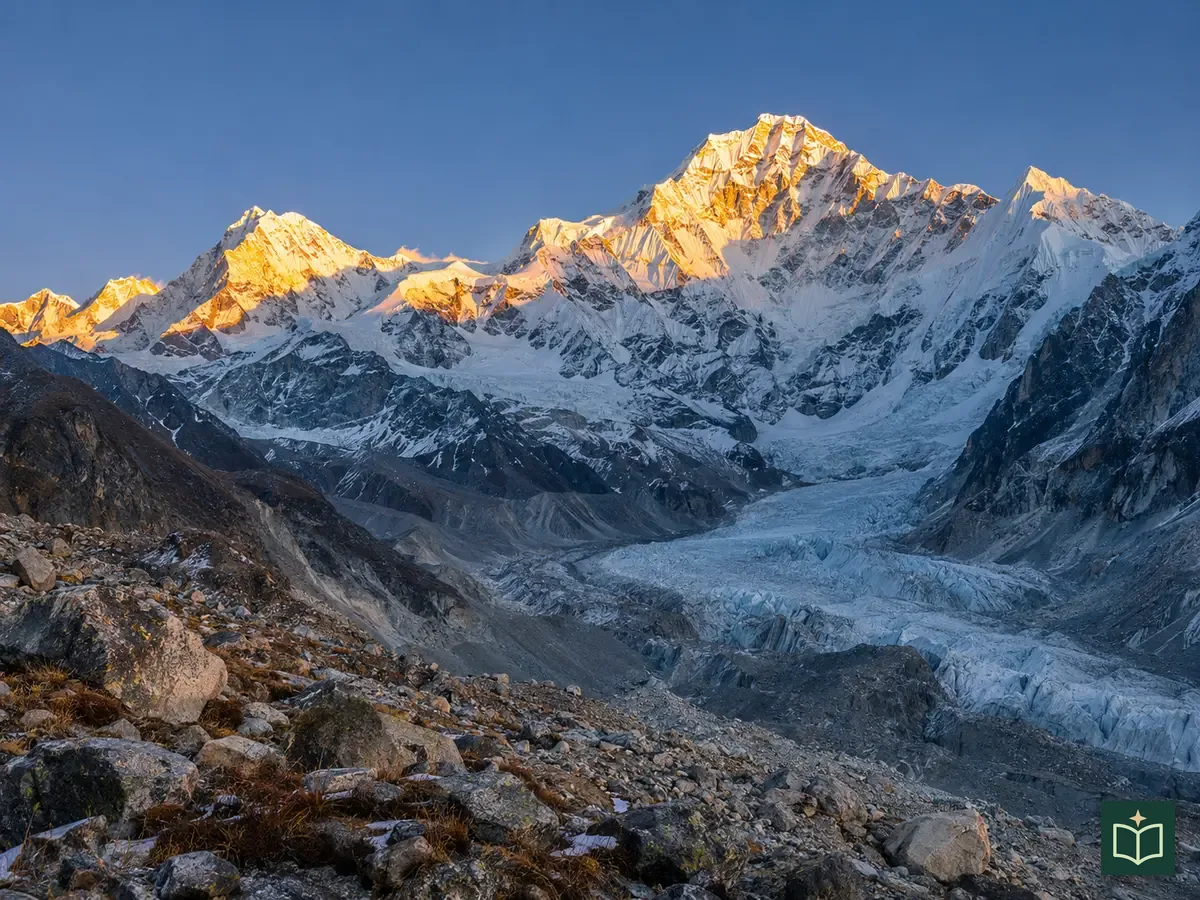
All ten of the world’s highest mountains rise in Asia, in the Himalaya and Karakoram ranges that run through Nepal, China, Pakistan and India. In fact, every one of the planet’s fourteen peaks above 8,000 metres sits in this belt; mountaineers call them the eight-thousanders. The four that miss this top ten, Gasherbrum I, Broad Peak, Gasherbrum II and Shishapangma, all stand between about 8,030 and 8,080 metres. Outside Asia nothing comes close: the highest summit in the Americas, Aconcagua in Argentina, reaches about 6,960 metres, almost 1,900 metres lower than Everest. Height here means the elevation of the summit above mean sea level, the standard measure used by surveyors and atlases.
Built by a collision
The reason for this concentration is plate tectonics. About 50 million years ago the Indian plate, drifting north, began to collide with Eurasia. Because both carry thick, buoyant continental crust, neither sank easily beneath the other. Instead the rock crumpled, stacked and thickened, raising the Himalaya and the Tibetan Plateau behind them. The collision continues today at a few centimetres a year, so the range is still being pushed upwards even as erosion, landslides and glaciers wear it down. Marine limestone containing fossils is found close to the summit of Everest, a striking reminder that rocks now nearly nine kilometres up once formed on the floor of an ancient sea.
Measuring the roof of the world
Everest’s height has been revised several times. A British survey in the 1850s calculated roughly 8,840 metres, and an Indian survey in 1955 gave 8,848 metres, the standard figure for decades. In 2020 China and Nepal jointly announced 8,848.86 metres, including the summit snow cap, after teams combined satellite positioning with measurements taken on the top. Smaller differences affect the other peaks too. Snow depth, survey methods and the model used to define sea level beneath a mountain range can each shift results by a few metres. That is why the values in this table are rounded and should be read as approximate rather than exact to the metre.
Second highest, hardest?
K2, on the border between Pakistan and China, is about 240 metres lower than Everest but is widely regarded as the tougher climb. It is steeper, more remote and more exposed to violent storms, and it was not climbed in winter until 2021. Annapurna I, the lowest mountain in this table, has historically had one of the highest death rates among the eight-thousanders because of its avalanche-prone slopes. Kangchenjunga, third on the list, was thought to be the world’s highest mountain until surveyors in the mid-19th century confirmed that Everest was taller. Height alone, in other words, tells you little about how difficult or dangerous a mountain is to climb.
Life in thin air
At the summit of Everest, air pressure is roughly a third of that at sea level, so every breath delivers only about a third as much oxygen. Above about 8,000 metres climbers enter what is often called the death zone, where the body cannot acclimatise and slowly deteriorates. Most people who climb the highest peaks use bottled oxygen, although a small number have reached all fourteen eight-thousanders without it. Reinhold Messner and Peter Habeler made the first ascent of Everest without supplementary oxygen in 1978. For comparison, the cabin of an airliner is typically pressurised to the equivalent of around 1,800 to 2,400 metres, far below the base camps of these mountains.
Why these mountains matter
The high Himalaya and Karakoram hold some of the largest stores of ice outside the polar regions. Their glaciers and snowfields feed rivers such as the Indus, Ganges and Brahmaputra, on which hundreds of millions of people depend for drinking water, farming and hydropower. That gives the region a significance far beyond mountaineering records. Scientists monitor glacier retreat across these ranges because changes in the timing and volume of meltwater affect water supplies downstream. The region is also closer to the Gulf than many people assume: a direct flight from Dubai to Kathmandu takes around four hours, and the trek to Everest Base Camp attracts many thousands of visitors every year.
Sources & further reading
Figures are rounded and widely published; check the linked organisations for the latest editions. These organisations do not endorse this website.