A family of giants
The solar system has hundreds of known moons, and the number grows as telescopes find small, distant ones around the giant planets. Most are tiny, irregular bodies only a few kilometres across. A handful, though, are true worlds. Seven moons are more than 2,700 kilometres in diameter, and after them there is a sharp drop: the eighth largest, Titania, is less than 1,600 kilometres across. The figures here are mean diameters measured by spacecraft and telescopes. Large moons are almost spherical because their own gravity has pulled them into a round shape, so diameters are well established and the ranking is one of the most stable in astronomy.
Jupiter’s Galilean moons
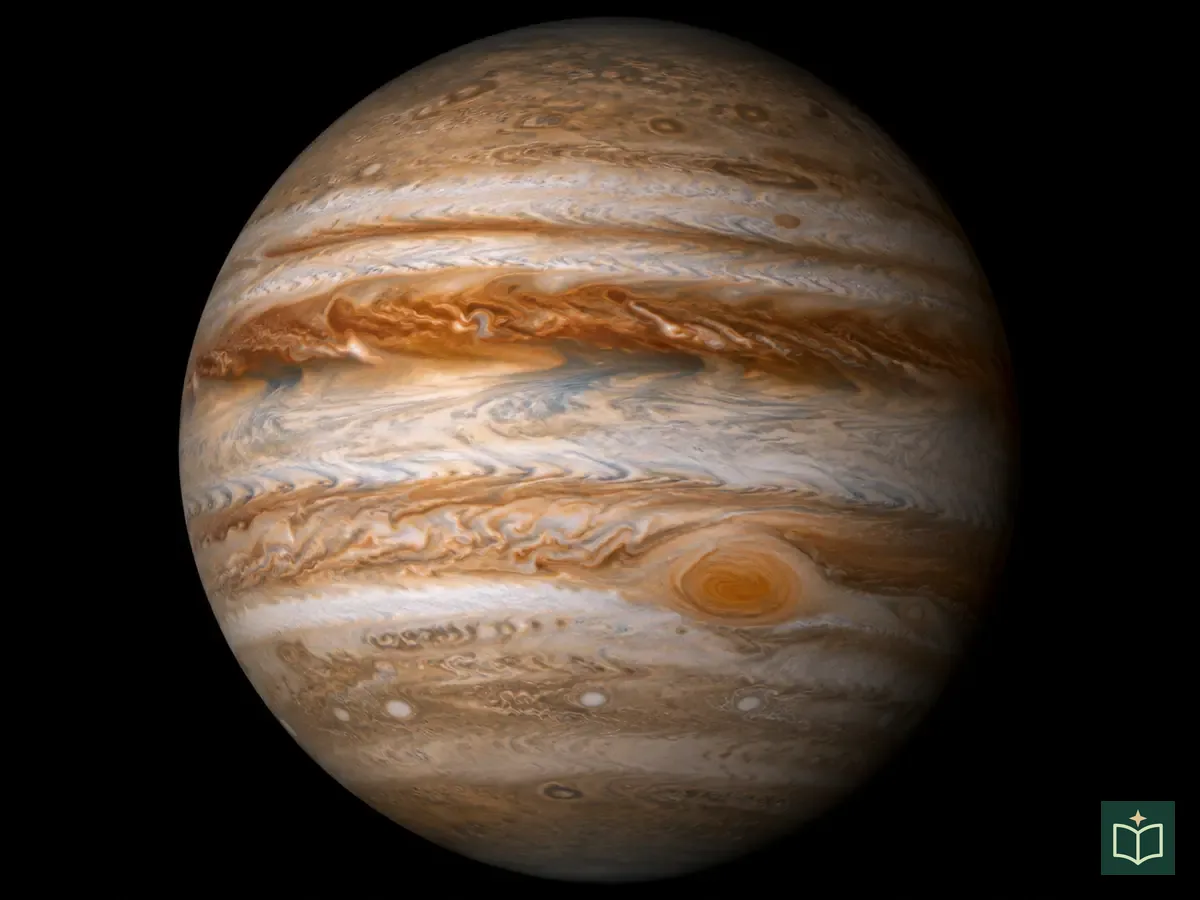
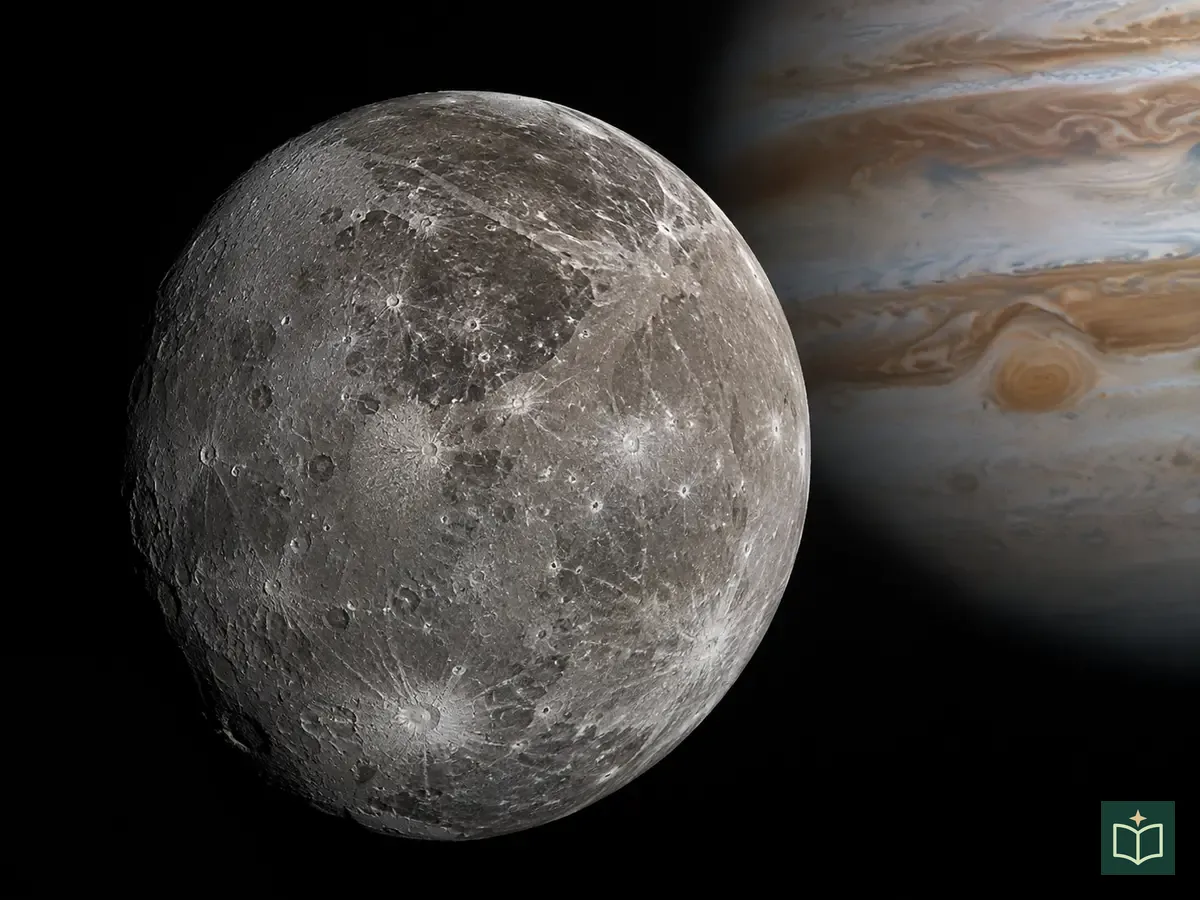
Four of the ten largest moons orbit Jupiter. Galileo Galilei discovered them in 1610, and their motion around Jupiter helped to overturn the idea that everything circled Earth. Ganymede, the largest, is the only moon known to generate its own magnetic field. Callisto is one of the most heavily cratered bodies in the solar system. Io, squeezed by Jupiter’s gravity, is the most volcanically active world known. Europa is covered by an icy crust above what scientists believe is a salty ocean. Two missions are heading there: the European Space Agency’s Juice, launched in 2023, and NASA’s Europa Clipper, launched in 2024, both due in the early 2030s.
Titan, a moon with weather
Titan, Saturn’s largest moon, is the only moon with a thick atmosphere. Its nitrogen-rich air is denser than Earth’s at the surface, and it hides the ground beneath an orange haze. The Cassini spacecraft and its Huygens probe, which landed on Titan in 2005, revealed rivers, lakes and seas filled with liquid methane and ethane, making Titan the only place besides Earth known to have stable liquid on its surface. Rain falls there, though it is hydrocarbon rain rather than water. NASA plans to send a rotorcraft called Dragonfly to fly between sites on Titan, with launch currently planned for the late 2020s.
Our unusual Moon
Earth’s Moon, fifth on the list, is remarkable not for its absolute size but for its size relative to its planet. Its diameter is more than a quarter of Earth’s, a far higher ratio than for the big moons of the giant planets. The leading explanation is that the Moon formed from debris thrown out when a Mars-sized body collided with the young Earth about 4.5 billion years ago. The Moon’s gravity drives most of the ocean tides and helps to stabilise the tilt of Earth’s axis, which in turn keeps our seasons relatively steady over long periods. It remains the only other world on which humans have walked.
Triton and the outer moons
Triton, Neptune’s largest moon, orbits in the opposite direction to its planet’s spin. That strongly suggests it was once an independent body from the Kuiper belt that Neptune captured. When Voyager 2 flew past in 1989 it photographed plumes rising from Triton’s frozen surface. Titania and Oberon, the largest moons of Uranus, were both discovered by William Herschel in 1787 and are named after characters from Shakespeare’s A Midsummer Night’s Dream. Rhea is Saturn’s second-largest moon. These mid-sized moons are made largely of water ice and rock and have been studied only in brief flybys, which is why many details about them remain uncertain.
Why moons matter
Several of these moons are central to the search for life beyond Earth. Europa, Ganymede and Callisto are thought to hide oceans beneath their ice, and Titan combines complex organic chemistry with a probable deep water ocean. Understanding them helps scientists judge how common habitable environments might be. Moons also make useful comparisons with planets. Ganymede and Titan are larger than Mercury but much less massive, because they contain a great deal of ice. The UAE has its own connection to the study of moons: its Hope spacecraft, orbiting Mars since 2021, made close passes of the tiny Martian moon Deimos, which is only about 12 kilometres across.
Sources & further reading
Figures are rounded and widely published; check the linked organisations for the latest editions. These organisations do not endorse this website.