The largest freshwater lake
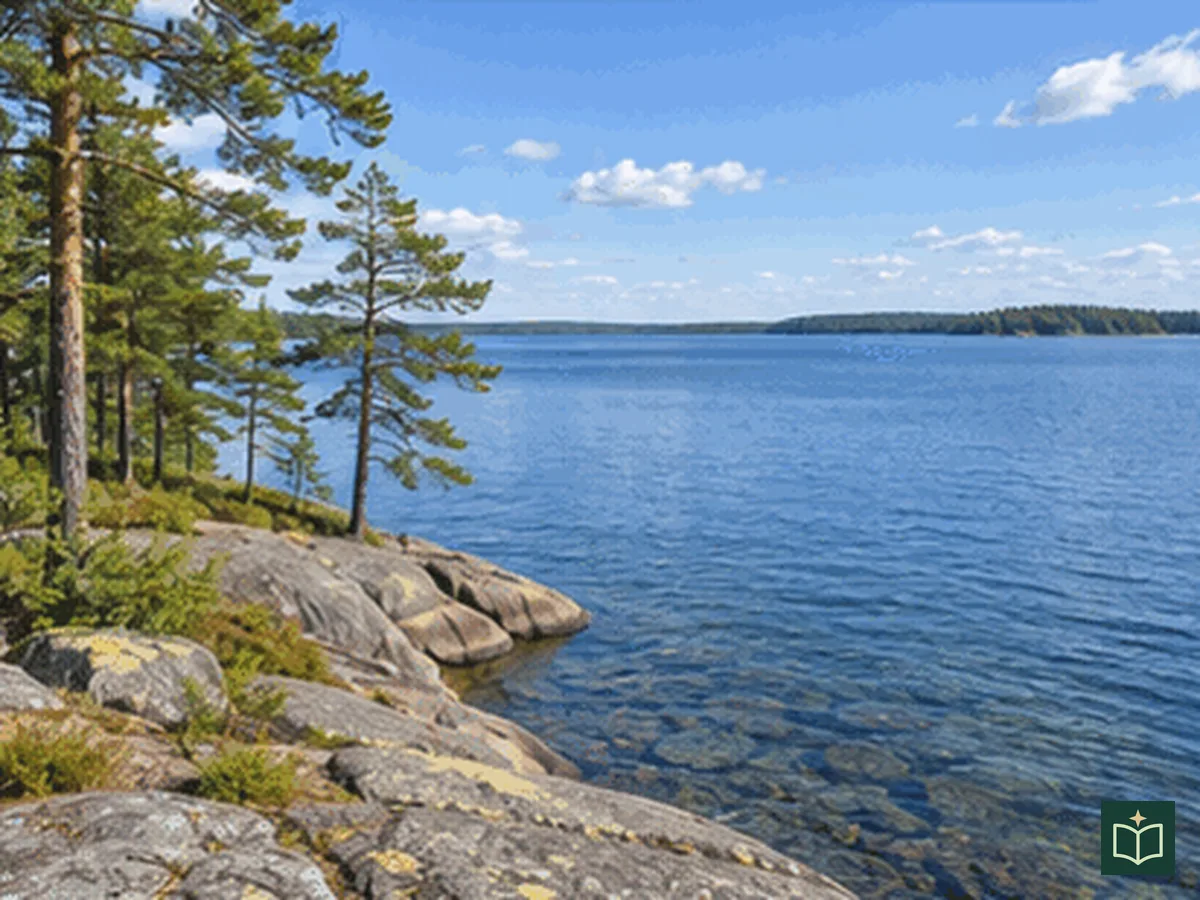
Lake Superior covers about 82,100 square kilometres, making it the largest freshwater lake in the world by surface area. It is about 4.6 times the size of Lake Ladoga, Europe’s largest lake. Superior is also deep, reaching about 400 metres, and holds about 12,000 cubic kilometres of water, around ten per cent of the world’s fresh surface water. Its water is cold and clear, and storms on it can raise waves as high as those at sea. The ore carrier Edmund Fitzgerald sank in a storm on Superior in 1975 with all 29 crew, one of many shipwrecks on the lake’s floor.
The Great Lakes as a system
Superior, Michigan, Huron, Erie and Ontario form the largest group of freshwater lakes on Earth. Together they hold about a fifth of the world’s fresh surface water. Water flows from Superior into Huron, from Michigan through the Straits of Mackinac into Huron, then through Erie, over Niagara Falls into Ontario and down the St Lawrence River to the Atlantic. Michigan and Huron are joined by a channel so wide that scientists often treat them as one lake, which would be the largest by area. Lake Michigan is the only Great Lake entirely within the United States; the others are shared with Canada.
Canada’s northern giants
Two of the largest lakes are in Canada’s Northwest Territories. Great Bear Lake, about 31,000 square kilometres, lies astride the Arctic Circle and is the largest lake entirely within Canada. It is frozen for much of the year, and its cold, clean water supports large lake trout. Great Slave Lake, about 27,200 square kilometres, is the deepest lake in North America, at more than 600 metres. Lake Winnipeg, in Manitoba, and Lake Athabasca, on the border of Alberta and Saskatchewan, are remnants of a huge glacial lake called Agassiz that covered much of central Canada as the ice sheets melted.
Made by ice
Most of these lakes owe their existence to ice. During the last ice age, sheets of ice up to several kilometres thick covered most of Canada and the northern United States. They scoured basins in softer rock and pushed the crust downwards under their enormous weight. As the ice retreated, meltwater filled the hollows. The land is still slowly rising today, a process called post-glacial rebound, which is gradually tilting some lake basins. Lake Nicaragua, in Central America, is different. It lies in a tectonic depression near volcanoes and is home to freshwater populations of bull sharks, which swim up from the Caribbean.
Lakes that serve millions
The Great Lakes are central to the economies of both countries. Tens of millions of people live in their basin, including the cities of Chicago, Detroit, Cleveland and Toronto, and the lakes supply drinking water to many of them. The St Lawrence Seaway, opened in 1959, allows oceangoing ships to sail from the Atlantic to ports at the western end of Superior. The lakes have also faced serious pollution. In the 1960s parts of Lake Erie suffered from algae blooms fed by fertiliser and sewage, leading Canada and the United States to sign the Great Lakes Water Quality Agreement in 1972.
Water in a dry region
For readers in the Gulf, where fresh water comes largely from desalination and from aquifers, the scale of these lakes is striking. Lake Superior alone holds roughly as much water as all the other Great Lakes combined, enough to cover the whole of North and South America to a depth of about 30 centimetres. Yet the lakes are not inexhaustible. Their water levels rise and fall over years with rainfall, evaporation and ice cover, and new threats include invasive species such as zebra mussels and warming water. Canada and the United States manage the shared lakes through joint agreements and commissions that monitor levels and water quality.
Sources & further reading
- US Environmental Protection Agency · Great Lakes ↗
- NOAA Great Lakes Environmental Research Laboratory ↗
- Britannica · Great Bear Lake ↗
Figures are rounded and widely published; check the linked organisations for the latest editions. These organisations do not endorse this website.