Down more than two kilometres
The two deepest known caves on Earth lie close together in the Arabika Massif, a limestone mountain range above the Black Sea coast in Abkhazia, a breakaway region internationally recognised as part of Georgia. Krubera, also called Voronya, and Veryovkina both descend more than 2,200 metres below their entrances. That is more than two and a half times the height of Dubai’s Burj Khalifa. Recent published lists put Krubera at about 2,220 metres and Veryovkina at about 2,210, a difference small enough to fall within the uncertainty of the surveys. Sarma, in the same massif, is third at about 1,830 metres.
A record that keeps changing
The title of deepest cave has passed back and forth. Krubera became the first cave known to exceed 2,000 metres in 2004, after Ukrainian-led expeditions pushed through narrow squeezes and flooded passages. Veryovkina was explored over several decades by Russian cavers and in 2018 reached about 2,212 metres, overtaking Krubera at the time. Later surveys and new explorations at the bottom of both caves have revised their depths by small amounts. Because the two are so close, different sources may list them in either order. Both end in sumps, flooded passages that only cave divers can follow, so their true depths may yet increase.
Why the Arabika Massif
Deep caves need three things: thick, soluble rock, a large height difference between where water enters and where it emerges, and enough time. The Arabika Massif has limestone more than two kilometres thick, rising well over 2,000 metres above sea level. Rain and snowmelt sink into the plateau and travel down through the rock to springs near, and even below, the Black Sea coast. Dye tracing has shown water from the massif emerging at springs at the coast and on the sea floor. As water dissolves its way down, it carves vertical shafts linked by steep passages, forming the deep caves explorers follow.
Europe and beyond
Outside Georgia, the deepest caves are mostly in the limestone of the Alps and the Pyrenees–Cantabrian ranges. Lamprechtsofen and Hirlatzhöhle in Austria, the Gouffre Mirolda and Gouffre Jean-Bernard in the French Alps, and the Sistema del Cerro del Cuevón in northern Spain all exceed 1,500 metres. Mexico’s Sistema Huautla, in Oaxaca, is the deepest known cave outside Europe and the Caucasus. Several of these systems are also long, with many kilometres of passages, because explorers have connected separate caves into single systems. The Arabian Peninsula has impressive caves in the mountains of Oman, but none known so far comes close to these depths.
Life at the bottom
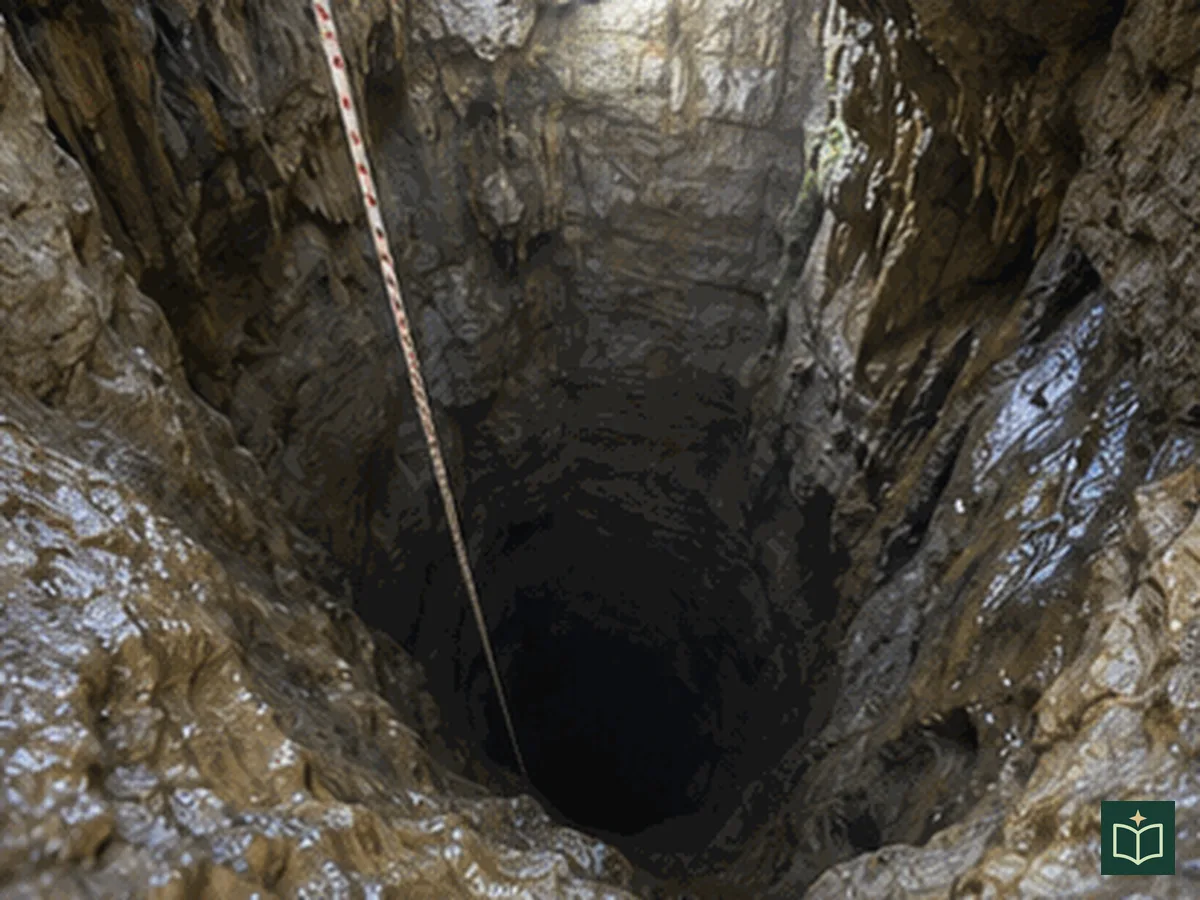
Expeditions to the deepest caves can last weeks. Teams rig ropes down hundreds of vertical drops and descend using climbing equipment, carrying food, sleeping bags and stoves to camps deep underground. Temperatures are only a few degrees above freezing, the air is damp, and sudden floods can trap explorers. Divers carry tanks through sumps to reach passages beyond. The caves also host life adapted to darkness. Scientists have described new species of springtails and other tiny animals from Krubera, some living close to its deepest point. Such discoveries add to the scientific value of expeditions, which also map water flows and study how caves form.
Measuring depth
Cave depth is measured from the highest known entrance to the lowest surveyed point. Explorers survey as they go, using compasses, inclinometers and measuring tapes or laser rangefinders, and calculate the vertical drop of each section. Small errors add up over hundreds of survey stations, so depths are usually quoted to the nearest metre but are uncertain by more than that. When two caves are linked, the system’s depth can jump if the new entrance is higher. Rankings are therefore a snapshot of current exploration. The values here are rounded from recent published lists and show the general order, which may shift as surveys continue.
Sources & further reading
Figures are rounded and widely published; check the linked organisations for the latest editions. These organisations do not endorse this website.