Capacity and output
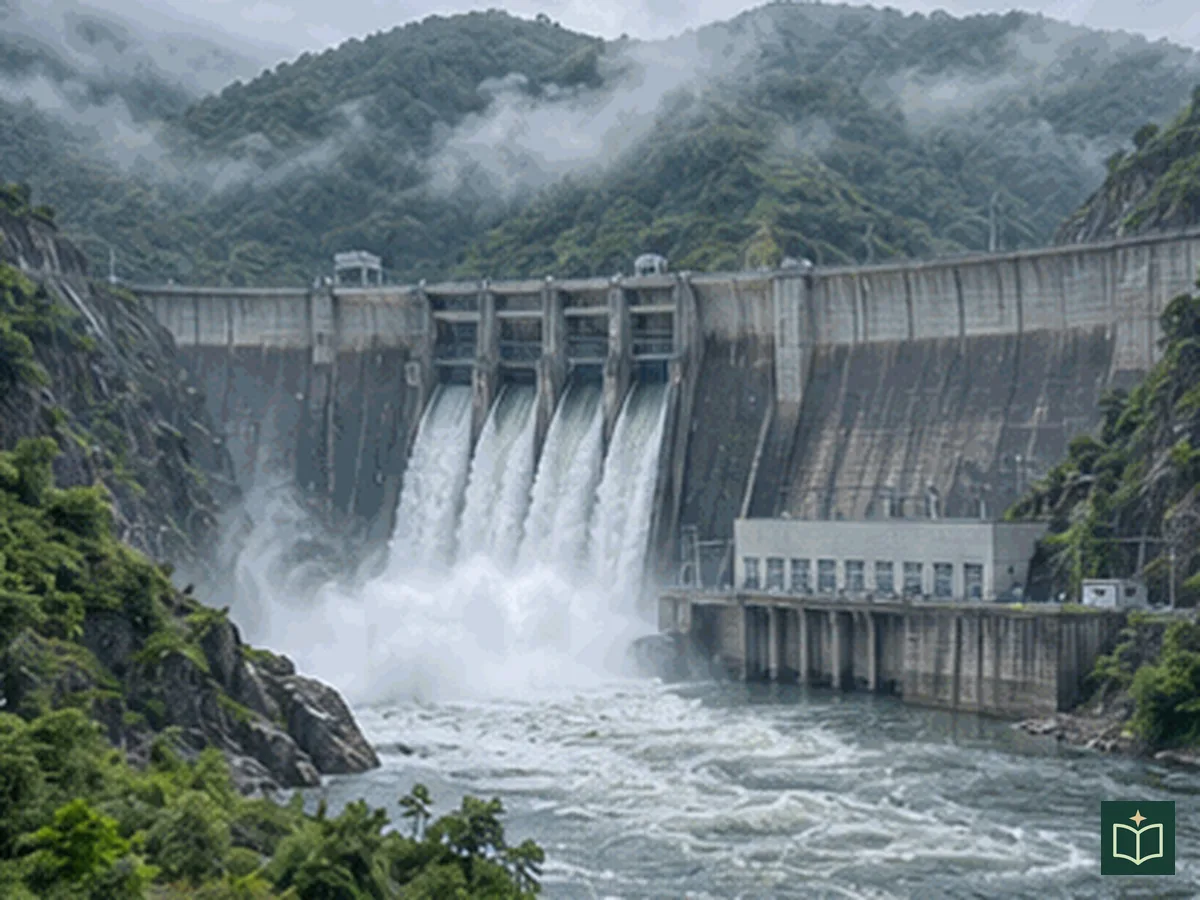
Power stations are usually compared by installed capacity, the maximum electrical power their generators can produce at once, measured in gigawatts. One gigawatt is a thousand megawatts. By that measure the largest power station on Earth is the Three Gorges Dam on China’s Yangtze River, with about 22.5 gigawatts from 32 main turbines. That is roughly 1.4 times the capacity of Baihetan, in second place. Capacity is not the same as output, however. A plant generates its maximum only when the river supplies enough water, so the electricity produced in a year depends on rainfall, snowmelt and how the reservoir is managed.
China’s staircase of dams
Five of the ten largest hydroelectric plants are in China, and three of them, Baihetan, Xiluodu and Wudongde, are on the Jinsha, the upper course of the Yangtze. Engineers have built a series of dams along this river, each using the steep drop between the Tibetan Plateau and the Sichuan Basin. Baihetan, completed in 2022, uses sixteen turbines of 1,000 megawatts each, the most powerful hydroelectric units ever installed. The dams also store water for flood control and help ships navigate. They have required the relocation of large numbers of people and changed river ecosystems, issues that have been widely debated in China and abroad.
Itaipu’s long record
Itaipu, on the Paraná River between Brazil and Paraguay, held the title of largest hydroelectric plant until Three Gorges was completed. It is jointly owned by the two countries, which share its electricity. Because the Paraná carries a large, steady flow through the year, Itaipu has at times produced more electricity in a single year than Three Gorges, despite its smaller capacity. It supplies a significant share of Brazil’s electricity and most of Paraguay’s. Brazil has two more plants in the table: Belo Monte, on the Xingu in the Amazon basin, whose output varies sharply between wet and dry seasons, and Tucuruí, on the Tocantins.
From Venezuela to Washington
The Guri Dam on Venezuela’s Caroní River supplies a large share of that country’s electricity, which has made the national grid vulnerable during droughts that lower its reservoir. Grand Coulee, on the Columbia River in Washington state, is the largest power station in the United States. Built in the 1930s and 1940s, it helped power aluminium smelters and aircraft factories during the Second World War and irrigates farmland across a dry region. Africa’s largest plant, the Grand Ethiopian Renaissance Dam on the Blue Nile, was completed in 2025 with a capacity of just over 5 gigawatts, below the threshold for this table.
Hydropower in the Gulf
The Gulf has almost no rivers that flow all year, so it cannot build conventional hydroelectric dams. But the same principle is used for storage. Dubai’s Hatta plant, in the Hajar Mountains near the border with Oman, is a pumped-storage station with a capacity of about 250 megawatts. When solar power is plentiful during the day, water is pumped uphill from a lower reservoir to an upper one; when electricity is needed, it flows back down through turbines. This lets surplus solar energy be used at night. Pumped storage is the most widely used form of large-scale electricity storage in the world.
Costs and the future
Large hydroelectric plants produce electricity with very low emissions once built, and they can raise or lower output quickly to balance the grid. But they flood valleys, displace communities, block fish migration and trap sediment that once nourished farmland and deltas downstream. Reservoirs in warm climates can also release methane from decaying vegetation. Many of the best sites in Europe and North America have already been used, so most new giant dams are in Asia, Africa and South America. China has begun building a hydroelectric project on the Yarlung Tsangpo in Tibet that is planned to exceed even Three Gorges when complete.
Sources & further reading
- International Energy Agency · Hydroelectricity ↗
- International Hydropower Association ↗
- Britannica · Three Gorges Dam ↗
Figures are rounded and widely published; check the linked organisations for the latest editions. These organisations do not endorse this website.