Why Australia is so dry
Australia is the driest inhabited continent. Much of it lies between about 20 and 35 degrees south, under the belt of high pressure where air descends and warms, suppressing clouds and rain. The interior is also far from the sea, and the Great Dividing Range in the east catches much of the moisture carried by winds from the Pacific. Geoscience Australia recognises ten named deserts on the mainland, with a combined area of about 1.37 million square kilometres, or roughly 18 per cent of the country. A much larger share of the continent is arid or semi-arid, including grazing lands and salt lakes that fall outside these named deserts.
The Great Victoria
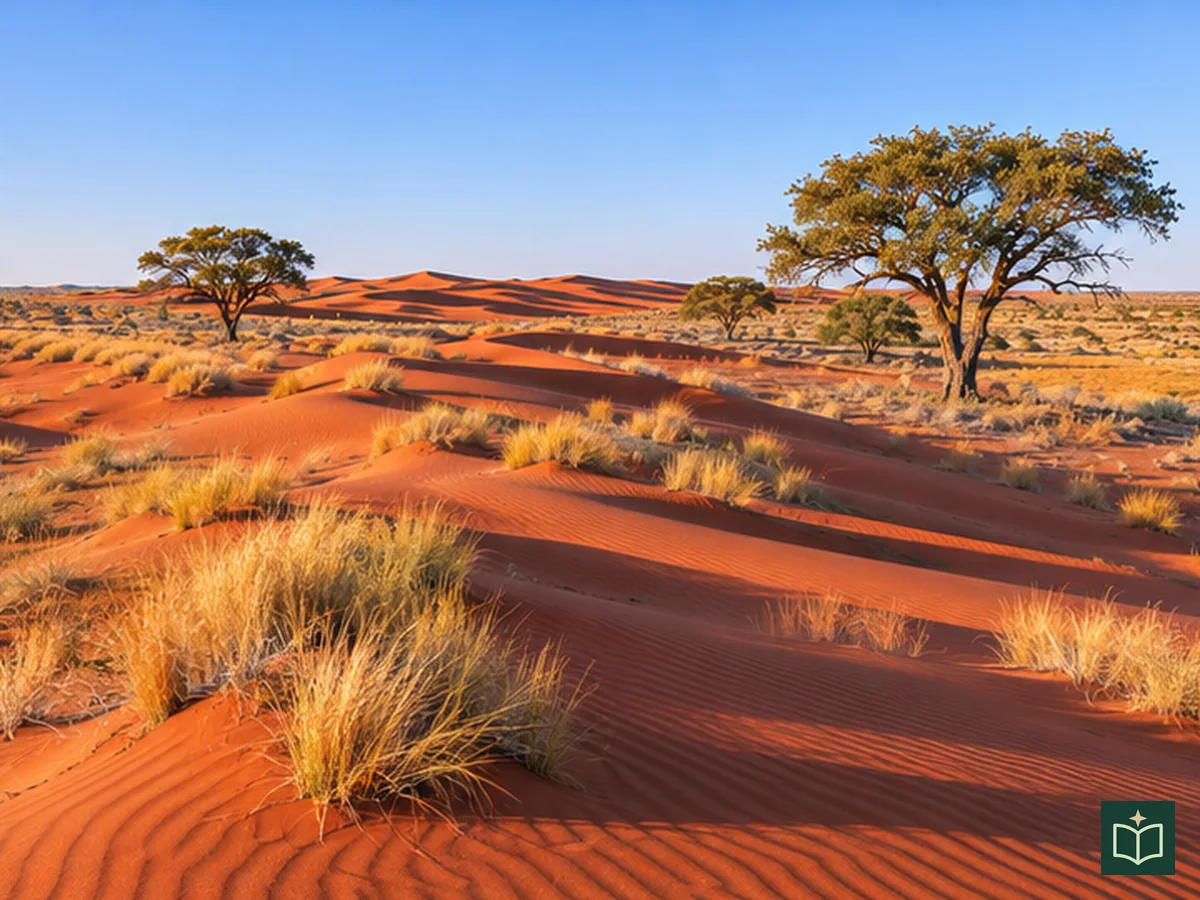
The Great Victoria Desert is the largest, covering about 348,750 square kilometres across Western Australia and South Australia, roughly four times the size of the UAE. It is a landscape of red sand dunes, salt lakes and plains covered with spinifex grass and scattered trees. Despite its dryness it supports many reptiles, small mammals and birds, and Aboriginal communities continue to live on their traditional lands there. In the 1950s and 1960s parts of the desert, at Maralinga and Emu Field, were used by the British government for nuclear weapons tests, which left contamination that took decades to clean up and lasting harm to local communities.
The Great Sandy and Tanami
The Great Sandy Desert, in the north of Western Australia, stretches about 267,250 square kilometres and is crossed by long parallel red dunes. It receives most of its rain in brief summer storms from the monsoon to the north, but evaporation far exceeds rainfall. The Tanami, straddling Western Australia and the Northern Territory, is a mix of sand plains and rocky ranges. Gold mining has been important there since the early twentieth century, and modern mines still operate. Both deserts include large areas managed by Aboriginal owners, where rangers combine traditional burning practices with modern science to care for the land.
The Simpson’s parallel dunes
The Simpson Desert, where the Northern Territory, Queensland and South Australia meet, is famous for its long, parallel sand dunes, which run for tens and sometimes hundreds of kilometres in the direction of the prevailing wind. The tallest, known as Big Red, rises about 40 metres and is a popular challenge for four-wheel-drive travellers; it lies near the small Queensland town of Birdsville. The Simpson lies within the vast Lake Eyre basin, which drains inland and rarely reaches the sea. After unusually heavy rain, floodwaters can travel for months to fill Kati Thanda–Lake Eyre, briefly turning the desert edge into wetlands crowded with birds.
Gibson to Pedirka
The Gibson Desert, in central Western Australia, is named after Alfred Gibson, a member of Ernest Giles’s expedition who disappeared there in 1874. It is mostly gravel plains and low sandy ridges. The Little Sandy lies to its west. In the east, the Strzelecki, Sturt Stony, Tirari and Pedirka deserts surround the Lake Eyre basin. Sturt Stony Desert is a gibber plain, a surface of tightly packed polished stones left behind when the wind blew away finer material, similar to the desert pavements of Arabia. Pedirka, at about 1,250 square kilometres, is the smallest, a patch of dunes and plains in South Australia.
Comparing with Arabia
Australia’s deserts look different from the great sand seas of Arabia. Most are at least partly covered by grasses, shrubs and low trees, because they receive more reliable rain than the driest parts of the Arabian Peninsula. Arabia’s Rub’ al Khali, the Empty Quarter, covers about 650,000 square kilometres, nearly twice the area of the Great Victoria, and is largely bare sand. Both regions have been home to people for a very long time. Aboriginal Australians have lived in the deserts for tens of thousands of years, developing detailed knowledge of water sources, plants and animals that is now helping scientists manage these fragile landscapes.
Sources & further reading
Figures are rounded and widely published; check the linked organisations for the latest editions. These organisations do not endorse this website.