Two ways to measure
Ranking coral reefs is harder than ranking mountains or rivers because a reef system is not a single object. The Great Barrier Reef, for example, is made up of about 2,900 separate reefs. Published lists of the largest reefs often mix lengths, park areas and reef areas, which cannot be compared fairly. This ranking therefore uses the most widely cited consistent measure: the area of shallow coral reef in each country, from the World Atlas of Coral Reefs produced by the UN Environment Programme’s World Conservation Monitoring Centre. The famous reef systems are discussed in the text by their length. The two approaches agree on one point: the Indo-Pacific holds most of the world’s coral.
The Great Barrier Reef
The Great Barrier Reef stretches about 2,300 kilometres along the coast of Queensland in north-eastern Australia, making it the largest reef system on Earth. It includes some 2,900 individual reefs and about 900 islands, within a marine park covering roughly 344,000 square kilometres, an area larger than Oman. It was listed as a World Heritage Site in 1981. It is often said to be visible from space, which is true in the sense that astronauts and satellites can see its pale outlines, though the claim is sometimes exaggerated. Australia’s second-largest share of reef in the table comes mainly from this system, together with the reefs off Western Australia.
The Coral Triangle
Indonesia tops the table with about 51,000 square kilometres of reef, around 18 per cent of the world’s total, followed by Australia and the Philippines. Indonesia, the Philippines and Papua New Guinea lie within the Coral Triangle, a region of the western Pacific with the greatest diversity of reef life on Earth, including roughly three quarters of all known coral species. Its reefs fringe thousands of islands rather than forming one long barrier, which is why no single Indonesian reef is famous, yet together they exceed even Australia’s. France ranks fourth through overseas territories such as New Caledonia, whose barrier reef, about 1,500 kilometres long, is among the longest in the world.
Arabia’s reefs
Saudi Arabia ranks eighth, with about 6,700 square kilometres of reef, most of it along its Red Sea coast. The Red Sea’s fringing reefs run along much of both its shores, and corals in its northern waters, including the Gulf of Aqaba, are notably tolerant of heat, which has made them a focus of research. The Arabian Gulf holds smaller reefs off the UAE, Qatar, Bahrain and Saudi Arabia, where corals survive sea temperatures in summer that would kill reefs elsewhere. In the Caribbean, the Mesoamerican Barrier Reef, about 1,000 kilometres long, runs from Mexico’s Yucatán Peninsula past Belize and Guatemala to Honduras.
Small area, big role
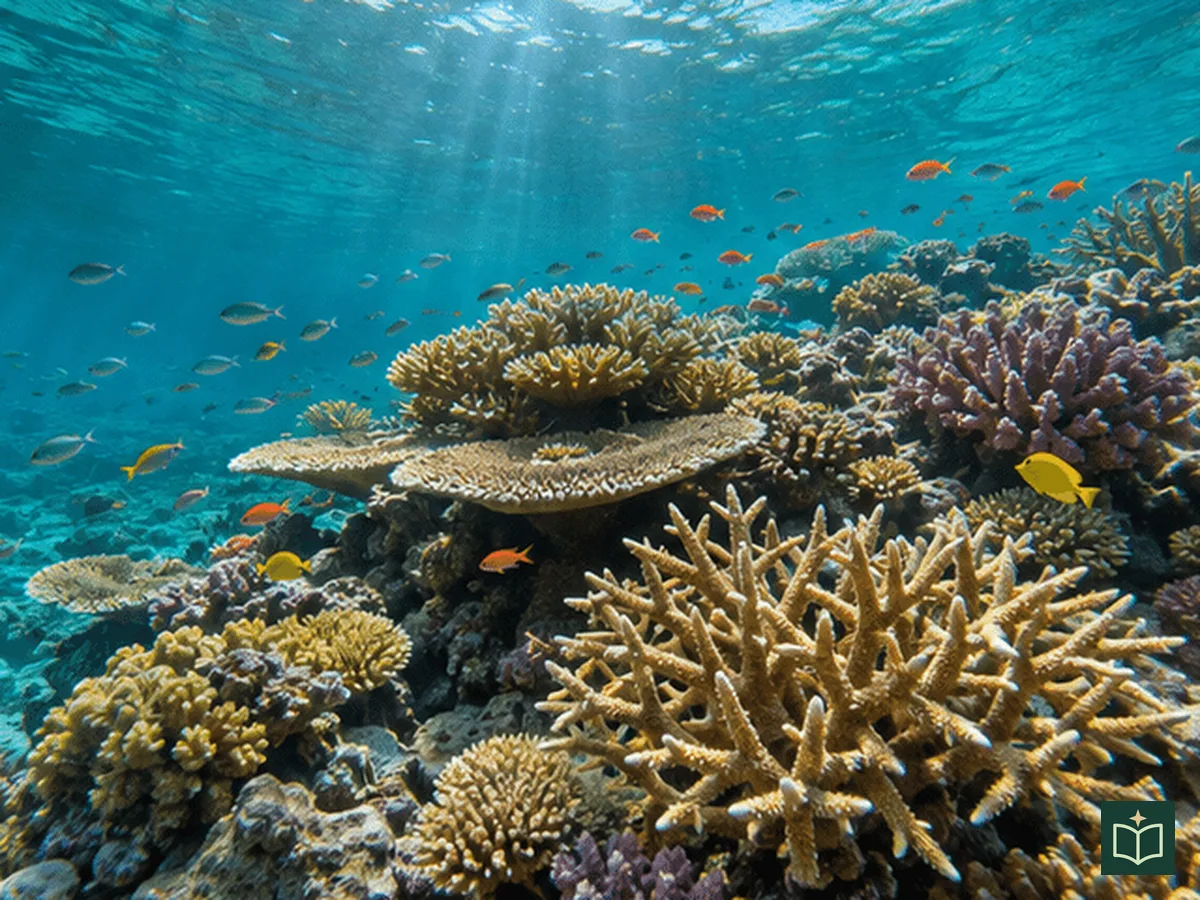
All the world’s shallow coral reefs together cover an estimated 284,000 square kilometres, less than a tenth of one per cent of the ocean’s area. Yet reefs support roughly a quarter of all known marine species at some stage of their lives. They protect coastlines by breaking the force of waves, supply fish to hundreds of millions of people and bring in tourism income for countries such as the Maldives and Fiji. The area estimates in the table date from a detailed global survey published in 2001; newer mapping has refined the numbers, but the order of the leading countries is broadly unchanged, and the figures are rounded here.
Under pressure
Coral reefs are among the ecosystems most sensitive to warming seas. When water stays too hot for too long, corals expel the algae that live in their tissues and turn white, a process called bleaching; if the heat persists, they die. The Great Barrier Reef has experienced several mass bleaching events since 1998, and NOAA declared a fourth global bleaching event in 2024. Pollution, overfishing and coastal construction add further stress. Scientists are studying heat-tolerant corals in the Red Sea and the Arabian Gulf to understand how some reefs survive extreme temperatures, research that may help others adapt as the world’s oceans continue to warm.
Sources & further reading
Figures are rounded and widely published; check the linked organisations for the latest editions. These organisations do not endorse this website.