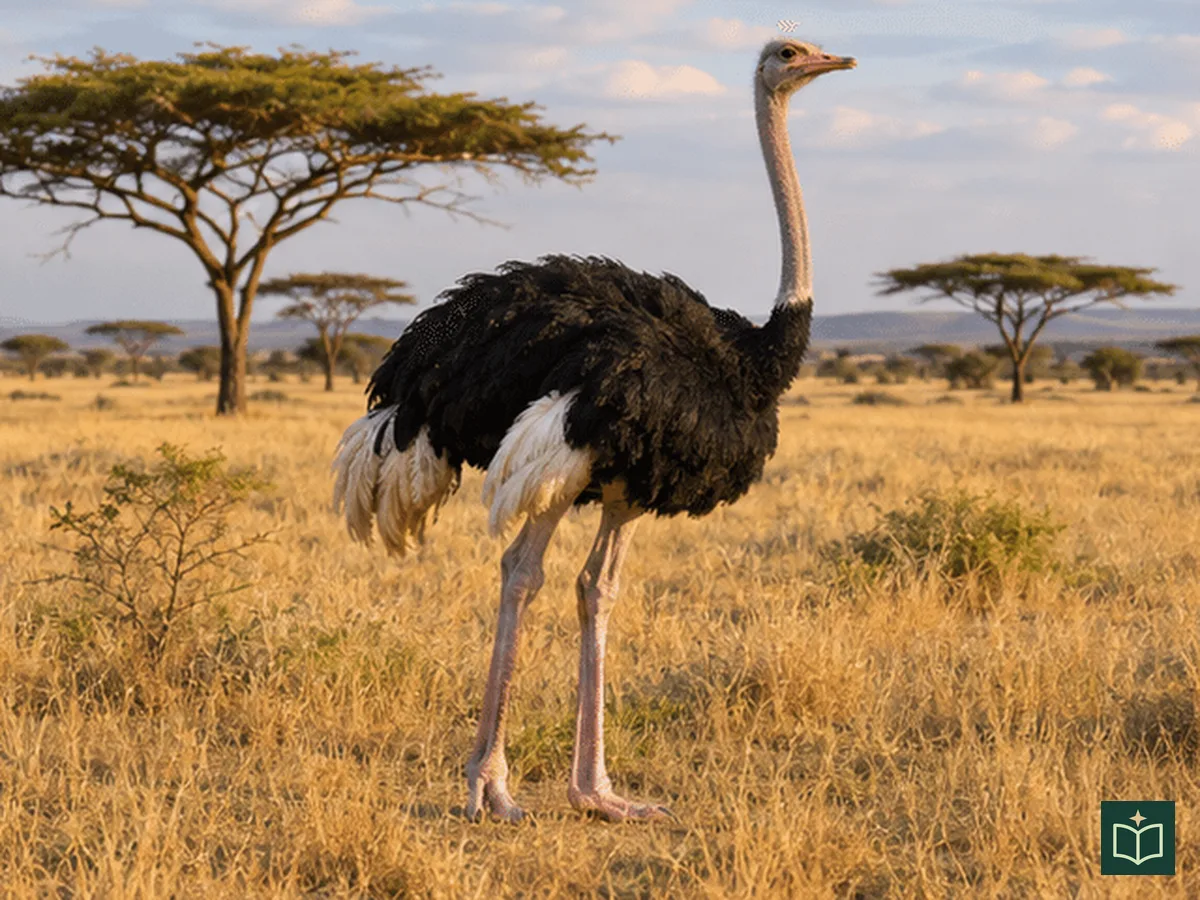
The ostrich in front
The common ostrich of Africa is by far the largest living bird. Large males weigh up to about 150 kilograms and stand around 2.7 metres tall, much of it neck and leg. It cannot fly, but it is the fastest bird on land, able to run at about 70 kilometres per hour, using powerful legs with just two toes on each foot. Its egg, weighing about 1.4 kilograms, is the largest laid by any living bird, though small compared with the hen’s body. A separate species, the Somali ostrich of the Horn of Africa, is similar in size and is sometimes counted alongside it in such lists.
Why the giants cannot fly
Flight demands a great deal of power, and the problem gets harder as birds grow. When a bird doubles in length, its weight rises roughly eightfold, but the area of its wings and the strength of its flight muscles do not keep pace. The heaviest flying birds today, such as the great bustard and kori bustard, weigh up to about 20 kilograms, and they take off only with effort. The heaviest birds therefore belong to the ratites, a group whose breastbone lacks the keel that anchors flight muscles. Without the need to fly, they could grow large, lay big eggs and run from predators instead.
Cassowaries, emus and rheas
Behind the ostrich come its distant relatives. The southern cassowary of New Guinea and north-eastern Australia can weigh about 70 kilograms; females are larger than males, and their dagger-like inner claws make them dangerous when cornered. The emu of Australia, up to about 60 kilograms, is the second-tallest bird after the ostrich. South America’s greater and lesser rheas fill two more places, roaming open grasslands in small flocks. Comparing the leaders, a large ostrich weighs roughly two and a half times as much as a large emu. In all these species, males usually incubate the eggs and care for the chicks, an unusual arrangement among birds.
Penguins and bustards
The emperor penguin, the heaviest penguin, ranks fourth. Adults can weigh about 45 kilograms before the Antarctic winter, but males lose a large part of that while fasting through weeks of incubating a single egg on their feet. Its relative the king penguin closes the table. Both have turned their wings into flippers for swimming, so they fly underwater rather than in air. The great bustard of Europe and Asia and the kori bustard of Africa are the heaviest birds that can still fly. In the Gulf, a smaller relative, the houbara bustard, is well known for its place in Arabian falconry and for captive-breeding programmes that release birds into the wild.
Lost giants
Today’s large birds are modest compared with some recent extinct ones. The elephant birds of Madagascar, which disappeared within the last thousand years or so, are estimated to have weighed several hundred kilograms, and the moa of New Zealand, hunted to extinction after people arrived around 700 years ago, included species taller than an ostrich. Arabia had its own ostrich, a smaller subspecies that roamed the Arabian Peninsula until hunting wiped it out in the twentieth century. Red-necked ostriches from Africa have since been reintroduced to protected reserves in Saudi Arabia. Weights for living birds also vary widely with season, sex and age, so the figures here are rounded.
Why size matters
Large flightless birds play important roles in their ecosystems. Cassowaries swallow large fruits whole and spread their seeds across the rainforest, helping many trees to regenerate. Emus and rheas shape grasslands in similar ways. Size also brings vulnerability: big birds breed slowly and need large areas, and flightless species cannot escape hunters, dogs or habitat clearance. Several are protected, and the southern cassowary is classed as threatened in Australia. Ostriches, by contrast, are widely farmed for meat, leather and feathers, including in parts of the Middle East. The story of the largest birds is ultimately one of trade-offs between flight, size and survival.
Sources & further reading
Figures are rounded and widely published; check the linked organisations for the latest editions. These organisations do not endorse this website.