Why the giants are iron
Most meteorites that fall are stony, but the largest ever found are all iron. The reason lies in how they survive. A stony meteoroid entering the atmosphere at many kilometres per second is heated and squeezed until it usually shatters into fragments. Iron meteorites, made mainly of iron and nickel from the cores of broken asteroids, are far tougher and more often arrive in one piece. They also resist weathering better once on the ground. The largest stony meteorite recovered, from the Jilin fall in China in 1976, weighed about 1.8 tonnes, tiny beside the iron giants in this table.
Hoba: the meteorite that stayed
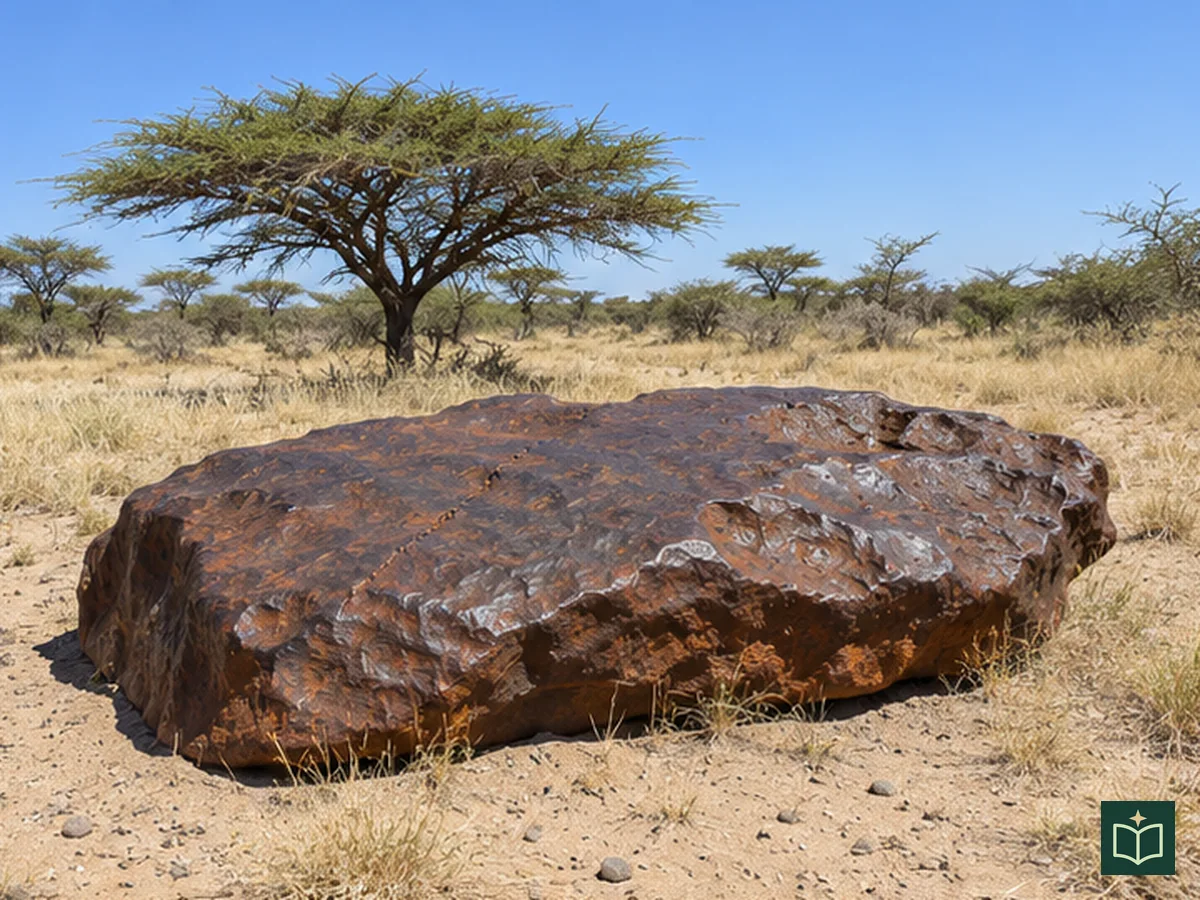
The Hoba meteorite was found in 1920 when a farmer’s plough struck metal near Grootfontein in northern Namibia. It is a flat block about 2.7 metres across and roughly a metre thick, made of about 84 per cent iron and 16 per cent nickel. Its weight is estimated at about 60 tonnes, though weathering has removed some of its original mass. Unusually, it left no crater. Scientists think its flat shape and low angle of entry let the atmosphere slow it to a relatively gentle landing. Hoba was declared a national monument in 1955 and has never been moved, so visitors see it where it fell.
Greenland’s iron mountain
For centuries Inuit people in north-west Greenland chipped iron from three large meteorites near Cape York to make blades and harpoon tips, one of the few sources of metal in the Arctic. In 1897 the American explorer Robert Peary shipped the largest piece, Ahnighito, to New York, where it is now displayed at the American Museum of Natural History, resting on supports that reach down to the bedrock beneath the building. Another fragment of the same fall, Agpalilik, weighing about 20 tonnes, was recovered in 1963 and is held in Copenhagen. Inuit oral tradition knew the largest as the Tent, the Woman and the Dog.
Argentina’s field of iron
Campo del Cielo, meaning field of the sky, is a scatter of craters and iron masses in Argentina’s Chaco province, created when a large iron meteoroid broke up over the area about four thousand years ago. Two of its pieces appear in the table. El Chaco was long quoted at about 37 tonnes, but a careful weighing in 2016 found 28.8 tonnes. In the same campaign, a mass called Gancedo was weighed at about 30.8 tonnes, making it the larger of the two. Campo del Cielo has yielded many tonnes of iron in total, and smaller fragments are among the most widely sold meteorites in the world.
China, Mexico and Tanzania
Three of the ten entries come from the Aletai fall in Xinjiang, northwestern China, a strewn field of iron masses spread over hundreds of kilometres. The best known, Armanty, has been known since the late nineteenth century; another large piece, WuQilike, was recovered only in 2021. Mexico’s Bacubirito, from Sinaloa, is a long, irregular mass of about 22 tonnes displayed in the city of Culiacán. Tanzania’s Mbosi meteorite, of about 16 tonnes, lies on a hillside in the south-west of the country. A little further down the list is the Willamette meteorite, found in Oregon and now at the American Museum of Natural History, the largest known in the United States.
Deserts as meteorite traps
Huge irons are rare, but small meteorites are found in large numbers in two kinds of place: Antarctica’s ice fields and hot deserts. In both, dark stones stand out against a pale surface and dry conditions slow weathering. Oman’s gravel deserts have yielded thousands of meteorites since the late 1990s, making the country one of the world’s richest hunting grounds. Each newly recognised meteorite is registered with the Meteoritical Society, whose database records its type, mass and location. Even the smallest can carry information about the early solar system, because most are fragments of asteroids that formed more than 4.5 billion years ago.
Sources & further reading
- American Museum of Natural History · Ahnighito ↗
- Britannica · Meteorite ↗
- Meteoritical Bulletin Database ↗
Figures are rounded and widely published; check the linked organisations for the latest editions. These organisations do not endorse this website.