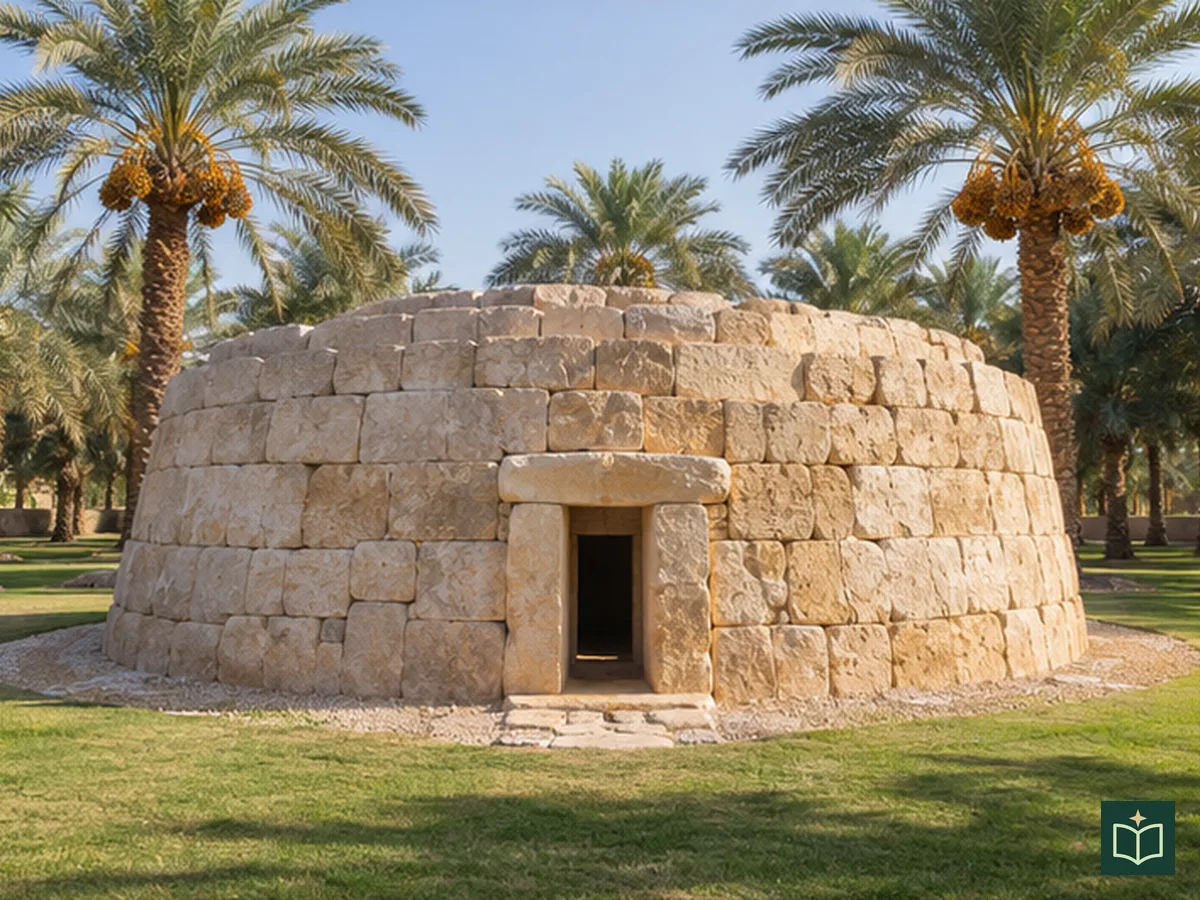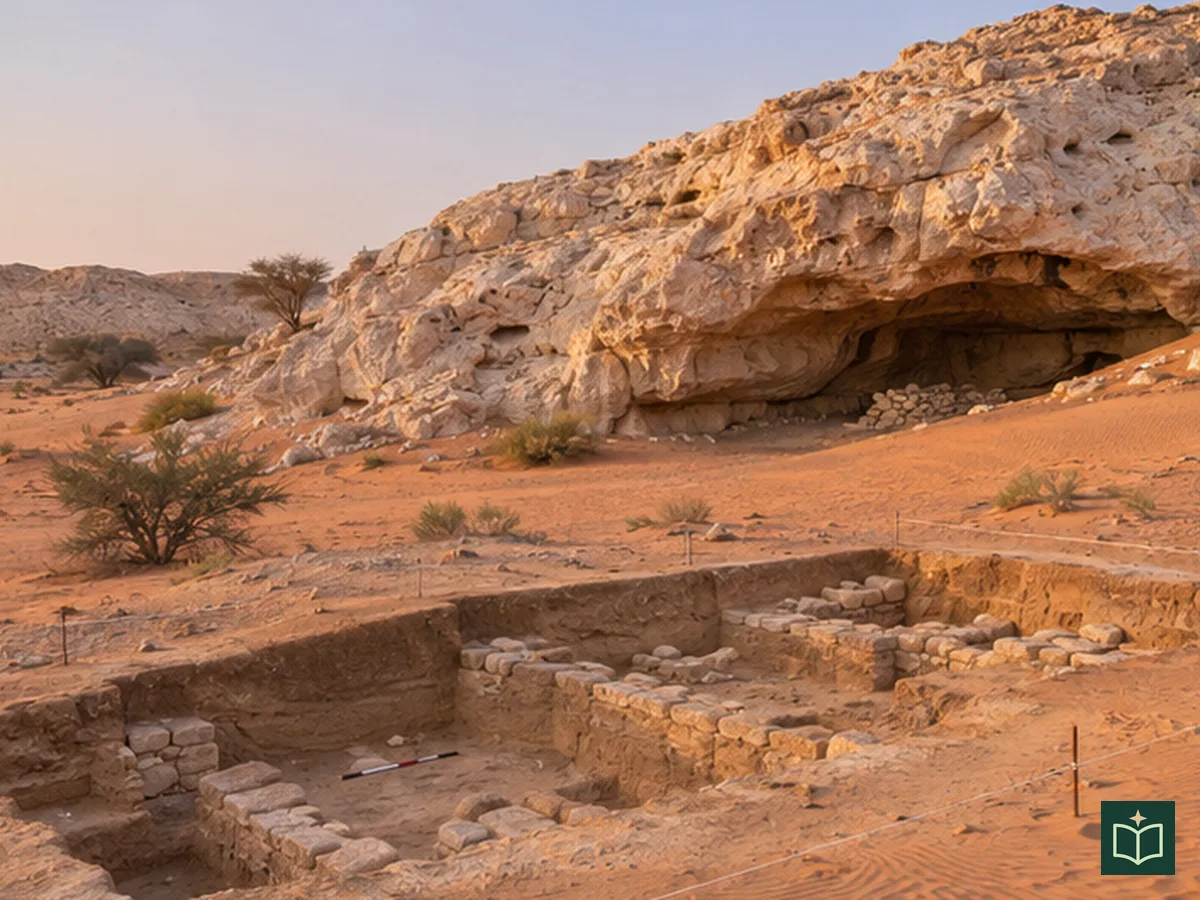
A rock shelter near Mleiha
Jebel Faya is a limestone ridge in the interior of Sharjah, close to the oasis town of Mleiha. At its foot lies a rock shelter where people camped again and again over tens of thousands of years. A long-running German and Sharjah excavation dug down through several metres of sand and rubble there, finding distinct layers of stone tools separated by sterile deposits. Each layer is a snapshot of people who used the shelter and then left. The deepest layers turned out to be far older than anyone had expected, and they placed a quiet corner of the UAE at the centre of a global debate about how our species spread out of Africa.
What the diggers found
The most discussed layer, known as Assemblage C, contained hand-axes, leaf-shaped blades and scrapers. No human bones were found, so the makers cannot be identified directly. But the way the tools were shaped resembles toolkits made by early Homo sapiens in East Africa at around the same time, and it differs from the tools of later periods at the site. Researchers dated the sediments using optically stimulated luminescence, which measures how long quartz grains have been buried away from sunlight. The results clustered around 125,000 years ago. Later studies at the site reported further layers that may be considerably older, suggesting people visited during more than one wet phase.
Why the climate mattered
Arabia's climate has swung repeatedly between harsh desert and something closer to savannah. These swings were driven by slow changes in Earth's orbit, which strengthened the monsoon and pushed rain belts northwards. Around 130,000 to 125,000 years ago, during the last interglacial period, lakes filled across the peninsula and rivers flowed where wadis now lie dry. Sea levels had also been lower shortly before this, narrowing the strait of Bab al-Mandab between Africa and Yemen. For people who hunted and gathered, a greener Arabia was not a barrier but an extension of familiar landscapes, offering water, game and stone for tools along the way.
A challenge to the old model
For decades the standard account held that modern humans left Africa in a single wave roughly 60,000 years ago, travelling quickly along the coast. Jebel Faya pointed to an earlier, inland presence. Other finds have since supported the idea of early movements: a finger bone of Homo sapiens from Al Wusta in Saudi Arabia, dated to about 85,000 years ago, and human footprints preserved beside an ancient lake bed in the Nefud desert. Together they suggest Arabia was visited several times when conditions allowed. Genetic studies, however, indicate that most people living outside Africa today descend mainly from a later dispersal, so early groups may have left few descendants.
What remains uncertain
Several questions are still open. Without fossils from Jebel Faya, some researchers argue that the tool similarities with Africa could reflect parallel invention rather than migration, or even the work of another human species. Luminescence dates carry margins of error of thousands of years. It is also unclear whether the people who left these tools survived the dry periods that followed, retreated, or died out. Desert conditions erase much of the record, and many sites lie buried under dunes. For these reasons scientists describe Jebel Faya as strong evidence for an early presence in Arabia, not as proof of a single, settled migration route.
Why it matters
Jebel Faya changed how archaeologists look at Arabia. Instead of a corridor people hurried across, the peninsula is now seen as a region that was repeatedly inhabited whenever rains returned, and as a possible staging ground for later journeys into Asia. The site also shows how closely human movement was tied to climate, a link visible across the whole story of human prehistory. Visitors can see finds and learn about the excavations at the Mleiha Archaeological Centre, a short drive from the ridge. For the UAE, the discovery extends its human story back by more than a hundred thousand years, long before the oases, towns and ports of later periods.
Sources & further reading
- Science · The Southern Route ‘Out of Africa’ (Armitage et al., 2011) ↗
- Smithsonian Human Origins · Homo sapiens ↗
Figures are rounded and widely published; check the linked organisations for the latest editions. These organisations do not endorse this website.