Built from the outside in
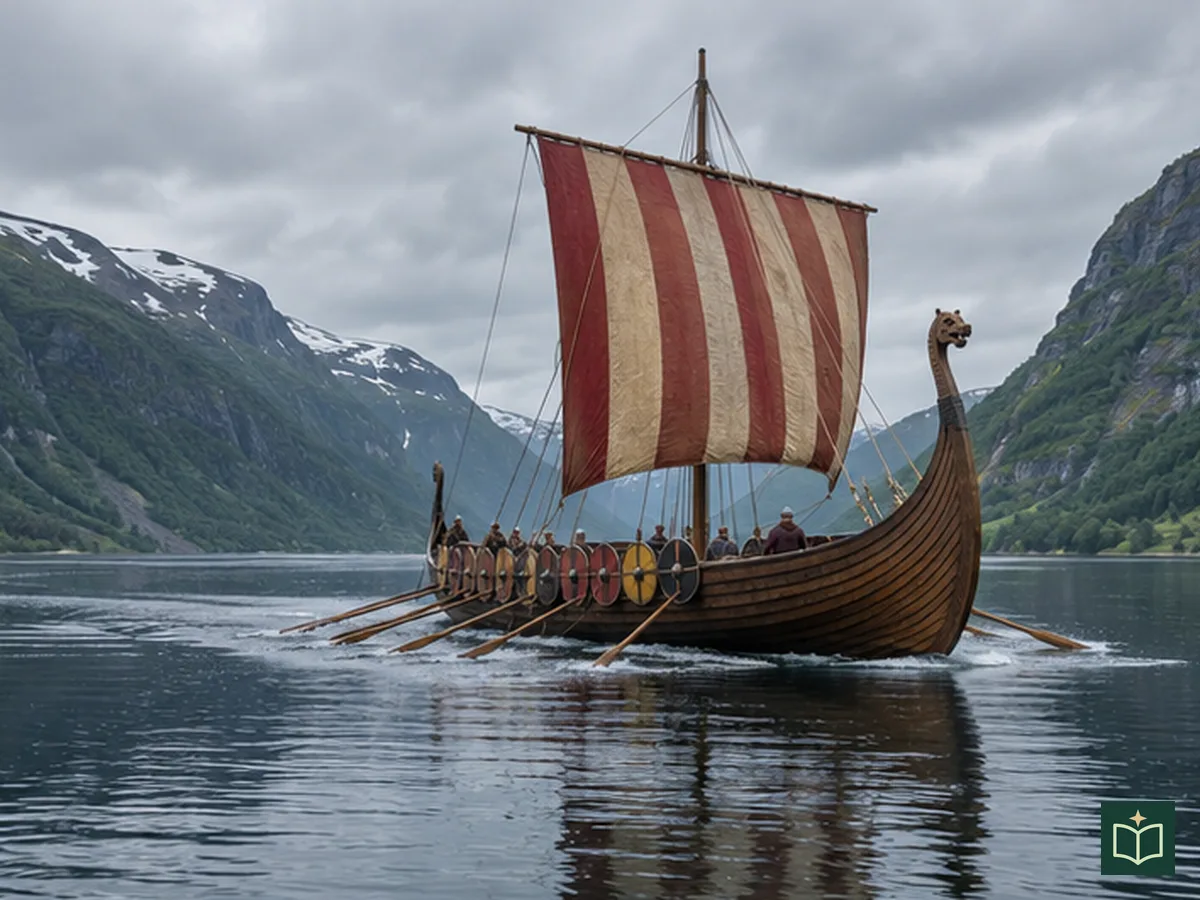
Viking shipbuilders worked differently from most modern builders. Instead of erecting a frame and covering it, they built the shell first. A keel, usually cut from a single oak trunk, formed the spine. Planks split radially from oak logs were then added one row at a time, each overlapping the one below and fastened with iron rivets, a method called clinker building. Only once the shell had taken shape were internal ribs inserted to stiffen it. Gaps were sealed with animal hair or wool soaked in tar. Splitting rather than sawing the wood kept its fibres intact, producing planks that were thin, light and remarkably strong.
Why flexibility mattered
The result was a hull that flexed as it moved through waves rather than resisting them rigidly. Lashings between some ribs and planks allowed slight movement, so the ship absorbed the shock of the sea instead of cracking. Longships had a shallow draught, often around a metre or less, which meant they could sail into shallow estuaries, land directly on beaches and row far upriver. They were also light enough that crews could haul them over land between rivers, using log rollers on portage routes. A single square sail of wool drove the ship on open water, while oars gave speed and control in calm weather, narrow channels and battle.
The ships we know
Much of what we know comes from a few remarkable finds. The Oseberg ship, buried in a Norwegian mound in AD 834, and the Gokstad ship from around 900 were preserved in blue clay. The Gokstad ship is about 23 metres long with holes for 32 oars. At Roskilde in Denmark, five ships deliberately sunk around 1070 to block a fjord channel were raised in the 1960s. One of them, a longship about 30 metres long built near Dublin, was reconstructed as the Sea Stallion, which sailed from Denmark to Ireland and back in 2007 and 2008, showing how such ships handled at sea.
Raiders from the sea
The attack on the monastery of Lindisfarne off north-east England in 793 is usually taken as the start of the Viking Age. Monasteries were attractive targets: wealthy, often on coasts or islands, and lightly defended. The longship's speed and shallow draught made surprise possible, since crews could appear without warning and leave before forces gathered. Over the ninth century raids grew into larger campaigns. Fleets rowed up the Seine and besieged Paris, and an army landed in England in 865 and conquered much of it. Rivers that had protected inland towns from attack by sea became highways for raiders instead.
Traders and settlers too
Longships are only part of the story. For carrying goods, livestock and families, Scandinavians also built broader, deeper cargo ships known as knarrs, which relied mainly on sail and needed fewer crew. These carried settlers to Iceland and Greenland and traded walrus ivory, furs, timber and slaves. In the east, Swedish Vikings, often called Rus, used smaller boats on the rivers of today's Russia and Ukraine, portaging between waterways to reach the Black and Caspian seas. There they traded with Byzantium and the Abbasid world, which is why large numbers of Arab silver coins have been found in Scandinavian hoards.
Why it matters
The longship combined materials, technique and design into a vessel that could do things no rival could. It turned Scandinavian communities on the edge of Europe into a force felt from Ireland to the Caspian, and helped found lasting settlements in Normandy, England, Ireland, Iceland and beyond. Reconstructions continue to teach maritime archaeologists about sailing speed, crew sizes and the skills involved. Clinker building also outlived the Vikings and remained common in northern European boats for centuries. The popular image of horned helmets is a nineteenth-century invention, but the ships themselves fully deserve their reputation as masterpieces of early medieval engineering.
Sources & further reading
Figures are rounded and widely published; check the linked organisations for the latest editions. These organisations do not endorse this website.