It began as an earthwork
The first Stonehenge had no great stones at all. Around 3000 BC, people on Salisbury Plain dug a circular ditch with a bank inside it, about 110 metres across. Just inside the bank they cut a ring of 56 pits, now called the Aubrey Holes. Many archaeologists think these held small standing stones, and cremated human remains were buried in and around them, making early Stonehenge one of Britain's largest cemeteries of its time. The builders were Neolithic farmers who herded cattle and pigs and used tools of stone, bone and antler. Metal had not yet reached Britain, so every later stage was also shaped without metal tools.
The sarsen circle
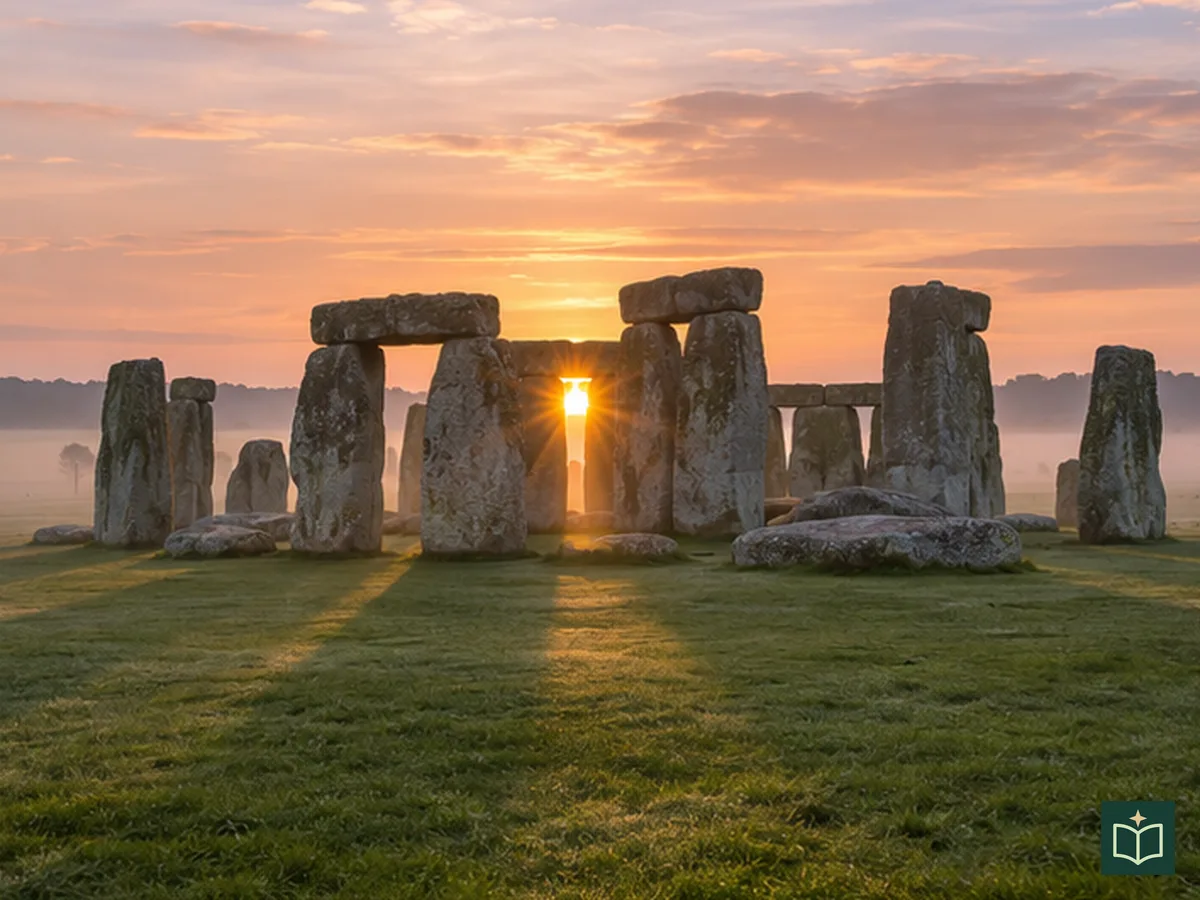
The monument most people picture was erected around 2500 BC. Builders raised an outer ring of 30 upright sarsens, a hard sandstone, capped with a continuous ring of lintels. Inside stood a horseshoe of five trilithons, pairs of uprights topped by a single lintel, the tallest reaching about seven metres. The joints copied carpentry: mortise-and-tenon fittings held lintels on their uprights, and tongue-and-groove joints locked the lintels to each other. In 2020, chemical analysis showed that most sarsens came from West Woods, about 25 km to the north. The largest weigh around 25 to 30 tonnes and were probably dragged on sledges over timber rails.
Stones from Wales and Scotland
The smaller bluestones, weighing a few tonnes each, came from much further away. Geologists have matched them to outcrops in the Preseli Hills of west Wales, roughly 225 km away, where archaeologists have found quarry sites with stone wedges and platforms. Whether they travelled mainly over land or partly by sea is still debated. In 2024 researchers reported that the Altar Stone, a six-tonne slab now lying flat in the centre, came from north-east Scotland, more than 700 km away. Moving it such a distance implies organised effort across much of Britain, and suggests the monument mattered to communities far beyond Salisbury Plain.
Built around the sun
Stonehenge's main axis is aligned on the solstices. Standing in the centre, an observer looking along the axis sees the midsummer sun rise to the north-east, close to the outlying Heel Stone, while in the opposite direction the midwinter sun sets between the uprights of the great trilithon. A processional route called the Avenue runs from the monument along this line. Excavations at nearby Durrington Walls, a vast henge with houses, uncovered pig bones suggesting large midwinter feasts. Many archaeologists therefore think midwinter was the most important moment, a time to gather, mark the turning of the year and honour the dead.
Endless rebuilding
The stones did not stay put. Over the centuries after the sarsens were raised, the bluestones were rearranged several times into new circles, ovals and lines. Around 1600 BC people dug two rings of pits, known as the Y and Z Holes, perhaps intending another rearrangement that was never completed. By then Britain had entered the Bronze Age, and hundreds of burial mounds had been built across the surrounding landscape. So Stonehenge was a work in progress for roughly fifteen hundred years, longer than any cathedral. Each generation inherited the monument from its ancestors and adapted it to its own beliefs and needs.
Myths and what we know
Stonehenge has attracted many myths. A medieval legend claimed the wizard Merlin moved the stones from Ireland. Later antiquarians linked it to the Druids, but Druids belong to the Iron Age, more than 2,000 years after the first earthwork. Theories about aliens or lost technology ignore the abundant evidence of quarries, tools, antler picks and experimental archaeology showing that large teams with ropes, timber and planning could move such stones. Stonehenge became a UNESCO World Heritage Site in 1986, together with Avebury. The open questions are now about meaning: whether it served mainly as a temple, a burial ground, a calendar, or a place uniting distant peoples.
Sources & further reading
- English Heritage · History of Stonehenge ↗
- UNESCO · Stonehenge, Avebury and Associated Sites ↗
- Britannica · Stonehenge ↗
Figures are rounded and widely published; check the linked organisations for the latest editions. These organisations do not endorse this website.