A rainbow-named metal
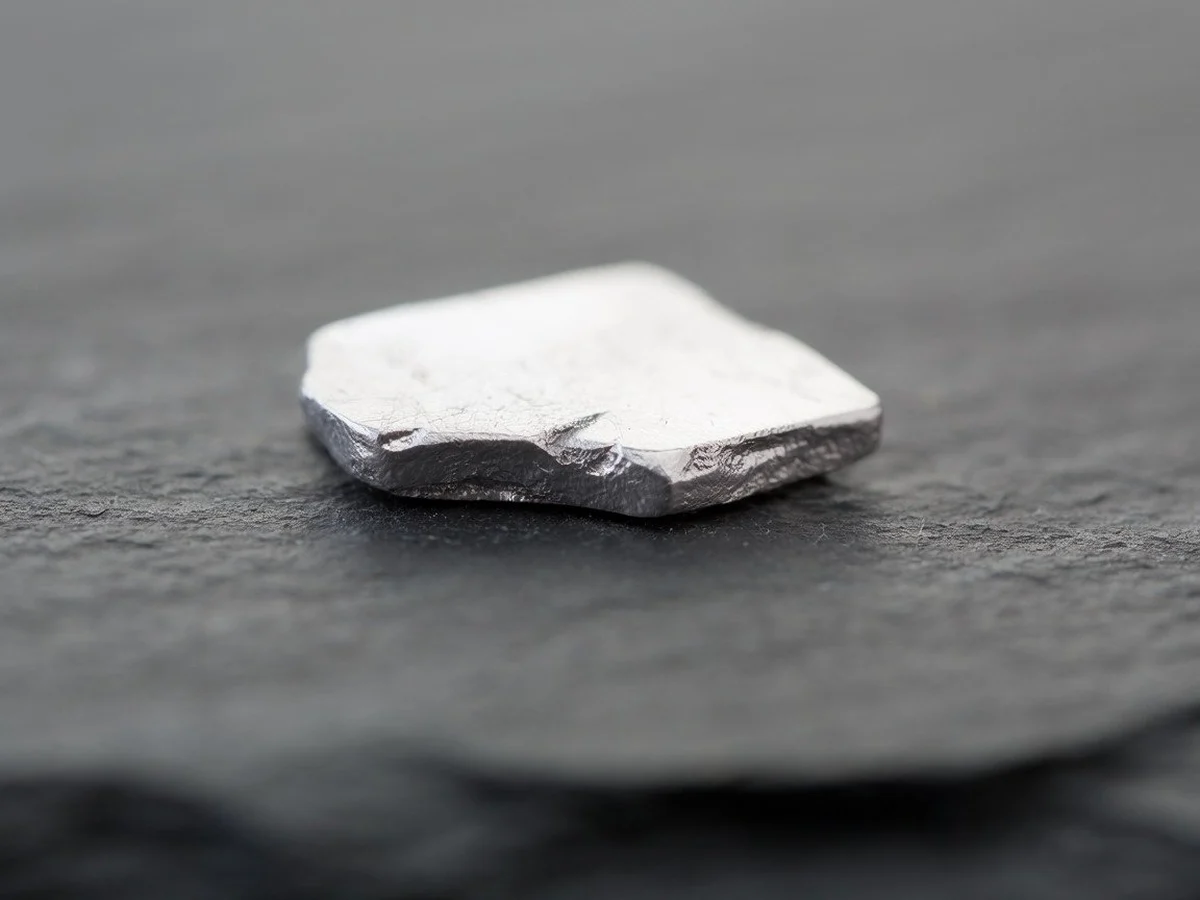
Iridium has the chemical symbol Ir and atomic number 77. It was discovered in 1803 by the English chemist Smithson Tennant, in the same black residue from dissolved platinum ore that gave him osmium. He named it after Iris, the Greek goddess of the rainbow, because its salts show many different colours. Iridium is a silvery-white metal and a member of the platinum group, alongside platinum, palladium, rhodium, ruthenium and osmium.
Among the rarest elements
Iridium is one of the rarest stable elements in Earth's crust, far rarer than gold. It is not mined on its own but recovered as a by-product of refining platinum and nickel ores, mostly in South Africa, with smaller amounts from Russia, Zimbabwe and Canada. World production is only a few tonnes a year. Because supply is so limited and closely tied to platinum mining, the price of iridium can swing sharply when demand changes.
The toughest against corrosion
Iridium is considered the most corrosion-resistant metal known. It is not attacked by most acids, including aqua regia, the mixture of nitric and hydrochloric acids that dissolves gold and platinum. It resists oxidation even at high temperatures. It is also very dense, almost as dense as osmium, and has a melting point of about 2,446 °C. These properties make it useful in some of the harshest environments in industry and science.
Spark plugs and crucibles
Many modern car engines use spark plugs with tiny iridium tips. Because iridium wears away very slowly, these plugs can last far longer than ordinary ones and keep producing a strong, precise spark. In laboratories and factories, crucibles made of iridium are used to grow large, pure crystals at very high temperatures, including crystals used in lasers, medical scanners and smartphone components, where the molten material must not react with its container.
Hydrogen and clean energy
Iridium has become important for clean energy. In a type of electrolyser called a proton exchange membrane, or PEM, electrolyser, electricity splits water into hydrogen and oxygen. The side that produces oxygen needs a catalyst that can survive very acidic, oxidising conditions, and iridium oxide is one of the few materials that works well. Because iridium is so scarce, researchers are working hard to use less of it per electrolyser or to find substitutes.
Measuring the world
Iridium also played a quiet role in measurement. The International Prototype Metre, adopted in 1889, and the International Prototype of the Kilogram were made of an alloy of 90% platinum and 10% iridium, chosen for its stability and hardness. For more than a century, the kilogram was defined by that metal cylinder kept near Paris. Since 2019, the kilogram has been defined using a fundamental constant of nature instead.
The dinosaur clue
In 1980, the physicist Luis Alvarez, his son Walter, a geologist, and colleagues reported a thin layer of clay at the boundary between the Cretaceous and Paleogene periods that contained unusually high levels of iridium. Because iridium is rare in Earth's crust but more common in asteroids, they proposed that a giant asteroid had struck Earth about 66 million years ago. The later discovery of the Chicxulub crater in Mexico strongly supported their idea.
Other uses
Iridium compounds are used as catalysts in chemical manufacturing, including the production of acetic acid. Iridium alloys are used in some electrical contacts, pen tips and medical devices, and radioactive iridium-192 is used in cancer treatment and in industrial radiography to inspect welds. Some organic light-emitting diodes use iridium compounds to produce efficient colours in screens, meaning a trace of this rare metal may be in the phone in your hand.
Handling and safety
Solid iridium is generally considered to have low toxicity and is stable in air. However, like many metals, its fine powders and some compounds need careful handling, and radioactive iridium-192 sources are tightly controlled because of their radiation. For most people, iridium remains an invisible metal, working inside engines, laboratories and factories. Its combination of rarity and toughness shows how a tiny amount of the right material can make modern technology possible.
Sources & further reading
General information; figures are approximate and production varies by year. Photograph: original AI-generated illustration (Adobe Firefly). Reference organisations do not endorse this website.