A life in politics
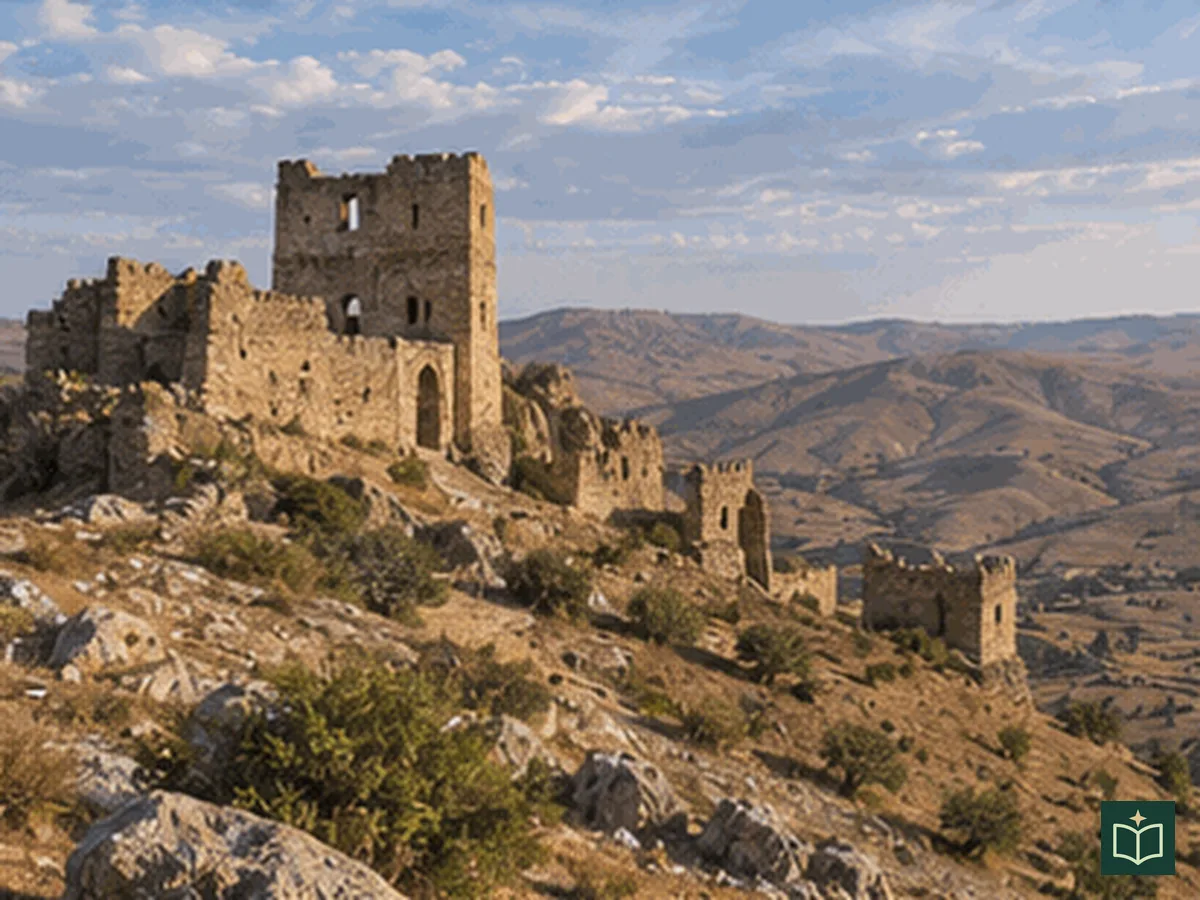
Abd al-Rahman ibn Khaldun was born in Tunis in 1332 to a family of scholars and officials whose ancestors had come from al-Andalus. As a teenager he lost both parents to the Black Death. He spent much of his career in the turbulent courts of North Africa and Granada, serving as secretary, envoy, judge and adviser to rival rulers, and sometimes spending time in prison when his patrons fell. These experiences of shifting alliances and collapsing regimes shaped his thinking. Weary of politics, he withdrew in 1375 to the fortress of Qal'at Ibn Salama, in today's Algeria, and there began writing a history of the world.
The Muqaddimah
Ibn Khaldun found existing histories full of errors, exaggerations and impossible numbers repeated without question. So before writing his history, he composed an introduction, the Muqaddimah, completed in 1377 and revised over the following decades. In it he argued that historians must understand how societies actually work, including geography, climate, economics, social bonds and politics, so they can judge whether reports are plausible. He called this new field 'ilm al-umran', the science of human society or civilisation. The Muqaddimah ranges over government, cities, trade, crafts, education and the sciences. Many scholars see it as a forerunner of sociology, economics and the philosophy of history.
Asabiyya: the glue of power
The central concept is asabiyya, often translated as group feeling or solidarity. Ibn Khaldun observed that groups living tough lives on the margins, such as desert or mountain tribes, develop strong loyalty, shared purpose and willingness to sacrifice. Religion can strengthen this bond further. Such groups can overthrow established rulers whose own solidarity has weakened. Once in power, the new dynasty founds or takes over cities, builds palaces and creates a court and bureaucracy. But the qualities that won power begin to erode in comfortable surroundings. Rulers depend increasingly on paid soldiers and officials rather than loyal kin, and the original bond gradually loosens.
The life cycle of a state
Ibn Khaldun described a pattern in which a dynasty typically lasts around three or four generations, often about 120 years. The founders remember the hardship of conquest. Their children, raised close to them, keep some of that spirit. The grandchildren inherit power without having earned it, and later generations grow used to luxury and ceremony, with little sense of what sustains them. Spending rises, rulers become isolated, and they lose touch with the people they govern. Eventually a new group with stronger solidarity emerges from the edges and replaces them. He presented this as a tendency drawn from North African and Islamic history, not as a fixed law.
Taxes and the economy
Some of the Muqaddimah's most quoted passages concern economics. Ibn Khaldun noted that at the start of a dynasty, tax rates are low but revenues are high, because people are encouraged to work and trade. Later, as spending grows, rulers raise rates and add new levies, discouraging enterprise, so revenues fall even as rates rise. Modern economists sometimes cite this as an early statement of the idea behind the Laffer curve. He also discussed the division of labour, the role of cities as engines of wealth, and how prices and wages depend on supply and demand. His point was that economic decline and political decline were closely linked.
Influence and limits
In 1401, while in Damascus, Ibn Khaldun met the conqueror Timur during the siege of the city and wrote an account of their conversations. He died in Cairo in 1406, where he had served as a judge. The Muqaddimah was studied by Ottoman scholars in the seventeenth century and became widely known in Europe after nineteenth-century translations. Today it is read across the Arab world and beyond. His theory has limits: it was built on the experience of North Africa and the Middle East, and does not fit every society or every state. But his insistence that history should be tested against how societies really work remains fresh.
Sources & further reading
Figures are rounded and widely published; check the linked organisations for the latest editions. These organisations do not endorse this website.